- 한국어
- English
- 日本語
- 中文
- العربية
- Español
- Français
- Deutsch
- Pусский
- Tiếng Việt
- Indonesian
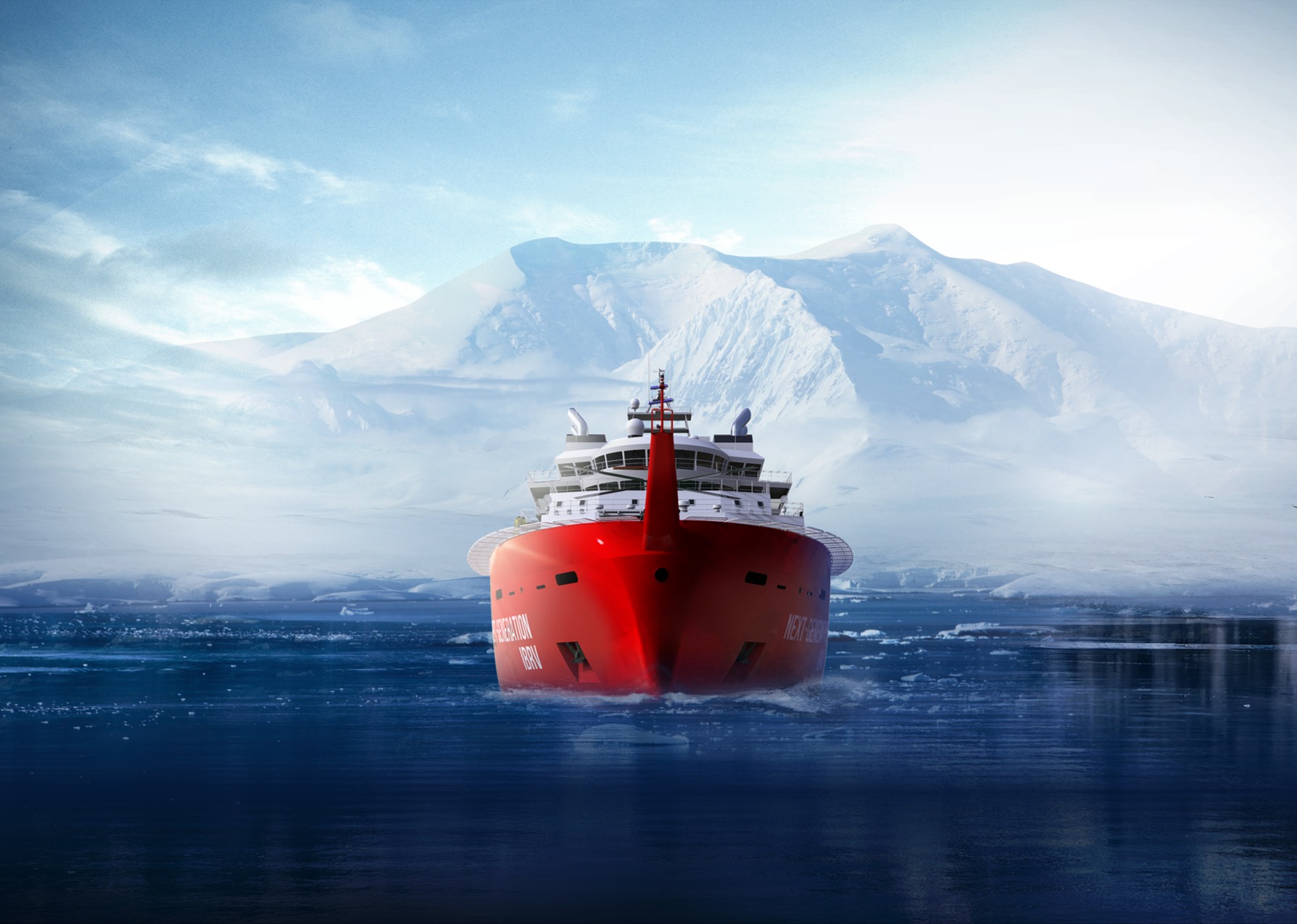
The Ministry of Oceans and Fisheries in July signed a contract with Hanwha Ocean to build a next-generation icebreaker by 2029. Shown is an image of the company's cutting-edge research icebreaker. (Hanwha Ocean)
By Charles Audouin
The era of the North Sea shipping route in the Arctic Ocean has opened due to climate change shrinking the ice cover in the region's waters.
The distance for cargo vessels from Northeast Asia to Northern Europe is expected to see a 32% cut from the route passing through the Suez Canal, which in turn will slash travel time 40%.
Ships heading from Northeast Asia to Northern Europe can slash travel distance and time by using the Arctic path, which could cut logistics costs, improve transportation efficiency and restructure the global shipping market.
The development of the route is designated a key national task, with a government blueprint seeking to use it to create a new engine of economic growth.
The North Sea route is the shortest maritime way across the Arctic and connects Asia, Europe and North America. As climate change decreases the waters' ice cover, the number of navigable days there is increasing.
Since 2010, the number of large cargo vessels navigating the route has steadily risen.
Korea commands huge potential to use this route as a logistics hub for connecting Europe, the Far East and Southeast Asia. Busan Port, the fourth largest in the world and connected to 280 counterparts across the globe, can serve as a transit port similar to Singapore's role as a global logistics center that utilizes the Strait of Malacca.
For this goal, the Korean government has prepared multifaceted support including for icebreaker construction, training for polar ship officers and expansion of port infrastructure.
The Ministry of Oceans and Fisheries will move to Busan by year's end, and a strategy seeks to integrate the cities of Busan, Yeosu and Gwangyang in Jeollanam-do Province, and Ulsan into a "marine capital region." Other plans including the launch of a maritime court and an investment corporation for the southeastern region.
"The private sector and the government are systematically arranging budgets and policy to prepare for the era of the North Sea shipping route," Minister of Oceans and Fisheries Chun Jae-soo on Nov. 21 told a news conference in Seoul for foreign correspondents. "To provide diverse support, we will leverage the geopolitical strengths of the southeastern region like Busan as well as ports, shipbuilding and industrial infrastructure."
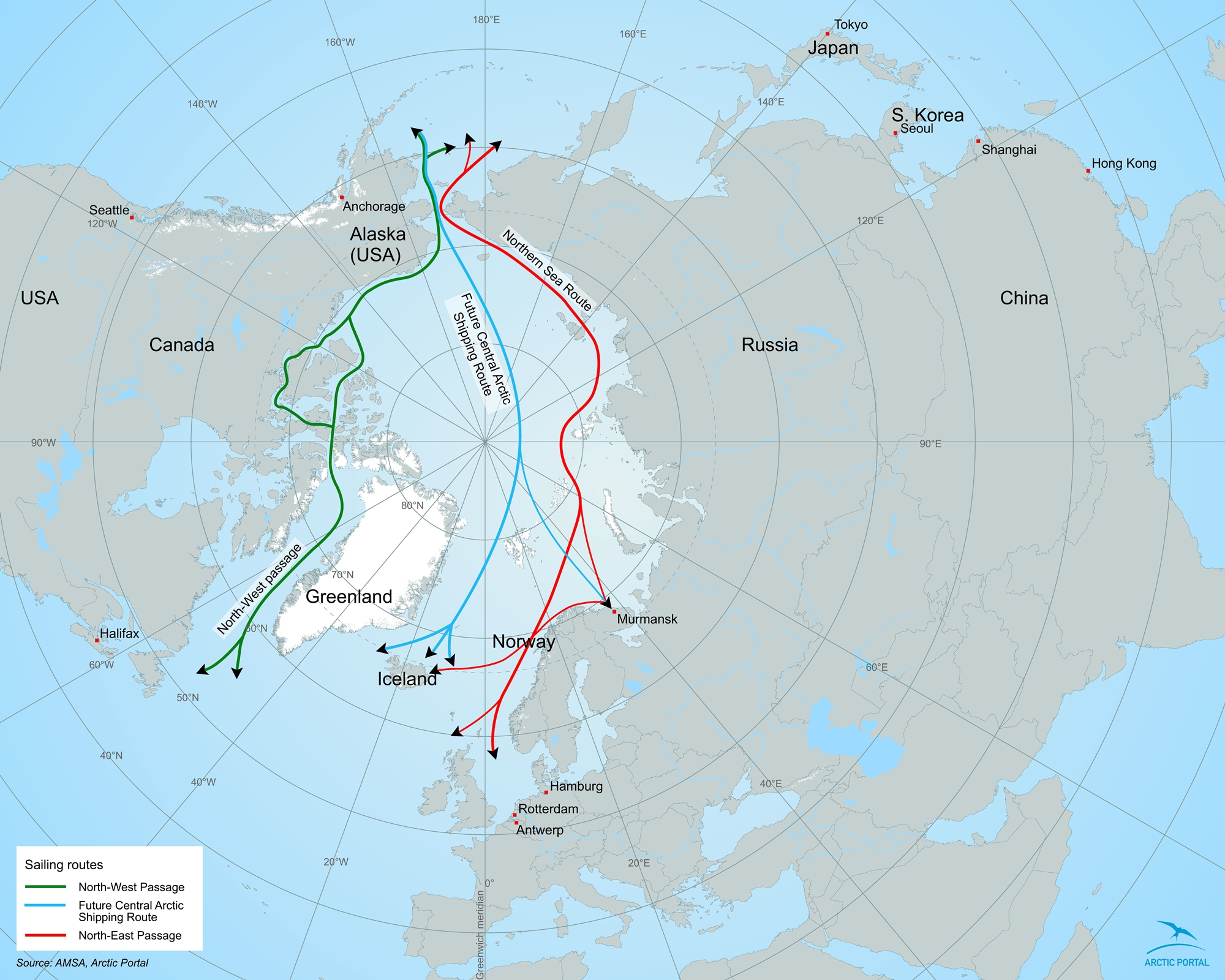
This map of the North Sea route shows the shipping distance from Busan to the Dutch city of Rotterdam via the Suez Canal as 20,000 km and requiring about 40 days. The Arctic route, however, slashes both distance and time to just 13,000 km and 30 days. (Arctic Portal)
Korea is seen as a major beneficiary of the route's development given the country's unrivaled know-how in shipbuilding and shipping.
"Korea has a powerful weapon in the competition for the North Sea route," Samjeong KPMG Economic Research Institute said in a recent report. "Given the nation's icebreaker construction capacity and accessibility to maintenance, repair and operations, Korea could emerge as the optimal partner of countries seeking to use the route."
The report also quoted Mads Qvist Frederiksen, executive director of the Arctic Economic Council, as saying that if the route grows active, it will boost demand for eco-friendly vessels due to surging demand for liquefied natural gas icebreakers, adding that Korea is the country best equipped for this.
Competition for the route has exploded. The U.S. announced plans to buy 15 icebreakers, China conducted a record-high 35 voyages on the route last year and Russia will invest KRW 39 trillion in relevant industries.
Minister Chun said, "For trial operations in the second half of next year, we will actively cooperate with Arctic coastal nations, Russia, the U.S., Japan and China."
The ministry on Nov. 26 concluded a memorandum of understanding with Denmark on cooperation in operation of the North Sea route, stabilization of supply chains for maritime logistics, and cooperation in green and digital shipping.
Under the accord, Seoul and Copenhagen agreed to discuss the route's commercial viability and limitations and jointly tackle diplomatic, safety, environmental and commercial priorities.
caudouin@korea.kr