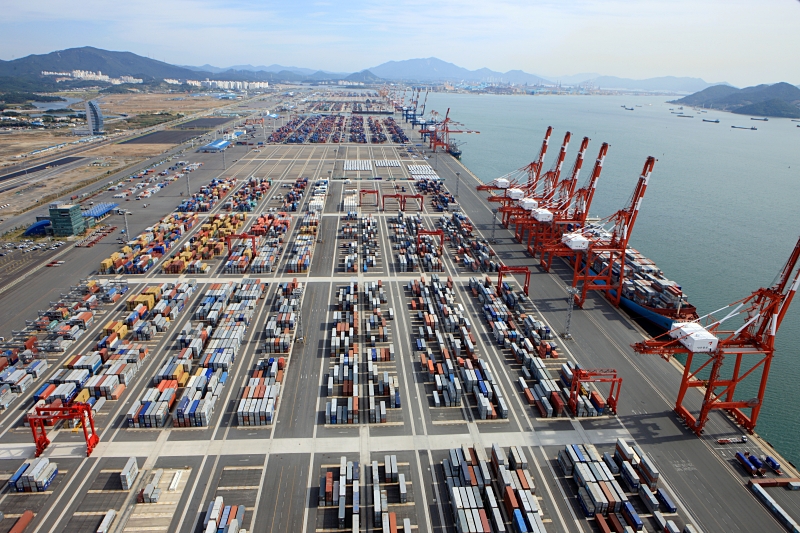
Last year's current account surplus broke an all-time record partially thanks to strong semiconductor exports. Shown is a container terminal at the Port of Yeosu-Gwangyang in Yeosu, Jeollanam-do Province (Gwangyang City Hall)
By Kim Hyelin
The country's current account surplus last year set a record-high USD 123.05 billion, the first time for the annual figure to break USD 120 billion, thanks to strong exports especially those of semiconductors.
Releasing tentative data on the international balance of payments, the Bank of Korea on Feb. 6 said the black figure in December last year reached USD 18.7 billion, the highest for the month in history.
Thus the cumulative surplus for 2025 hit USD 123.05 billion, smashing the previous mark of KRW 105.1 billion set in 2015 and surpassing the Bank of Korea's forecast of USD 115 billion made in November last year.
The trade balance (exports minus imports) saw a surplus of USD 18.85 billion, up from the previous month and year on year, to set a monthly record. Exports reached USD 71.65 billion, up 13.1% year on year.
By item, brisk growth was shown by semiconductors (43.1%), computer peripherals (33.1%) and wireless communication devices (24%) on a customs clearance basis. The expansion of exports was especially robust in Southeast Asia (27.9%), China (10.1%) and the U.S. (3.7%).
Imports inched up 1.7% to USD 52.8 billion, with those of raw materials such as petroleum products, coal, gas and crude oil declining overall due to falling energy prices.
Inbound shipments of capital goods rose 5.8% driven by semiconductors and information and communications equipment. Those of consumer goods jumped 17.9% led by gold and passenger vehicles.
The service account recorded a deficit of USD 3.69 billion.
The primary income account earned a surplus of USD 4.73 billion, a major improvement from the previous month. Notably, the dividend income surplus surged to USD 3.71 billion, raising the overall balance.
Net financial assets (assets minus liabilities) in December finished USD 23.77 billion higher.
In direct investment, Koreans invested USD 6.49 billion more abroad, while foreign investors raised their exposure in Korea by USD 5.17 billion. Securities investment saw domestic investors spend USD 14.37 billion more abroad, mainly in stocks, while foreign investors added USD 5.68 billion in Korea, primarily in bonds.
kimhyelin211@korea.kr