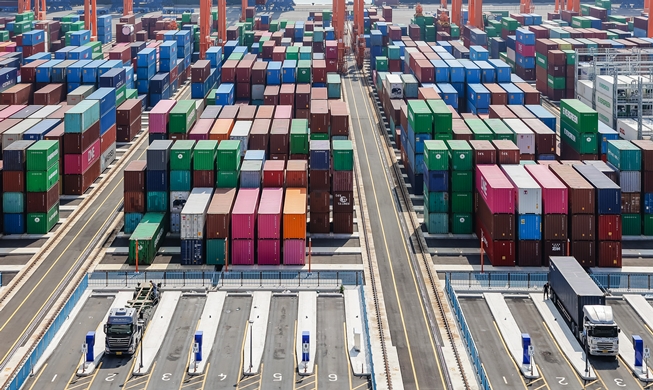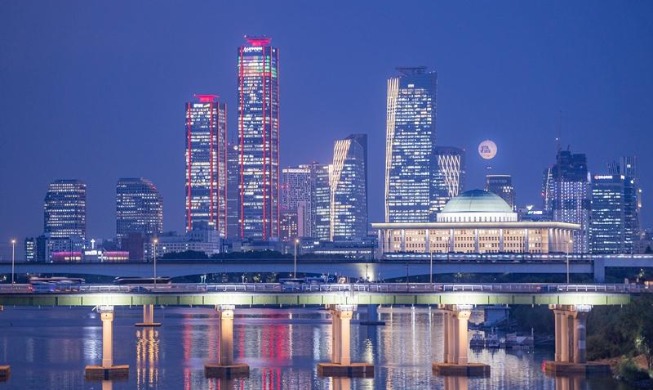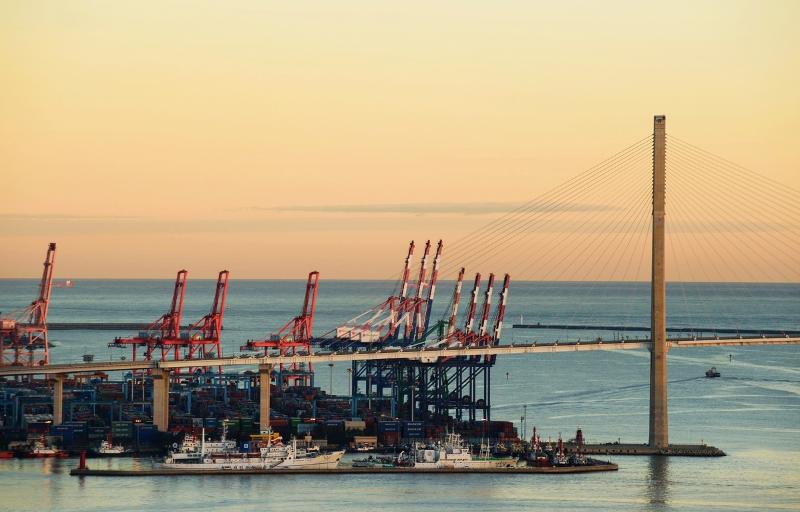
The Bank of Korea on June 9 released preliminary data on national income in the first quarter showing growth of 1.8% in gross domestic product. Shown is Singamman Pier at Busan North Port in Busan's Nam-gu District. (Busan Port Authority)
By Kim Seon Ah
The economy grew 1.8% in the first quarter this year from the fourth last year, driven by surging exports led by semiconductors and higher facility investment.
Gross national income (GNI), which measures the aggregate income of all residents of a country, rose 9.2% over the same period. Such rapid growth is also expected to bring per capita GNI closer to the USD 40,000 threshold this year.
The Bank of Korea on June 9 said this in releasing tentative data on national income in the first quarter, adding that GDP growth of 1.8% beat its forecast made in April and reflected stronger facility investment and private consumption.
By sector, manufacturing rose 3.9% thanks to brisk output of computers, electronics and optical equipment. The service sector went up 0.6% led by wholesale and retail trade, accommodations and food services, and finance and insurance, while construction grew 2.2% on the back of recovery in building and civil engineering projects.
By spending type, private consumption inched up 0.6% as expenditures on clothing and financial services gained momentum. Facility investment jumped 6.6% as that in machinery and transportation equipment increased.
Investment in construction went up 1.4% but government consumption dipped 0.4% due to lower spending on health insurance benefits.
Exports, the backbone of the Korean economy, expanded 5.9% thanks to strong demand for information and communications technology items like semiconductors. Imports grew 3.9% fueled by growth in incoming shipments of machinery, equipment and cars.
Real GNI, a key indicator of real purchasing power, surged 9.2% thanks to improved terms of trade and higher net factor income from abroad. Nominal GNI also increased 11% in the first quarter from the fourth last year, outpacing GDP growth, and surging 17.1% on a year-on-year basis.
Per capita GNI reached USD 36,963 (KRW 52.57 million) last year.
"If high nominal income continues at this pace, per capita GNI will encroach USD 40,000 this year," the central bank said in a statement. "While the timeline for achieving this goal is likely to be moved up from the original projection of 2028, corporate earnings and trends in the KRW-USD exchange rate will be key variables."
sofiakim218@korea.kr