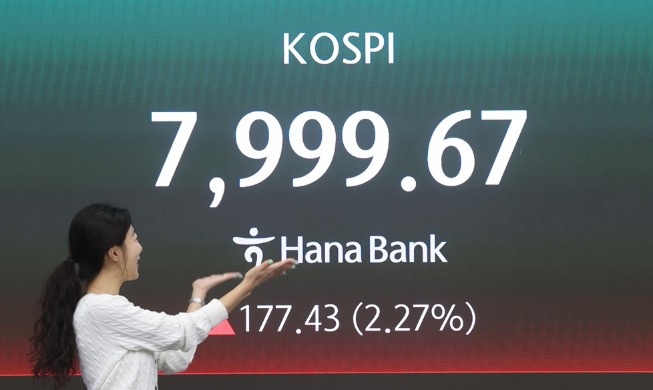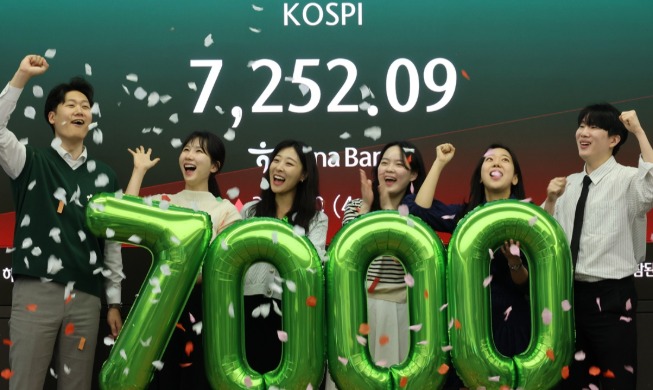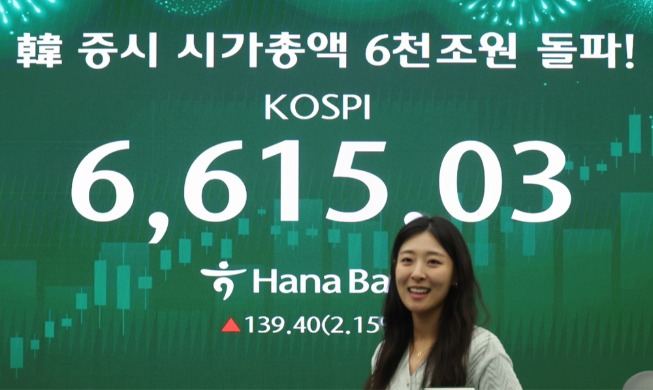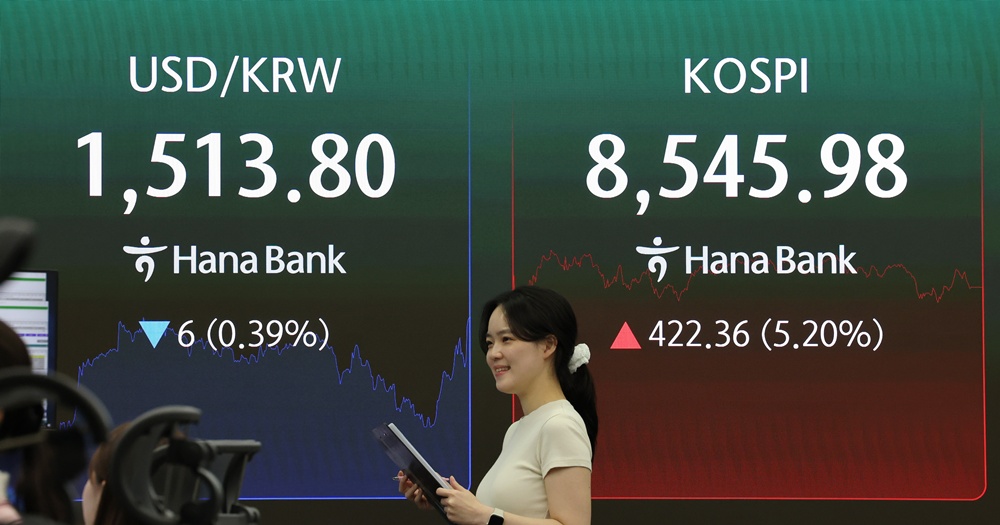
The KRW-USD exchange rate and the benchmark stock index KOSPI are shown on June 15 on a massive screen installed at the dealing room of Hana Bank headquarters in Seoul's Jung-gu District. (Yonhap News)
By Lee Jihae
The country's benchmark stock index KOSPI has surged back to the 8,500 level with the thawing of geopolitical risk in the Middle East, raising expectations for breaching 9,000.
Foreign investors have driven this rebound thanks to two straight days of net buying.
The KOSPI on June 15 closed at 8,545.98, up 422.36 points or 5.2% from the previous trading day. In early trading, the triggering of the year's 26th buy-side circuit breaker suspended buying for five minutes.
Foreign and institutional players were the main drivers of the index's rebound. The former were net buyers of KRW 1.01 trillion worth of shares and institutions KRW 539.2 billion. Among institutions, buying pressure from financial investment companies (KRW 805 billion) and pension funds (KRW 24.9 billion won) pushed the KOSPI further upward.
But individual investors offloaded KRW 1.48 trillion worth of shares for profit taking.
The easing of geopolitical risk is considered to have fueled this rebound. Early that morning, U.S. President Donald Trump announced a signing ceremony in Switzerland with Iran on June 19 to end their conflict, stimulating a surge in risk appetite.
Higher sentiment among foreign investors also affected the foreign exchange market. The KRW-USD rate closed the week at KRW 1,511.1, down 8.7 from the previous trading day.
jihlee08@korea.kr