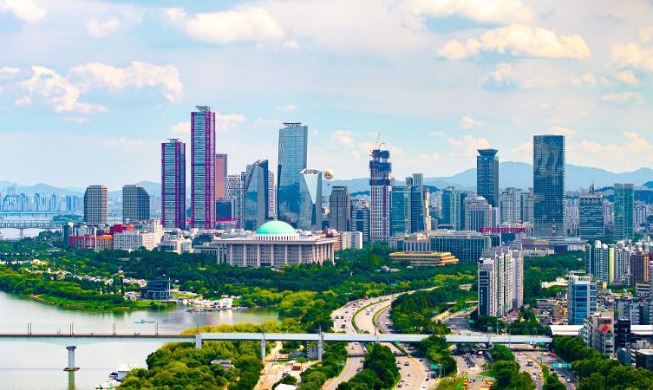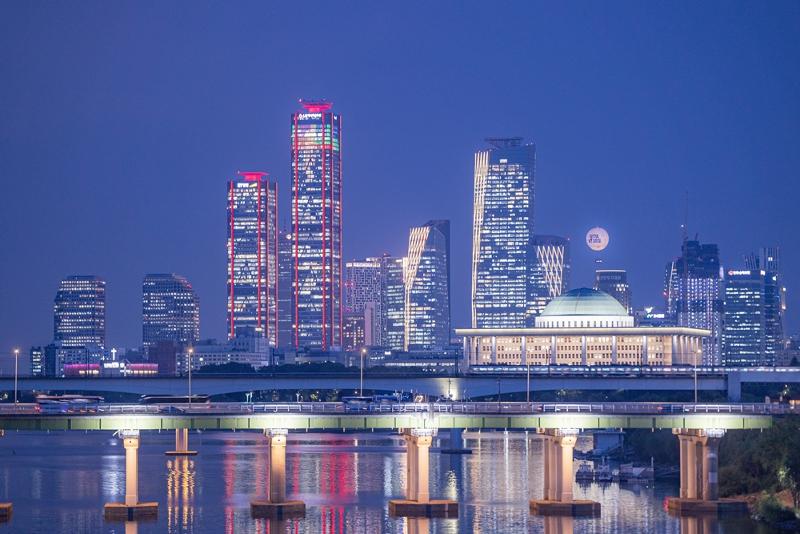
The Organisation for Economic Co-operation and Development has maintained its 2026 growth forecast for Korea at 2.6%. Shown is the the helium-powered balloon Moon of Seoul on Aug. 17, 2025, highlighting the nighttime skyline over the Yeouido neighborhood of Seoul's Yeongdeungpo-gu District. (Seoul Metropolitan Government)
By Kim Seon Ah
The Organisation for Economic Co-operation and Development (OECD) has maintained its growth forecast for Korea at 2.6% this year, citing a continued upward trajectory despite domestic and external uncertainties thanks to recovery in consumer spending and surging semiconductor exports.
The OECD on July 2 said this in its 2026 economic survey of the country, maintaining its predictions for gross domestic product (GDP) growth of 2.6% this year and 1.9% next year made last month.
Private consumption, fiscal spending and semiconductor exports will drive economic growth this year, it added. Consumer sentiment, which weakened after the declaration of martial law in late 2024, has recovered thanks to expansionary fiscal policy and the distribution of government-issued stimulus coupons, with the economic impact of the conflict in the Middle East contained thanks to the government's quick response.
Private consumption is projected to increase 2.2% this year and 2.1% next year. Private investment is expected to remain weak over the short term but recover from the second half of this year.
Exports will grow 6% this year before slowing to 1.9% next year.
The OECD said consumer inflation will hit 2.6% this year and 2.2% next year, with higher energy prices maintaining short-term upward pressure on inflation but demand-driven inflationary pressure to remain limited.
General government debt was projected to reach 51.4% of GDP this year and 52.3% next year. The OECD suggested strengthening fiscal soundness given the rapidly aging population and using surplus tax revenue to expand the growth base and invest in education and workforce training.
It also recommended simultaneous policies to expand housing supply and manage demand centered on the Seoul metropolitan area, sign more trade agreements to diversify export markets and promote the spillover of productivity gains from semiconductors to other sectors.
sofiakim218@korea.kr