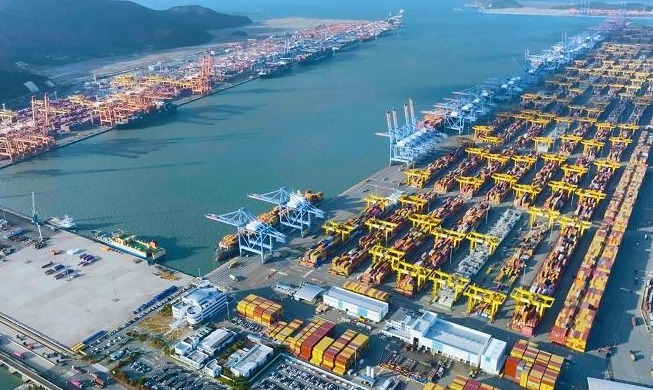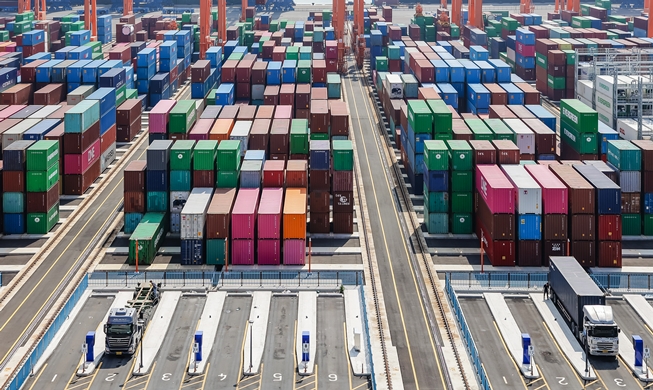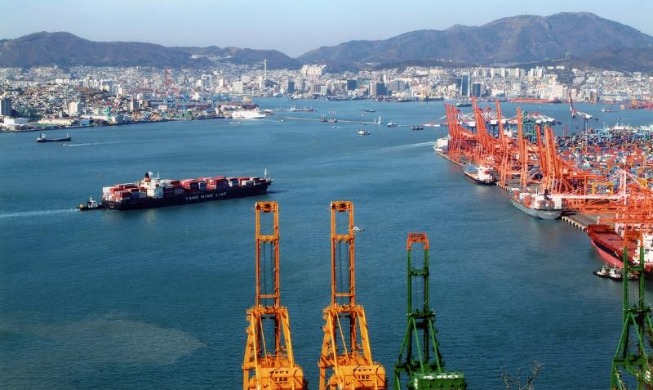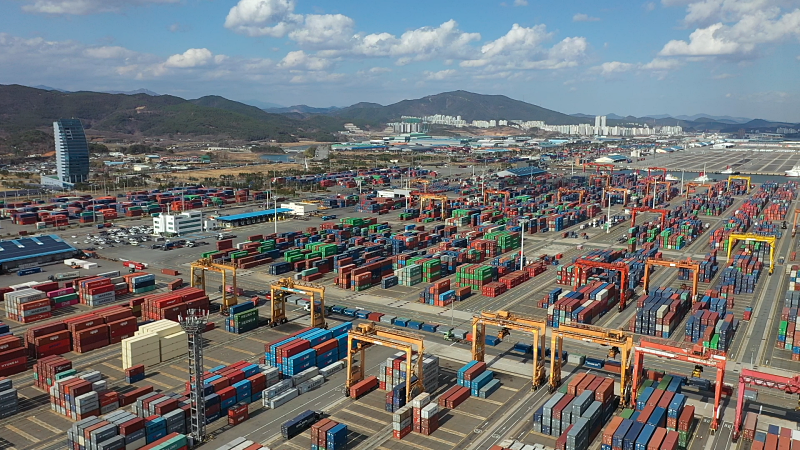
The current account surplus in August hit USD 46.11 billion, the second-highest figure in history following the record set in June. Shown is a container terminal at Gwangyang Port in Gwangyang, Jeollanam-do Province. (Yeosu Gwangyang Port Authority)
By Yoon Sojung
The semiconductor export boom propelled the current account surplus in August to its second-highest monthly figure in history at USD 46.11 billion.
This was according to preliminary balance of payments data released on Oct. 9 by the Bank of Korea.
The black figure was up USD 4.4 billion from that of July (USD 42.08 billion) and posted an increase of USD 36.27 billion year on year. Following the record surplus set in June of USD 49.73 billion, the current and goods account surpluses in August each posted their second-highest monthly marks in the same month.
Led by robust demand for information and technology (ICT) products led by semiconductors, goods exports was a key factor in this result by surpassing USD 100 billion for the third straight month.
Exports in August reached USD 98.28 billion on a customs clearance basis, up 68.7% year on year, with those of chips and ICT equipment seeing continued growth.
By item, those of computer peripherals (SSDs) skyrocketed 366.8%, followed by semiconductors (206.1%) and petroleum products (64.9%). Exports of cars fell 30.1%, however, while those of ships dropped 10.6%.
Among markets, those to China saw the biggest growth of 119.4%, followed by Southeast Asia (91.7%) and the U.S. (89.2%), while the rate of those to the European Union slowed to 14.6%.
Imports rose 22.4% year on year to USD 63.5 billion, led by the steady growth of raw materials and capital goods. Those of consumer items also began to increase.
Imports of raw materials went up 13.1% led by coal (42.7%), non-ferrous metals (30.3%) and crude oil (21.1%). Those of capital goods grew 42.9% driven mainly by semiconductor manufacturing equipment (96.5%), chips (70.6%) and ICT devices (42.6%).
Imports of consumer goods rose 4.3%, with grains (9.5%) and durable consumer goods (7.1%) leading the way.
The travel account finished USD 770 million in the red, but the deficit in the service sector fell to USD 1.68 billion, down from USD 1.97 billion in July, due to improvements in transportation and intellectual property royalties.
Net assets in the financial account jumped USD 40.23 billion. In direct investment, overseas investment by Koreans rose USD 6.22 billion, while investment in Korea by foreign players fell USD 1.61 billion.
Overseas securities investment by Koreans, primarily in stocks, saw a jump of USD 16.6 billion while foreign investment in domestic securities, mostly bonds, fell USD 4.85 billion.
arete@korea.kr