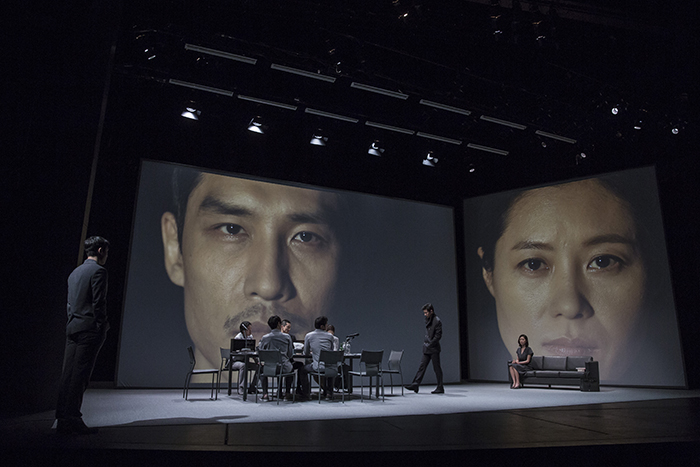
The two Koreas have been divided now for over 70 years, and the conflict between the two has been the source of many stories. 'The Empire of Light' tells the tale of a North Korean spy who has assimilated into South Korean society as an ordinary citizen, shedding light on our times.
Stories of undercover spies are a familiar subject matter in films and TV shows alike.
Through these stories, the audiences are able to experience the lives of double agents as they face life-threatening situations in the tensest scenarios. The anxiety one feels in the face of danger, and the enormous relief that arrives when the plot resolves itself after a thrilling climax, are the lures of such tales. These thrills are what make spy stories exciting, and why such material is revisited time and time again.
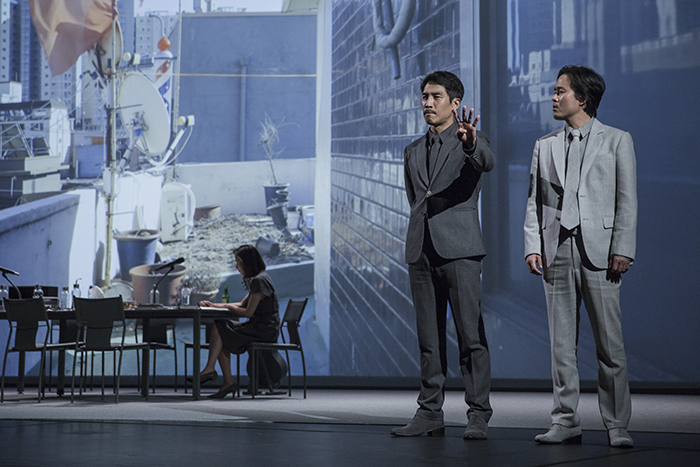
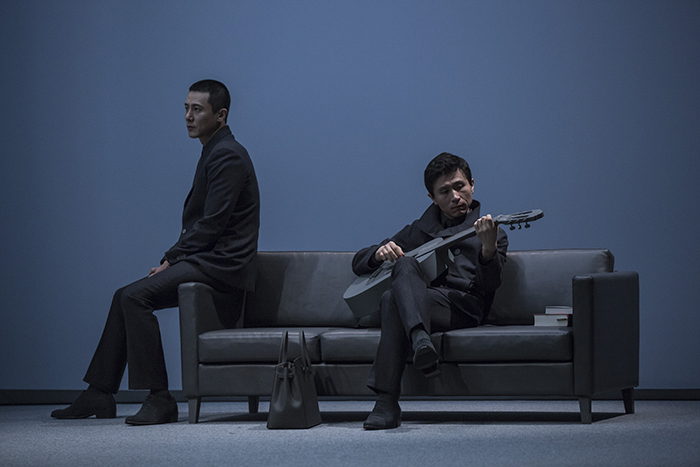
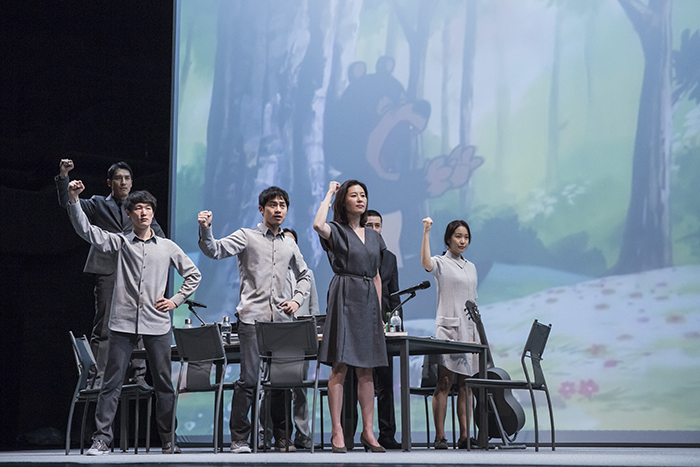
The themes of love, retrospection and political strife entwine and interlace in the play 'The Empire of Light,' delivering the message that life itself is never simple.
A play co-produced in Korea and France has as its main character a double agent.
Entitled "The Empire of Light," the play is about a North Korean spy who spends a decade in the South under cover. The production was brought to the stage by the National Theater Company of Korea and the French Centre Dramatique National Orleans in celebration of the 130th anniversary of the establishment of diplomatic ties between Seoul and Paris.
It's Feb.16 at 7:30 p.m. at the Myeongdong Theater in Seoul.
The actors are already gathered around a table on stage, talking quietly among themselves. When the time arrives, the lights don't dim on cue at the opening. The acting begins before the audience realizes that it has begun. Images of the actors' faces are projected onto the screens that double as walls on the stage, creating an unusual mise en scene for the performance of the real actors and actresses on stage.
Kim Ki-young, a man born in 1963 in Pyongyang, North Korea, is dispatched to South Korea. He enrolls in a prestigious university in Seoul as part of his cover. While participating in a student activist group, he falls in love with Jang Mari, a South Korean woman, and they get married. The audience is faced with the irony of a North Korean spy, sent on a mission to spread Kim Il Sung's ideologies, joining a political science group to learn about different sets of ideals.
For over 10 years, Kim receives no orders from the North. He assimilates into South Korean society, importing foreign films for a living and enjoying ordinary pleasures like drinking Heineken, eating sushi and following soccer. Then one day, he receives an email from Pyongyang. He is given 24 hours to erase all evidence of his existence before reporting back to the North. While he deliberates whether he should stay or leave, Kim reminisces over the past 10 years of his life.
The play grapples with an array of issues. In two hours, the audience is exposed to topics as diverse as the relations between North and South, the marital love of a middle-aged couple, the Gwangju democratization movement, Korean society in the 1980s and conflict between dictatorship and democracy. Yet such topics cannot be seen as universal. This is because political dissension between the North and the South, Marxism, North Korean ideology and the Gwangju democratization movement are social phenomena that aren't discussed in the arena of public debate.
The play is based on a familiar spy story, but its message is too ideological and complex. There is also no answer. Why? It's because life itself is not simple.
The play doesn't seem to have a moral lesson. Instead, it poses many questions, and asks that audience members dwell on them. What we can essentially take away from the play is that, through deep introspection, a solution for the future may be found.
"The Empire of Light" runs in Seoul until March 27.
By Wi Tack-whan, Lee Hana
Korea.net Staff Writers
Photos: National Theater Company of Korea
whan23@korea.kr