Minister of Culture, Sports and Tourism Kim Jongdeok stressed in a recent radio documentary aired on the BBC that, “Singers or film makers are the ones that lead the Korean Wave, known as Hallyu.”
The broadcaster's two-part documentary “South Korea: The Silent Cultural Superpower” went on the air on March 23 and 29. It features Rana Mitter, a history professor at the University of Oxford and director of the China Centre there, as he visits Korea and talks with some of Korea's top artists, producers and musicians. Through the conversations, the professor analyzes what's behind the boom in popularity of Korean TV shows and music that has been seen across East Asia and elsewhere in the world.
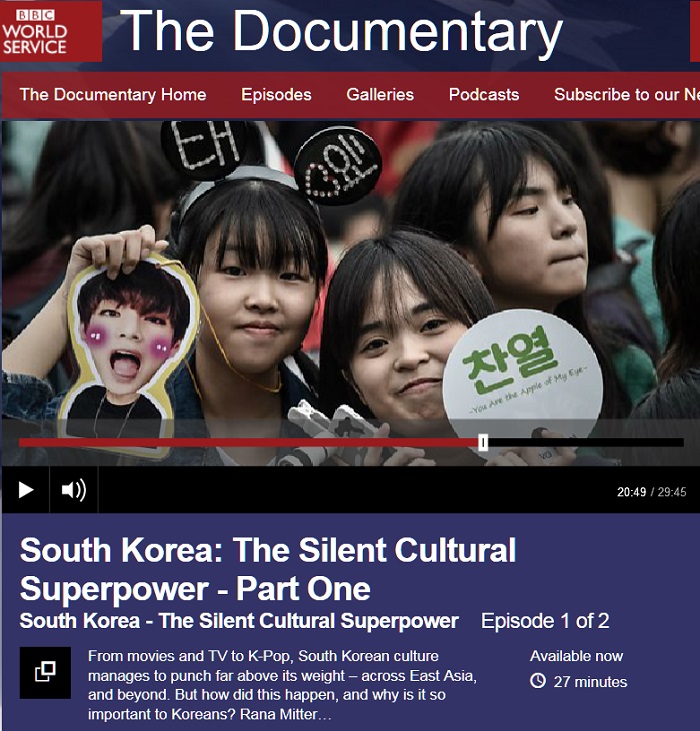
In the first episode, which spotlighted the rising popularity of content coming out of Korean studios and recording booths, the culture minister said that, “When you think about how the Korean Wave, like, K-pop and K-culture, all were formed, it wasn’t actually originated by the support of the Korean government. They just came up naturally by themselves, by some small- and mid-sized entrepreneurs or film makers, because they wanted to make some profits to survive.”
“We, the Korean government and the culture ministry, support the work they want to make, but we would not take any role or whatsoever as a decision maker or in getting involved in the actual working process at all. It’s the working people, I mean, film makers or singers, who take the lead in actually promoting the Korean Wave outside South Korea. The government is just putting a little bit of stepping stones so that they can jump up and move forward. That’s all we do,” the minister said.

In the second episode of the documentary, which focused on what's driving the growth in popularity of Korean pop culture around the world, the minister recognized “the importance of the country’s cultural producers.”
The minister said, “Through K-pop, Korean movies, dramas and, of course, literature, Korea has become one of the most accessible and well-known countries in Asia.”
He went on to say that, “Korea has a unique but diverse culture. This sets it apart from other East Asian countries, such as China and Japan, and makes it attractive to Western tastes. It has long been the policy of the Korean government to invest in culture, as you understand political, economic and social benefits that culture can place in modern developed economies.”
You can listen to the documentary by clicking on the links below.
Episode 1: http://www.bbc.co.uk/programmes/p03ms8rv
Episode 2: http://www.bbc.co.uk/programmes/p03nqs43
By Sohn JiAe
Korea.net Staff Writer
Photos: BBC, the Ministry of Culture, Sports and Tourism
jiae5853@korea.kr
The broadcaster's two-part documentary “South Korea: The Silent Cultural Superpower” went on the air on March 23 and 29. It features Rana Mitter, a history professor at the University of Oxford and director of the China Centre there, as he visits Korea and talks with some of Korea's top artists, producers and musicians. Through the conversations, the professor analyzes what's behind the boom in popularity of Korean TV shows and music that has been seen across East Asia and elsewhere in the world.
The BBC airs the first half of 'South Korea: The Silent Cultural Superpower' on March 23, a narrative on the popularity of Korean TV shows and pop music around the world.
In the first episode, which spotlighted the rising popularity of content coming out of Korean studios and recording booths, the culture minister said that, “When you think about how the Korean Wave, like, K-pop and K-culture, all were formed, it wasn’t actually originated by the support of the Korean government. They just came up naturally by themselves, by some small- and mid-sized entrepreneurs or film makers, because they wanted to make some profits to survive.”
“We, the Korean government and the culture ministry, support the work they want to make, but we would not take any role or whatsoever as a decision maker or in getting involved in the actual working process at all. It’s the working people, I mean, film makers or singers, who take the lead in actually promoting the Korean Wave outside South Korea. The government is just putting a little bit of stepping stones so that they can jump up and move forward. That’s all we do,” the minister said.
Minister of Culture, Sports and Tourism Kim Jongdeok emphasizes in the BBC radio documentary ‘South Korea: The Silent Cultural Superpower’ the potential that content makers have to be a driving force behind the popularity of Korean TV shows and music around the world. Pictured is the minister speaking on March 2 to the first batch of student 'Creators’ at the Culture and Creativity Academy in Seoul, a training facility aimed at developing young talent.
In the second episode of the documentary, which focused on what's driving the growth in popularity of Korean pop culture around the world, the minister recognized “the importance of the country’s cultural producers.”
The minister said, “Through K-pop, Korean movies, dramas and, of course, literature, Korea has become one of the most accessible and well-known countries in Asia.”
He went on to say that, “Korea has a unique but diverse culture. This sets it apart from other East Asian countries, such as China and Japan, and makes it attractive to Western tastes. It has long been the policy of the Korean government to invest in culture, as you understand political, economic and social benefits that culture can place in modern developed economies.”
You can listen to the documentary by clicking on the links below.
Episode 1: http://www.bbc.co.uk/programmes/p03ms8rv
Episode 2: http://www.bbc.co.uk/programmes/p03nqs43
By Sohn JiAe
Korea.net Staff Writer
Photos: BBC, the Ministry of Culture, Sports and Tourism
jiae5853@korea.kr