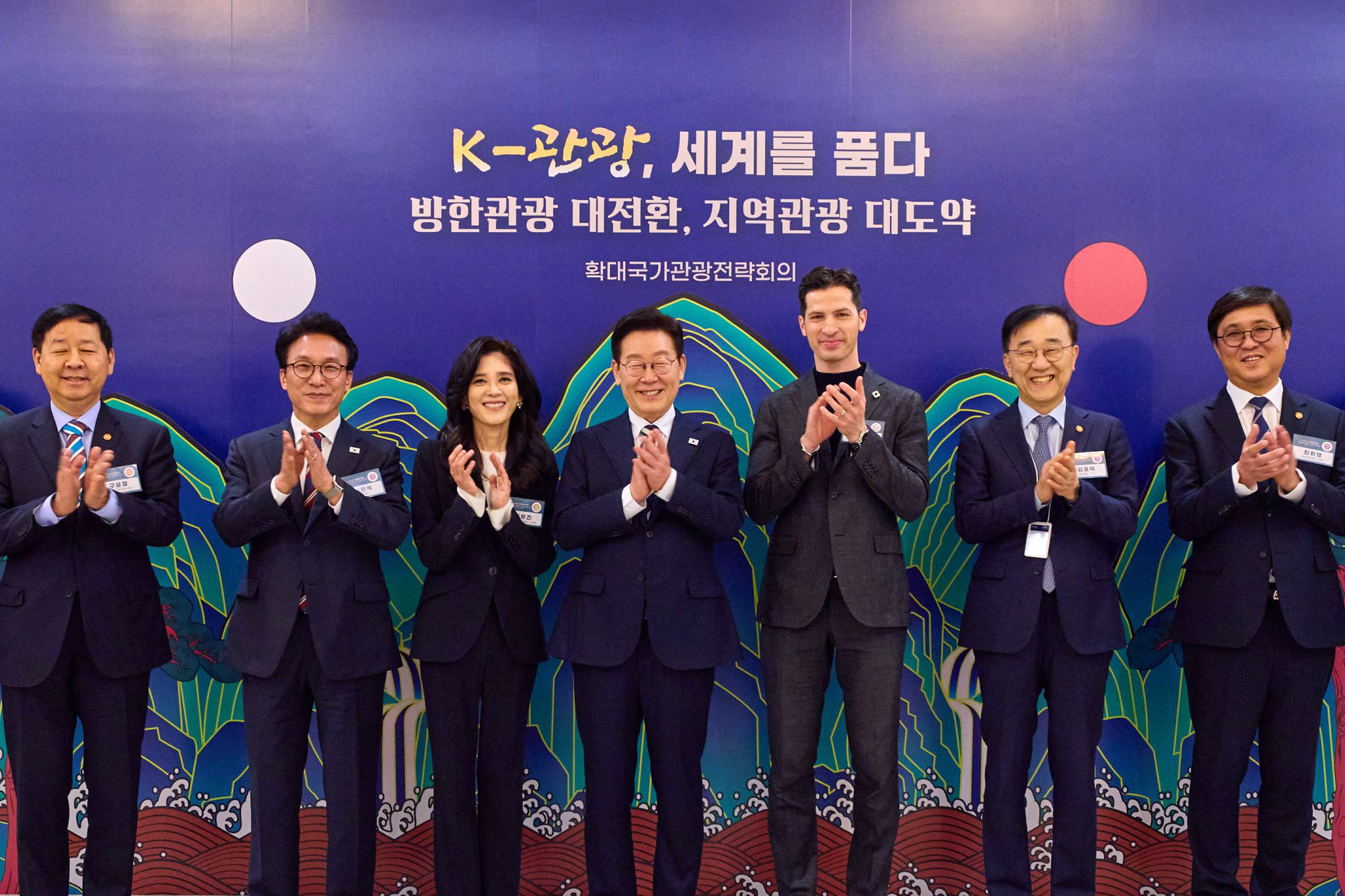
President Lee Jae Myung (center), Prime Minister Kim Min-seok (second from the left) and the heads of related ministries on Feb. 25 pose for a photo with Hotel Shilla CEO Lee Boo-jin (third from left) and Italian Chamber of Commerce in Korea Vice Chairman Alberto Mondi (third from right) at an expanded meeting on national tourism strategy under the theme "K-Tourism, Embracing the World" at Cheong Wa Dae in Seoul's Jongno-gu District.
By Hong Angie
Photos = Cheong Wa Dae
New initiatives seek to stimulate tourism and achieve the country's goal of 30 million foreign tourists per year.
The plan is to greatly simplify visa procedures, lower entry barriers, and diversify tourism demand from its concentration in the Seoul metropolitan area to airports and attractions in the provinces, expanding the base of tourism in Korea.
Minister of Culture, Sports and Tourism Chae Hwi-young on Feb. 25 announced this in releasing a plan for a "great transformation of domestic tourism" and "big leap forward in travel to the provinces." He was speaking at an expanded meeting on national tourism strategy under the theme "K-Tourism, Embracing the World" at Cheong Wa Dae in Seoul's Jongno-gu District.
The biggest change announced was improved immigration convenience. Pilot visa-free entry will go to groups of three or more tourists from Indonesia, which has the world's fourth-largest population and a recent surge in travelers to Korea.
Benefits for visitors from China and Southeast Asia will also be expanded. Those who have visited Korea are eligible for a five-year multi-entry visa and those living in major cities in both regions can apply for a 10-year multi-entry visa.
Another incentive is a waiver of visa issuance fees through December for group tourists from China, Vietnam, the Philippines, Indonesia, India and Cambodia.
The automated immigration system, which can be used by visitors from 18 countries including Japan, Singapore and Australia, will be expanded to include tourists from other major economies like the European Union. More automated checkpoints will be added to slash processing times.
In addition, provincial airports will get more international flights and the entry barriers for cruise ships will be lowered. Direct global routes to such airports will also be boosted to promote easier tourist access to more regions through incentives such as reduced fees for airport facility use.
The airports in Gimhae, Gyeongsangnam-do Province, and Cheongju, Chungcheongbuk-do Province, will immediately hike the number of domestic routes by allowing more takeoffs and landings by civilian aircraft.
Another plan is to expand attractions and programs in the provinces by discovering hidden gems and reviving old ones. More half-price travel and vacation programs will be offered to lower perceived travel costs.
The planned connection of tourism hubs nationwide through programs like the Korea Train Trail will seek to improve convenience in inter-regional travel.
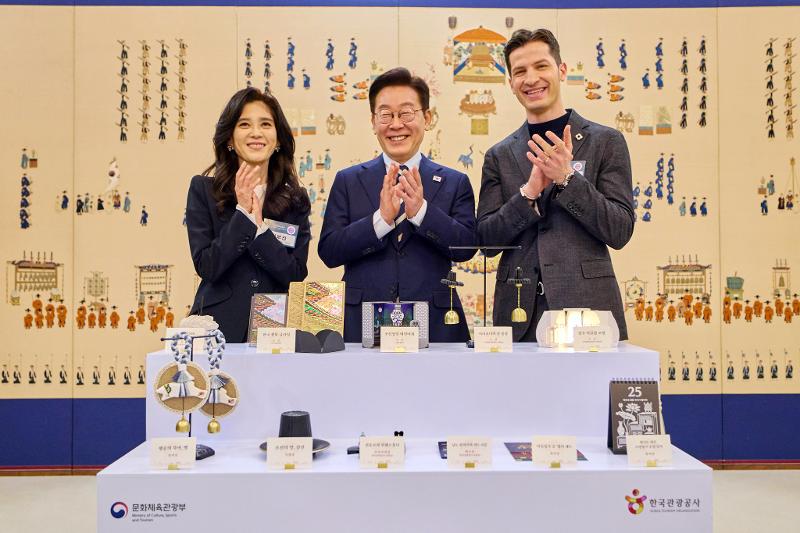
President Lee Jae Myung (center) on Feb. 25 poses for a photo with Hotel Shilla CEO Lee Boo-jin (left) and Italian Chamber of Commerce in Korea Vice Chairman Alberto Mondi at an expanded meeting on national tourism strategy themed "K-Tourism, Embracing the World" at Cheong Wa Dae in Seoul's Jongno-gu Office.
shong9412@korea.kr