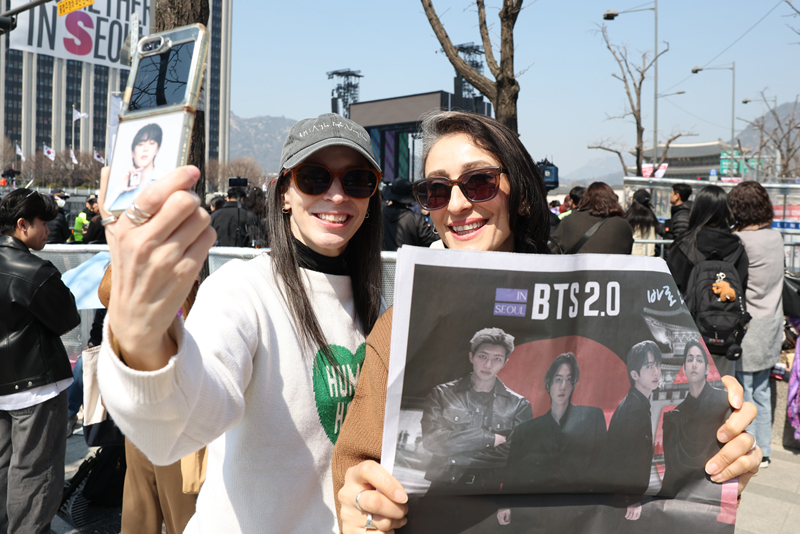
The Ministry of Culture, Sports and Tourism and the Korean Foundation for International Cultural Exchange on March 30 said the 2026 Overseas Hallyu Survey showed that K-pop was the first thing that came to mind when thinking of Korea by those with previous experience with Korean content. Shown are BTS fans on March 21 at Gwanghwamun Square in Seoul's Jongno-gu District taking a photo before the concert marking the release of the fifth album "Arirang" by the K-pop boy band BTS. (Lee Jeongwoo)
By Hong Angie
Nearly 70% of foreign nationals abroad who have experienced Korean cultural content have a positive perception of Hallyu (Korean Wave), a survey has found.
The Ministry of Culture, Sports and Tourism and the Korean Foundation for International Cultural Exchange on March 30 said this in releasing the results of the 2026 Overseas Hallyu Survey based on data collected last year. A key finding was that 69.7% of 27,400 respondents from 30 countries who experienced Korean cultural content had a positive impression of such content.
Conducted last year from Nov. 13 to Dec. 12, the survey was expanded this year to cover more countries such as Singapore, Chile and Poland and include new questions related to characters and performances.
By region, Hallyu remained strong in Southeast Asia. The Philippines (87%) had the highest positive rating of such content by a country, followed by India (83.8%), Indonesia (82.7%) and Thailand (79.4%).
The Korean Wave's popularity also surged in the West, seeing a jump of eight percentage in the U.K., 6.2 in Spain, 6.1 in the U.S. and six in Australia as well as 6.4 in Japan.
By sector, food (55.1%) was the most popular aspect of Hallyu within the respondents' home countries, followed by music (54%), beauty and cosmetics (52.6%), K-dramas (51.3%) and movies (48.9%).
The proportion of people who reported at least one instance of use or consumption of Hallyu was highest for food (78%), followed by movies (77.9%), dramas (72.9%), music (71.9%), and beauty and cosmetics (61.8%).
On what came to mind first when thinking of Korea, K-pop (17.5%) topped the list, followed by food (12.1%), dramas (9.5%), beauty and cosmetics (6.2%), and movies (5.9%).
K-pop supernova BTS (6.9%) was ranked the most influential Hallyu star, followed by actor Lee Min-ho (4.6%) in second and the girl group BLACKPINK and BTS member Jungkook tied for third.

A combined 27,400 people from 30 countries with exposure to Korean cultural content ranked the smash hit "Squid Game" as their favorite K-drama, while "Parasite" took the top spot for movies. Shown is a scene from the series' second season. (Netflix)
The blockbuster series "Squid Game" (12.4%) was No. 1 among K-dramas for the ninth consecutive year, followed by new entrants to the top rankings "When Life Gives You Tangerines" (4.6%) and "Bon Appétit, Your Majesty" (2.1%).
In cinema, director Bong Joon-ho's "Parasite" (8.4%) topped the category for the sixth year in a row, while director Yeon Sang-ho's "Train to Busan" (5.8%) was second for the fifth straight year.
In a first, the survey covered the perception of productions made abroad integrated with Korean content such as "KPop Demon Hunters." Respondents said content reflecting Korean cultural elements (23.3%) was the most important factor in it being seen as Korean, followed by that "featuring many Korean characters" (21.8%) and "Korea as the setting" (19.1%).
Korean cultural content fused with content from other countries was also dubbed "attractive" (60%), "trendy" (60%), "easy to accept" (57.3%) and "original" (55%).
shong9412@korea.kr