Amid the crisis of an entrenched demographic cliff, small but clear signs of hope have emerged. The number of births last year rose 6.8% from the year before. This three-part series looks at policies driving this resurgence in the number of babies amid the prolonged ultra-low birth rate and Korea's distinctive culture of childbirth.
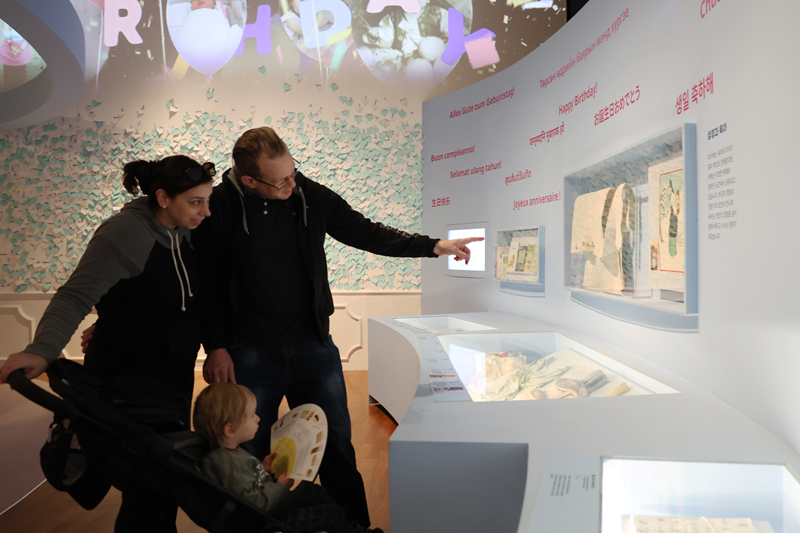
A family on April 7 looks at the nation's past and present baby carriers at the exhibition "Happy Birthday" held at the National Folk Museum of Korea in Seoul's Jongno-gu District. Unlike in most Western cultures in which people carry babies in the front, Koreans carry their babies on their backs with podaegi, a large quilted cloth with long straps.
By Hong Angie
Photos = Park Daejin
The exhibition "Happy Birthday" at the National Folk Museum of Korea in Seoul has received added meaning with the annual number of births returning to the 250,000 level last year.
The artifacts displayed represent a profound sense of collective care as seen through the hanging of geumjul (sacred straw rope), preparation of miyeokguk (seaweed soup) for the mother and the Cheonin Cheonjamun, a classic textbook whose title literally means "1,000 Characters from 1,000 People" from the Joseon Dynasty (1392-1910) to mark the first birthday of a baby of an aristocratic family.
This spirit continues in modern form like postpartum care centers and parenting communities.
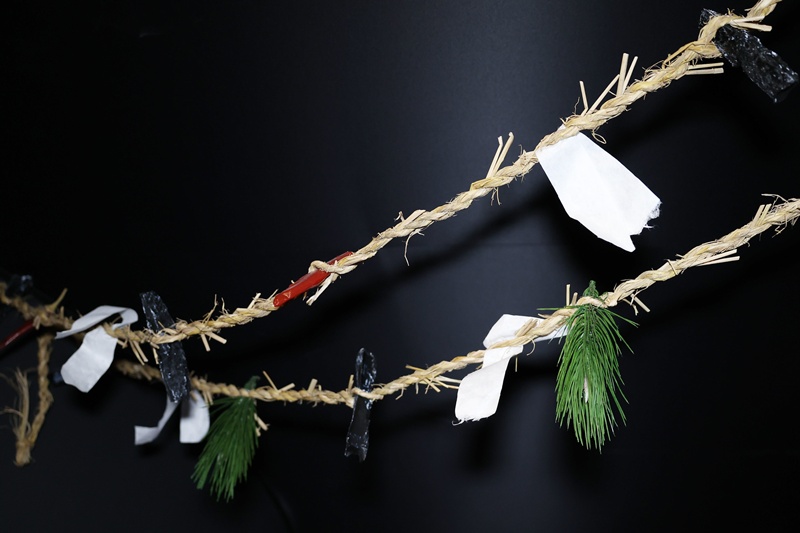
A geumjul (sacred straw rope), which is used in a traditional childbirth custom, is displayed on April 7 at the exhibition "Happy Birthday" at the National Folk Museum of Korea in Seoul's Jongno-gu District.
Red chili pepper and black charcoal: symbolic boundary geumjul
In the past, people hanged geumjul (sacred straw rope) at the gate of the mother's home; the rope was adorned with red chili peppers for a boy and charcoal for a daughter. This was a sign that outsiders could not enter the house for 21 days.
More than just an announcement of childbirth, geumjul served as a sacred boundary to ward off harmful or impure spirits from the outside.
This custom embodies practical, science-based wisdom to protect a mother and her newborn, both of whom had weakened immune systems. While Japan used shimenawa (sacred Shinto ropes) and the West door ribbons to express congratulations, geumjul in Korea constituted a communal pledge to protect life through taboo, namely preventing outsiders from entering.
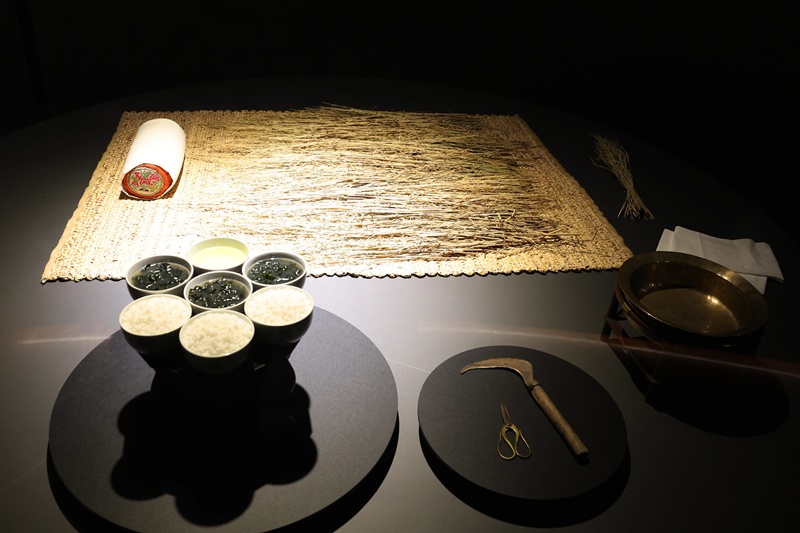
These items used in traditional childbirth are on display at the exhibition "Happy Birthday" at the National Folk Museum of Korea in Seoul. On the left is samshinsang, a dish combining rice and miyeokguk (seaweed soup) for Samshin, the three gods that oversee birth, a straw mat for the baby and traditional tools used to cut the umbilical cord.
Reason for serving miyeokguk after childbirth
A simple meal of miyeokguk (seaweed soup) at a corner of the exhibition hall shows a long-standing tradition of Korea's postpartum care. One account says the practice of eating the dish began after people saw whales eat seaweed to heal their postpartum wounds.
Modern medicine has shown that seaweed is rich in iodine and calcium, which are good for promoting uterine contraction and blood purification.
Steaks or vegetables are often recommended in Western cultures for nutritional recovery, but Korean tradition emphasizes on (warmth) by aiding health restoration through warm soups.
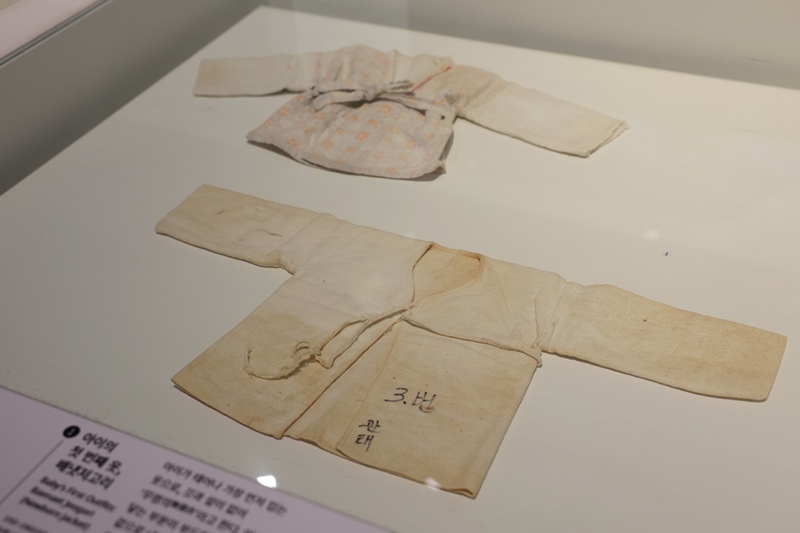
Upper garment for celebrating baby's 100th day
Upper garment celebrating baby's 100th day
The baegil jeogori, an upper garment worn by a baby to celebrate the 100th day of birth, is made without a collar or cuffs to minimize seams, reflecting the parents' wish for their child's future to be free from obstacles.
The baenaet jeogori, an upper garment worn when the baby is born, bears the marks of handling, conveying the prayers of a family wishing for a baby's survival. The culture of both outfits endures today as gifts to welcome new life.
Records of maternal solidarity across generations
The solidarity among women that turned the fear of childbirth into courage has continued through generations. A faded letter sent by a mother to her married daughter in the early 1900s contains heartfelt advice stemming from experience and love.
From parenting guides in the early 2000s to the exhibition's present-day finale — mom cafes and group chat rooms on smartphones — this legacy continues. The steady stream of parenting concerns and words of reassurance shared in real time serve as a modern-day guide to life and letters from mothers.
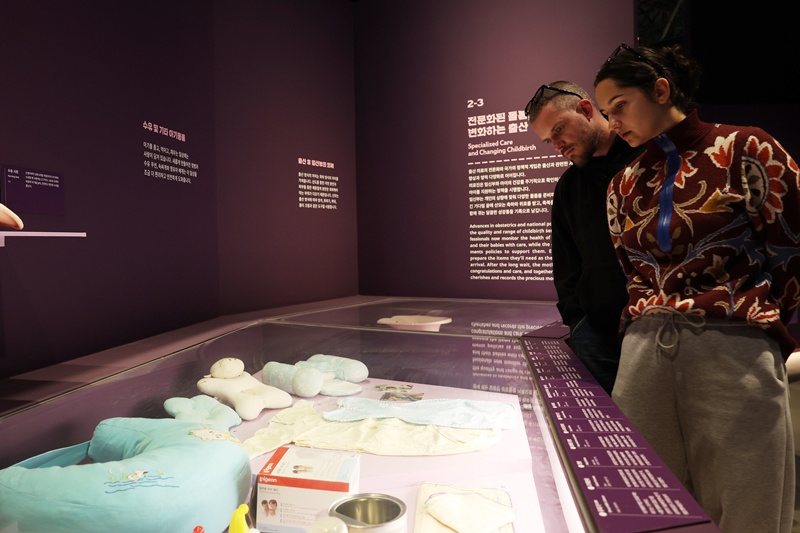
Visitors on April 7 look at contemporary baby products at the exhibition "Happy Birthday" at National Folk Museum of Korea.
shong9412@korea.kr