View this article in another language
- 한국어
- English
- 日本語
- 中文
- العربية
- Español
- Français
- Deutsch
- Pусский
- Tiếng Việt
- Indonesian
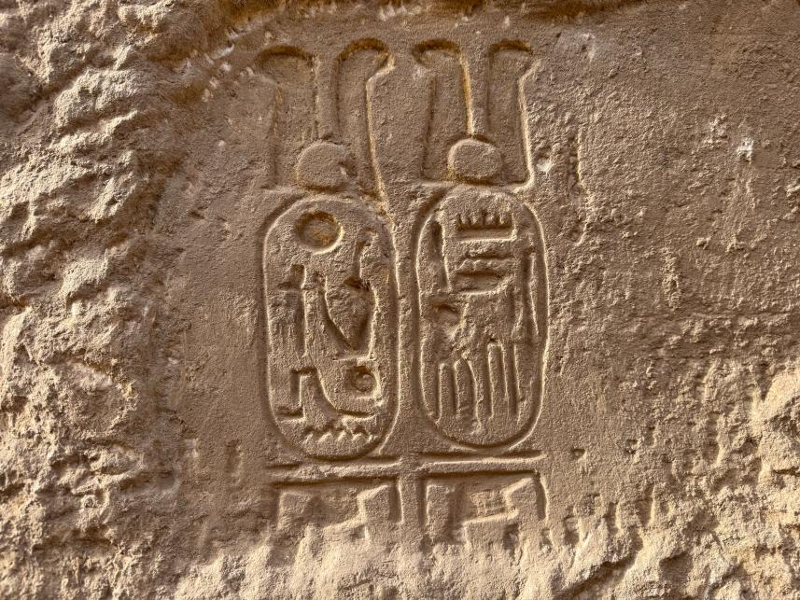
The Korea Heritage Service (KHS) and Korea National University of Heritage on April 9 announced their discovery of a cartouche of Ramses II during their restoration of the Ramesseum, the pharaoh's temple, in Luxor, Egypt. (KHS)
By Yoo Yeon Gyeong
A Korean archaeological team has discovered hieroglyphs bearing the name of the ancient Egyptian pharaoh Ramses II at his temple.
The Korea Heritage Service (KHS) and Korea National University of Heritage on April 9 announced the discovery of a cartouche during a restoration of the Ramesseum, the 13th-century B.C. mortuary temple of the pharaoh, in Luxor, Egypt.
A cartouche is an oval outline-shaped hieroglyph with the name of an ancient pharaoh. Its archaeological value is high, as the form of the script and the pharaoh's name allow for precise dating.
The KHS has collaborated with Egypt's Supreme Council of Antiquities to carry out the official development assistance project dubbed "Capacity Enhancement for the Development of Sustainable Cultural Heritage Tourism (2023–27)."
The discovery was made during excavations between June last year and February this year on the north side of the pylon at the Ramesseum.
The cartouche discovered is the first found on the cornerstone of the tower gate, which is the main entrance to the temple.
dusrud21@korea.kr