- 한국어
- English
- 日本語
- 中文
- العربية
- Español
- Français
- Deutsch
- Pусский
- Tiếng Việt
- Indonesian
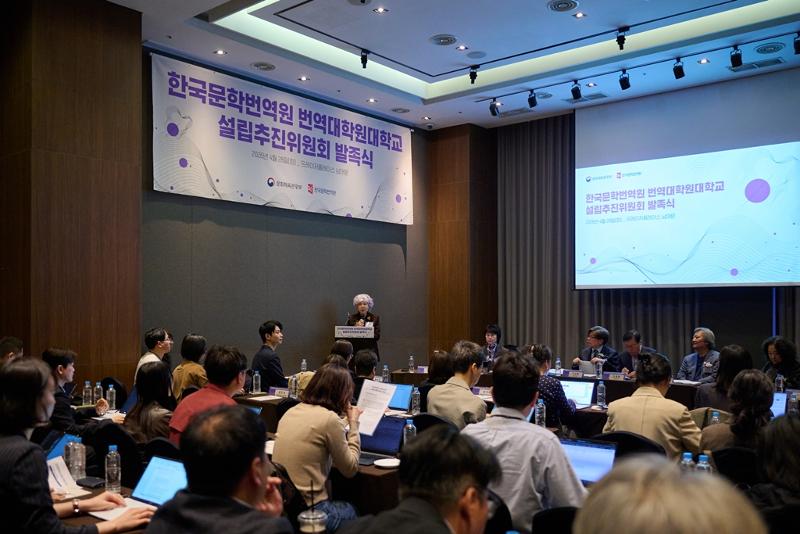
A news conference for the Literature Translation Institute of Korea's launch of a committee to set up a graduate school on April 28 is held at the serviced residence Fraser Place Namdaemun in Seoul's Jung-gu District.
By Kim Seon Ah
Photos = Literature Translation Institute of Korea
A graduate school of translation will be set up in fall next year to train professional translators of Korean literature and cultural content.
The Literature Translation Institute of Korea (LTI Korea), an affiliate of the Ministry of Culture, Sports and Tourism, on April 28 held an inauguration ceremony for the school's promotional committee at the serviced residence Fraser Place Namdaemun in Seoul's Jung-gu District, saying, "We will accelerate preparations with the goal of opening in September next year."
The inaugural class will see 60 students -- 30 Korean and 30 foreign -- specializing in seven languages: English, French, German, Spanish, Chinese, Japanese and Russian.
The committee's nine members are poet and former culture minister Do Jonghwan; fellow poets Moon Chung-hee and Ra Taejoo; novelists Hwang Sok-yong and Eun Heekyung; literary critics Kwon Yeongmin and Yoo Sungho; translator Darcy Paquet, famous for doing the subtitles for the Oscar-winning film "Parasite"; and Park "Kenny" Eun-kwan, CEO of the luxury brand Simone Accessories Collection.
The plan is to convert LTI Korea's Translation Academy, launched in 2008 as the country's lone center for specialized translation education for Korean literature and cultural content, into a graduate school offering a master's degree.
LTI Korea has produced over 1,600 graduates but its limits in training degree-based professionals due to being a non-degree program has provoked criticism.
Attendees at the ceremony all agreed on the need for the graduate school.
"Korean literature has already reached a high level, but the depth of its works has not been fully conveyed due to the limitations of Korean being a minor language," Do said. "To advance toward a Hallyu (Korean Wave) that deeply permeates through literature, the training of professional translation personnel is essential."
Moon emphasized the experiential significance of translation. "If our works had not been translated into multiple languages, it would have been difficult for Korean literature to spread worldwide," she said. "Translation is the most important tool allowing Korean literature to meet readers around the globe."
Ra indicated the limitations of the field. "While Korean novels are now fairly well known overseas, Korean poetry is almost unknown," he said. "We need translation support that is balanced and not biased toward a specific genre."
Yoo expanded the concept of translation. "Translation is a critical act of choosing and interpreting texts, as well as a process of incorporating a work into world literature," he said. "A translator is not merely a conveyor but a creator who transfers culture and memory."
"To fulfill this role, systematic education at the graduate level -- not short-term training -- is necessary."
Park mentioned the business structure surrounding translation. "The reason Korean literature has not received sufficient global recognition is not due to its literary quality, but the lack of a structure for translation and later distribution and marketing," he said. "The graduate translation school cannot just be an educational institution -- it must play a role to complement these structural shortcomings."
The committee members all stressed translation as a core element of the globalization of Korean literature, with the school to do more than just teach translation in assuming a strategic role in connecting Korean literature with the world.
LTI Korea President Chon Sooyoung pledged to "set up a more professional and future-oriented educational system for translation" and "lead the way for global cultural and artistic exchange by developing high-level translation talent suitable for the digital transformation era."
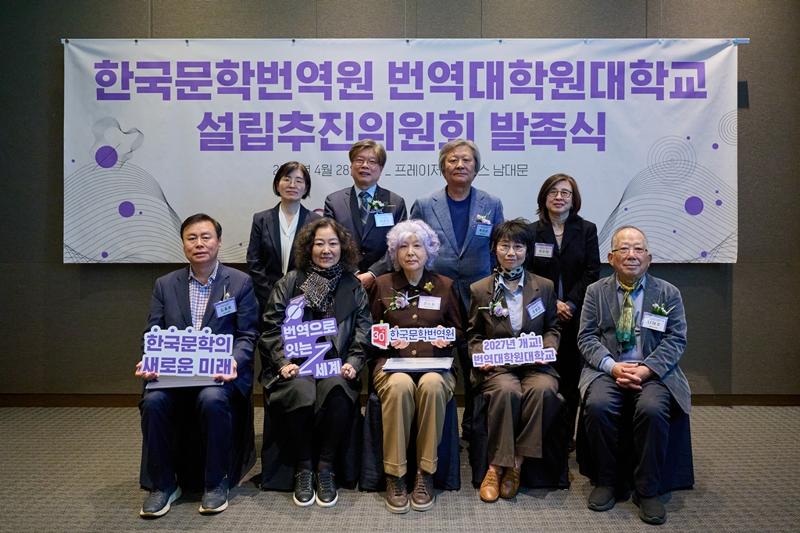
Members of LTI Korea's committee for launching a graduate school of translation and others on April 28 pose for a group photo at the launching event for the committee. From top left clockwise are Kwak Hyunju, head of the education division of LTI Korea; literary critic Yoo Sungho; Park "Kenny" Eun-kwan, CEO of the luxury brand Simone Accessories Collection; translator Yoon Sunme; poet Ra Taejoo; Jung Hyang-mi, deputy minister for cultural policy at the Ministry of Culture, Sports and Tourism; LTI Korea President Chon Sooyoung; and poets Moon Chung-hee and Do Jonghwan.
sofiakim218@korea.kr