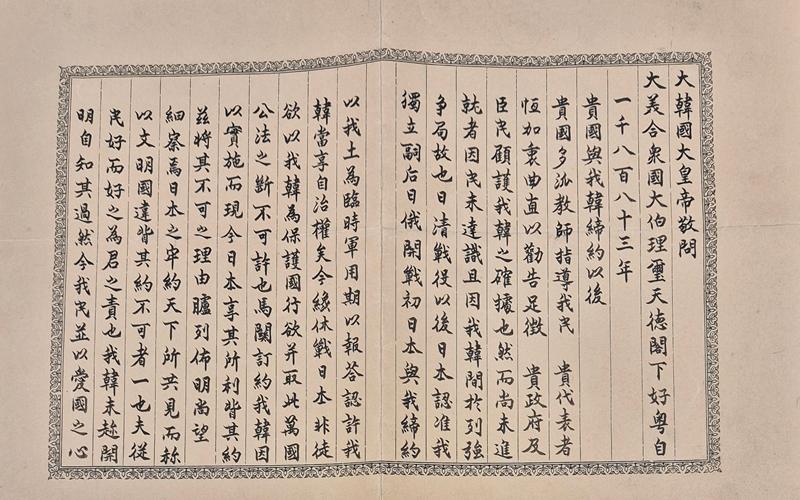
The Seoul-based Hulbert Memorial Society on May 6 said it recently authenticated an original handwritten letter by Emperor Gojong of the Korean Empire (1897-1910) and its English-language translation by American missionary Homer B. Hulbert at the Roosevelt Collection of the Library of Congress in Washington. (Hulbert Memorial Society)
By Kim Seon Ah
A handwritten letter sent by Emperor Gojong of the Korean Empire (1897-1910) to U.S. President Theodore Roosevelt a month before the conclusion of the Eulsa Treaty, which Japan used to strip Korea of its national sovereignty, has been found after 121 years.
The Hulbert Memorial Society in Seoul on May 6 said it recently authenticated the original letter written by Gojong and the English-language translation by American missionary Homer B. Hulbert at the Roosevelt Collection of the Library of Congress in Washington.
Signed in November 1905, the treaty was used by imperial Japan to strip Korea of its diplomatic rights. Korea consequently lost its sovereignty and was reduced to a Japanese protectorate and de facto colony.
In the two-page letter dated Oct. 16, 1905, Gojong wrote, "Japan is not only trying to make us its protectorate but also wants to annex us."
"This violates the Treaty of Shimonoseki, which stipulates the autonomy of the Korean Empire," he added, urging American support.
The Joseon Dynasty of Korea declared itself the Korean Empire in 1897 two years after the Treaty of Shimonoseki was signed to end the First Sino-Japanese War.
The letter was written in brush calligraphy on two sheets of yellow paper each 42 cm wide and 30 cm long. On the edges is a plum tree pattern symbolizing the empire's imperial family.
The artifact is considered to have high historical value mainly due to the imperial seal stamped on it. The six-page edition in English is believed to have been translated and handwritten in pen by Hulbert.
Due to Japanese interference, Hulbert was unable to deliver the letter to the U.S. until Nov. 25, 1905, after the Eulsa Treaty was signed.
sofiakim218@korea.kr