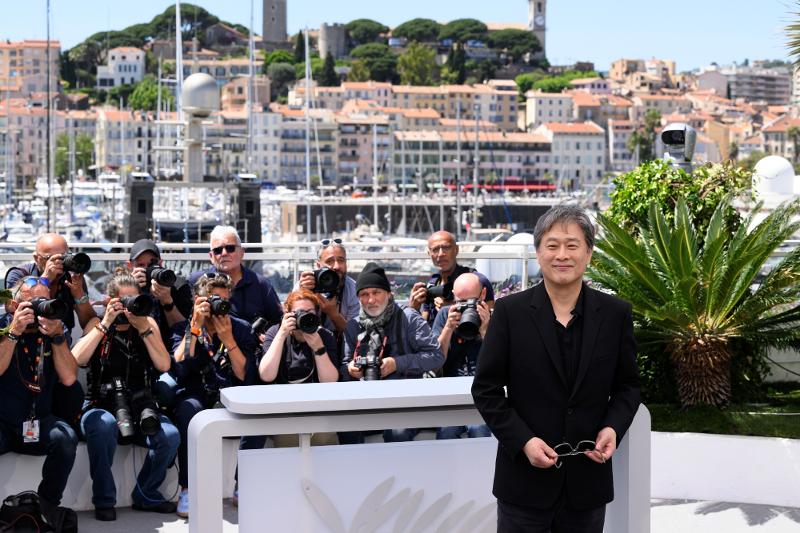
Director Park Chan-wook on May 12 poses for photos as part of the red carpet event of this year's Cannes Film Festival in Cannes, France. (Yonhap News)
By Charles Audouin
Video = Official YouTube channel of Cannes Film Festival
"Korea is no longer on the outskirts of global cinema."
Acclaimed director Park Chan-wook on May 12 hailed the global rise of Korean cinema at a news conference for the opening ceremony of the Cannes Film Festival in Cannes, France. He is the first Korean to head the jury of the event's Competition section.
"I first went to the festival in 2004, and at the time, Korean films were presented very occasionally," he said. "Just 20 years have since passed but we've seen so many changes over that time."
"I don't want to describe this phenomenon simply as Korean cinema doing very well and finally entering the center of the industry," he added. "Instead, it's the result of the center of cinema being expanded and able to embrace a wider variety of films from more countries."
"The result is that I became president of the jury here."
On domestic works invited to this year's festival such as those by directors Na Hong-jin, Yeon Sang-ho and July Jung, Park said, "I'm glad that works I'm looking forward to have been invited."
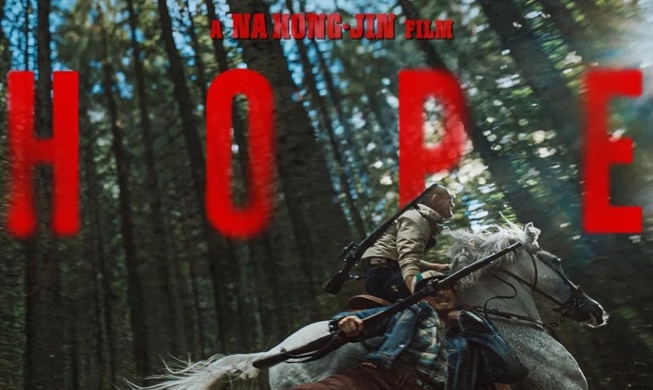
"Hope," Na's first work in 10 years, is in the Competition section against 21 other competitors for the Palme d'Or, the festival's top prize.
On how he would view films in the section, he said, "I intend to watch the films with the pure eyes of the audience with absolutely no prejudice, preconceptions or stereotypes, just a sense of excitement over which films will surprise me."
"But after the screenings are over and we hold jury deliberations, I will evaluate them as a professional, someone with clear insights into cinema and knowledge of film history."
Park also said, "I don't think politics and art should be divided."
"The very notion of considering politics and art as opposing concepts is strange. Just because something has a political statement doesn't mean that it should be considered an enemy of art," he added. "But I also think a film shouldn't be excluded simply because it lacks a political statement worth listening to."
"Even if the statement is admirable, it's just propaganda if not achieved with artistic excellence," he said. "Art and politics are not opposing concepts, and if artistically expressed well, (a political statement) is worth listening to."
The director has won Cannes awards for his works "Oldboy" (2003), "Thirst" (2009), "The Handmaiden" (2016) and "Decision to Leave" (2022).
caudouin@korea.kr