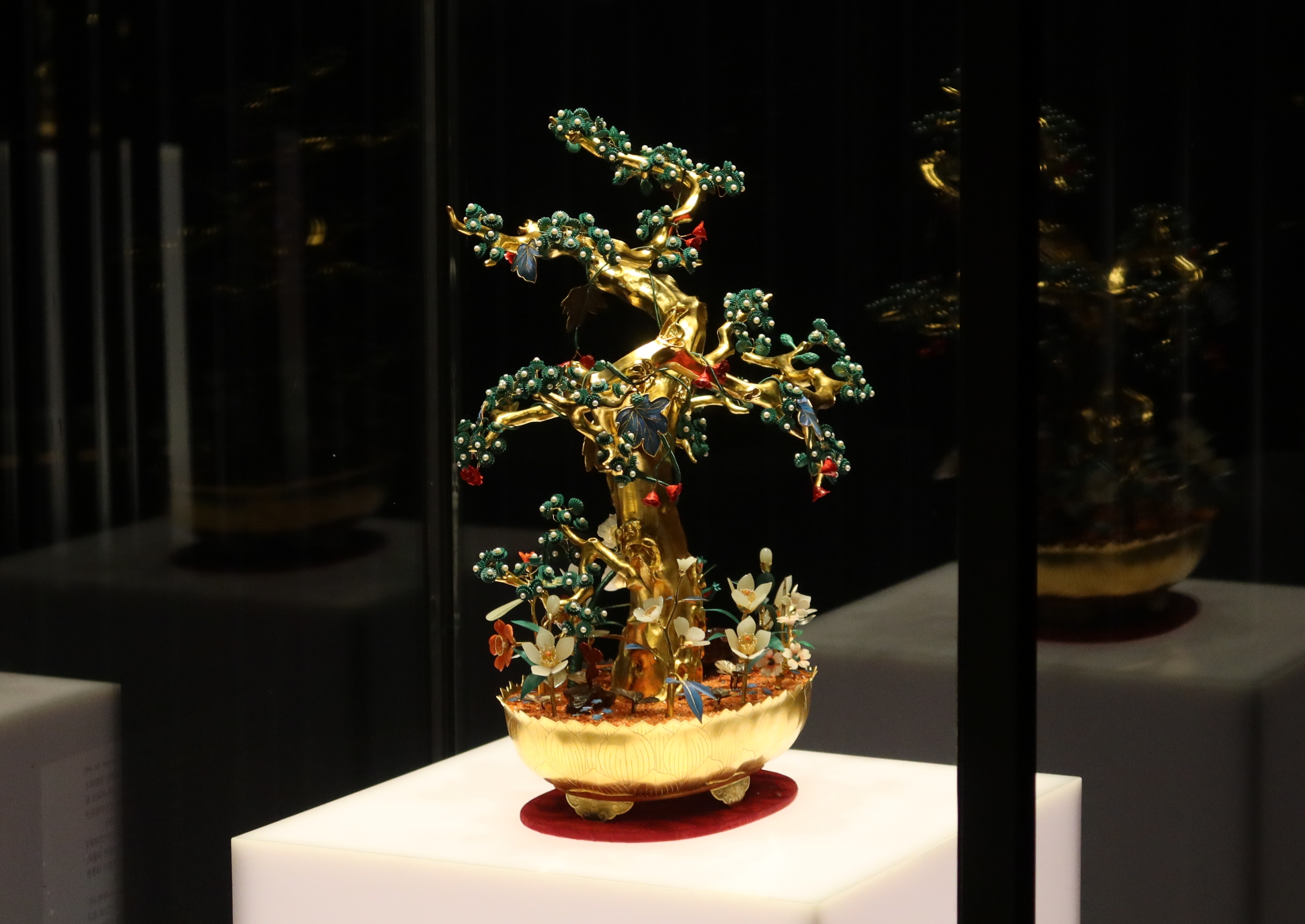
This is a replica of a banhwa, a diplomatic gift from the Joseon royal court, on display through Aug. 30 at Dondeokjeon Hall of Deoksugung Palace in Seoul's Jung-gu District. (Charles Audouin)
By Charles Audouin
The Kingdom of Joseon (Korea) and France on June 4, 1886, formed official diplomatic relations by signing the Treaty of Friendship and Commerce.
To mark the occasion, Joseon King Gojong sent a unique gift to French President Sadi Carnot: a banhwa, a handicraft with jewels and metal expressing the wish for the well-being and prosperity of the recipient country.
Long part of the collection at the Guimet Museum in Paris, this relic has been reborn as a replica on Korean soil and is on display to mark the 140th anniversary of bilateral ties. The exhibition "Banhwa: Blossoms of Auspicious Wishes" runs through Aug. 30 at Dondeokjeon Hall of Deoksugung Palace in Seoul's Jung-gu District.
The event explores the background of banhwa, a handicraft using jewels and metal representing the wish for the safety and prosperity of the recipient country, its selection as a diplomatic gift, symbolism embedded in the flowers and trees shown, and production techniques.
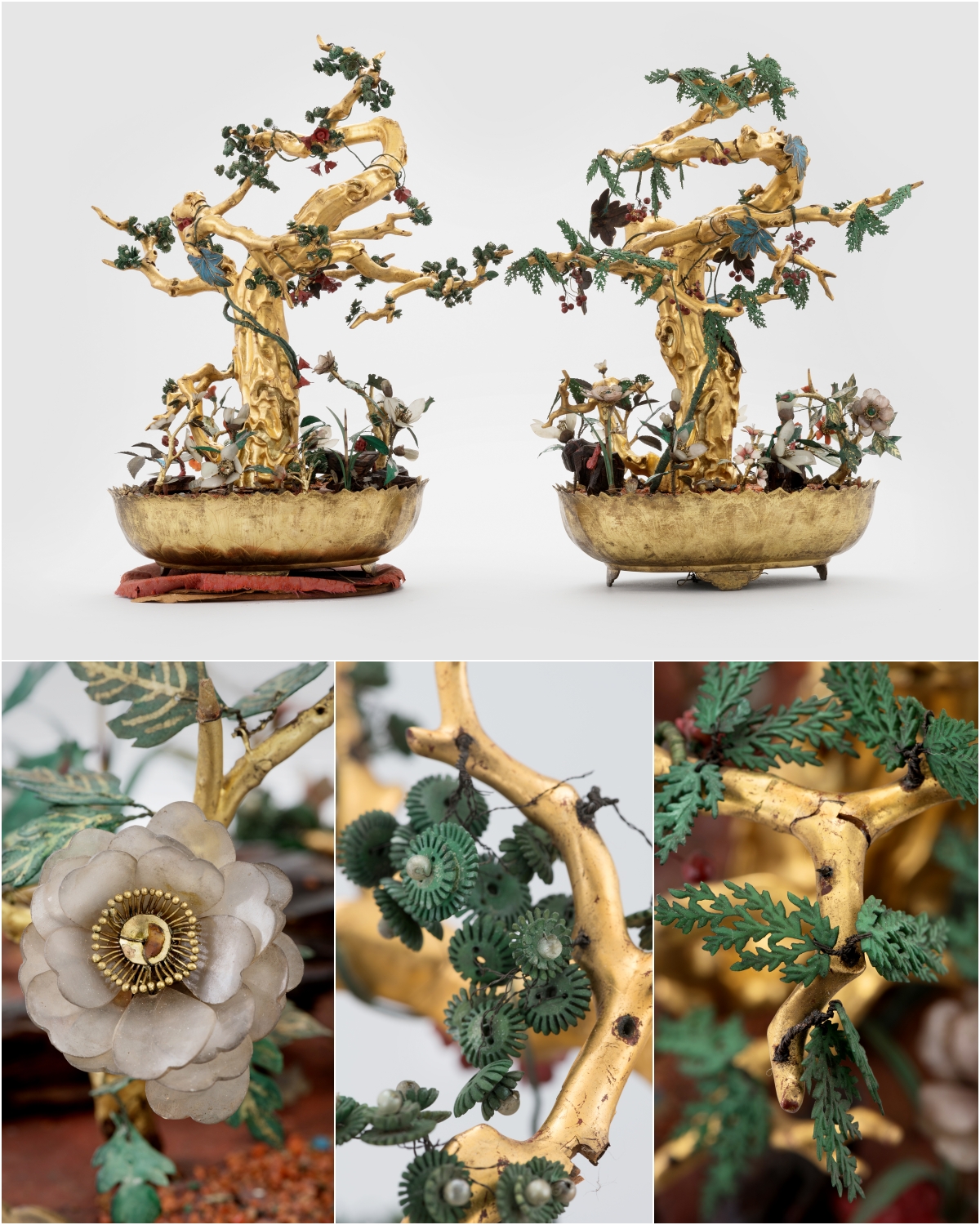
Shown are details of the original banhwa. From the bottom left are a peony symbolizing wealth and luck and pine and cypress trees signifying longevity. (Korea Heritage Service)
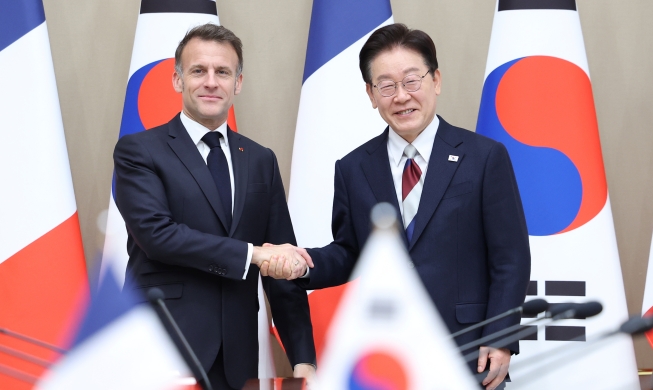
When French President Emmanuel Macron in April paid a state visit to Korea, President Lee Jae Myung gifted him a "banhwa homage," a modern reinterpretation of the banhwa motif. The item made it seem as if Gojong's sentiment from 140 years ago was recreated in today's diplomatic arena.
The Korea Heritage Service said, "Banhwa is a cultural heritage embodies the wish for wealth, longevity, prosperity and hope and the spirit of the times, a determination to seek a path forward for the nation amid pressure from imperialist powers."
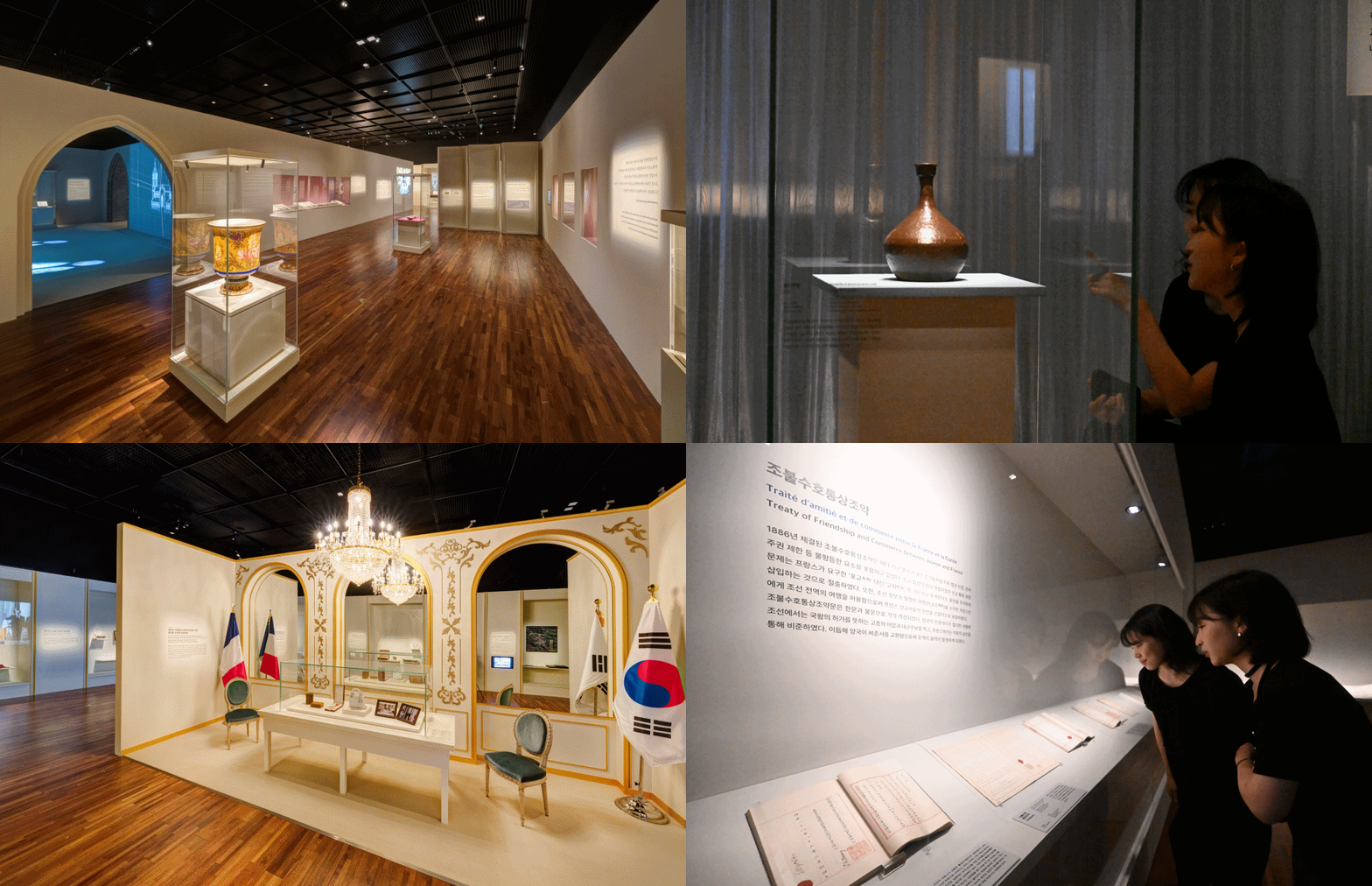
Items on display in exhibition "Gifts and Records: 140 Years of Korea-France Friendship" at National Palace Museum of Korea (Korea Heritage Service)
Another exhibition featuring the deep friendship and diplomatic history between both countries is at the National Palace Museum of Korea within Gyeongbokgung Palace in Seoul's Jongno-gu District.
"Gifts and Archives: 140 Year of France-Korean Friendship," through Aug. 2 shows gifts and letters exchanged between the leaders of both countries, dating back to the 1886 signing of the bilateral treaty.
On display are artifacts ranging from the original copy of the treaty as well as a Korean-French dictionary, the first modern edition compiled by missionaries at MEP, or the Paris Foreign Missions Society.
Other highlights include the painted white porcelain vase Salamina, which President Carnot gifted to Gojong, as well as the latter's presents of Goryeo celadon, banhwa and books.
Shown for the first time in Korea at the event is an onggi (earthenware pottery) jug presented to French diplomat Charles de Montigny, who visited Joseon in 1851, before the establishment of diplomatic relations. He met Joseon officials after the rescue of the crew of the French whaling ship Narval, which drifted ashore on Bigeumdo Island in Sinan-gun County, Jeollanam-do Province.
Other items include silverware, ceramics and small tables exchanged between the leaders of both sides since the founding of the Republic of Korea in 1948. They include mother-of-pearl lacquer boxes and inlaid celadon given by Roh Tae-woo and Kim Young-sam of Korea to Francois Mitterrand, tracing the development of bilateral ties in the modern era.
Lectures for adults and educational programs for elementary school students will also be held over the exhibition period. After its run at the museum ends on Aug. 2, the event will be moved to the Presidential Archives from Aug. 14 to Sept. 13.
caudouin@korea.kr