- 한국어
- English
- 日本語
- 中文
- العربية
- Español
- Français
- Deutsch
- Pусский
- Tiếng Việt
- Indonesian
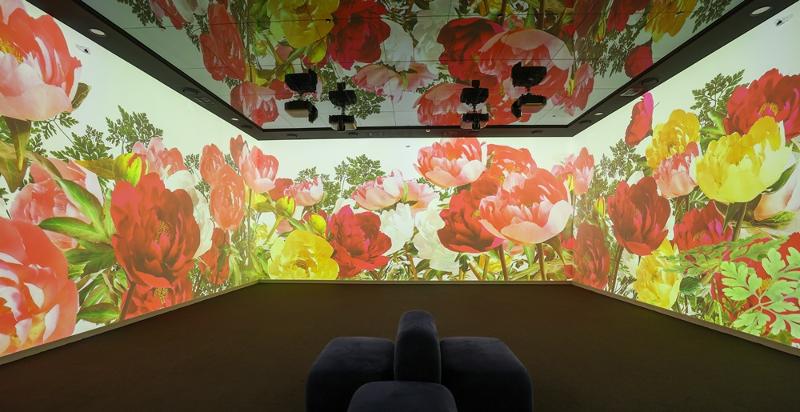
This media art piece shows peonies, which in traditional art symbolized wealth and prosperity, at the open cultural space Cheongwadae Sarangchae of Cheong Wa Dae in Seoul.
By Lee Jihae
Photos = Park Dae Jin
An exhibition that reinterprets traditional culture and the appeal of provincial regions through digital content offers a new immersive experience.
Hosted by the Ministry of Culture, Sports and Tourism at the open cultural space Cheongwadae Sarangchae in Seoul, "Full of Colors: Regions Shaping K" sheds new light on traditional culture through graphics, media art and interactive content.
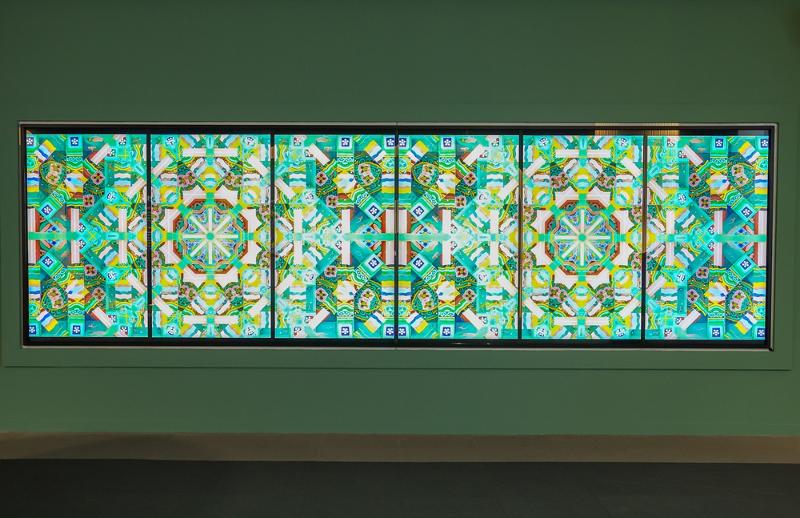
Artist Koo Bohnchang’s "Korea Fantasy is a contemporary reinterpretation of dancheong, a traditional decorative technique for wooden buildings and artifacts.
Artist Koo Bohnchang’s "Korea Fantasy" is an immediate eye-grabber as a contemporary reinterpretation of dancheong, a traditional decorative technique that applies colorful patterns and motifs on wooden buildings that are associated with the state or religion like royal palaces, Buddhist temples and government offices.
The geometric patterns filling the screen, like a kaleidoscope of symmetrical glass fragments, show the vibrant colors and luminous harmony unique to dancheong. The continuously expanding and repeating images evoke a dynamic sensation as if the traditional patterns were alive.
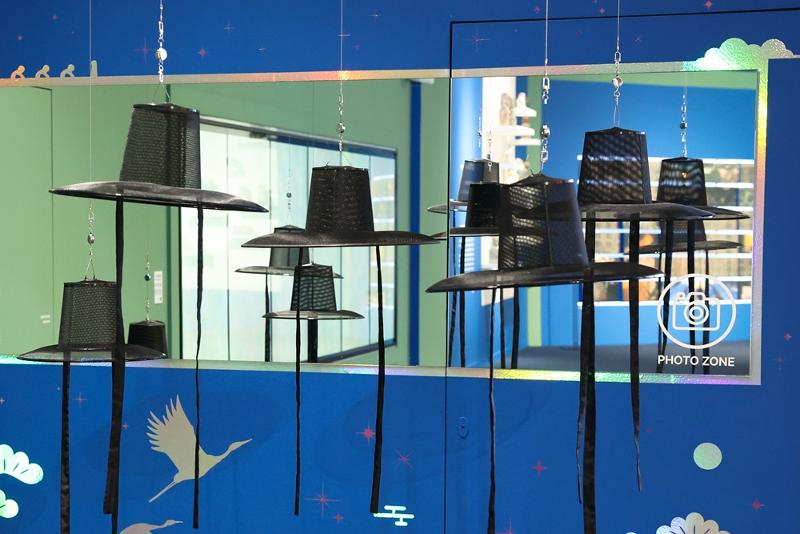
This photo zone allows visitors to take photos of themselves wearing a gat, a traditional hat for male aristocats during the Joseon Dynasty (1392-1910), at the open cultural space Cheongwadae Sarangche of Cheong Wa Dae in Seoul.
A photo zone allows visitors to snap themselves wearing a gat, a traditional hat for male aristocrats that symbolized the status of the yangban (ruling elite) during the Joseon Dynasty (1392-1910).
Women, children and slaves were prohibited from wearing this hat, which was the exclusive domain of the male yangban. The hat was made by assembling two parts -- daewu, the cylindrical component going high above the crown, and yangtae, the round brim.
Both parts were initially made of bamboo but as time passed, horsehair -- more specifically, the mane or tail hair -- was used to make daewu. This was because the doorways of Joseon homes were low, causing the bamboo daewu to get damaged when people entered or left rooms. Horsehair was lighter than bamboo with high elasticity, making it more durable.
Use of the gat began to decline after the Short Hair Edict, a royal decree in 1895 that abolished the traditional topknot hairstyle and required men to cut their hair short.
The hat's global popularity has recently surged after appearing in Korean content such as the animated blockbuster "KPop Demon Hunters" (2025) and the historical zombie thriller "Kingdom" (2021).
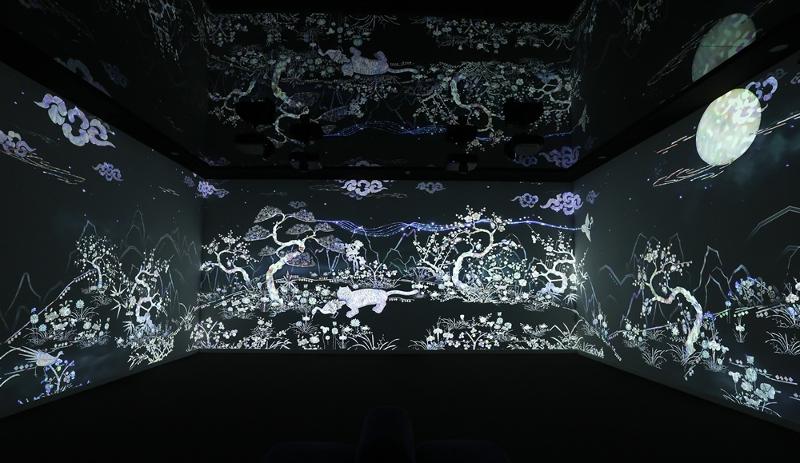
Media art reinterpretation of traditional najeonchilgi (mother-of-peal lacquerware)
A media art piece reinterprets traditional najeonchilgi (mother-of-pearl lacquerware) with a contemporary sensibility, bringing motifs such as tigers and the Ten Symbols of Longevity to life.
Five videos shown at the media art gallery feature traditional culture. The one that stands out most is inspired by najeonchilgi, a traditional craft technique in which thin pieces of iridescent shell, typically from abalone or pearl oysters, are inlaid on a lacquered surface.
First, multiple coats of natural lacquer made from the sap of the lacquer tree are applied to a wooden box or piece of furniture to create a glossy black base. Delicately cut pieces of seashell are then arranged as intricate designs such as flowers, cranes or dragons and laid on the surface.
Finally, additional layers of lacquer are applied to complete the work.
Cheongwadae Saranchae depicts the recreation of mother-of-pearl's shimmering colors through media art against a background of jet-black lacquer. The mother-of-pearl designs shine with slightly different colors depending on angle of light, and images of tigers, deer and cranes moving and leaping add a sense of vitality and energy.
A series of videos featuring intangible cultural heritage and landmarks from across the nation are also displayed.
Running through Dec. 31, the exhibition is open daily from 9 a.m. to 6 p.m. except Tuesdays. Admission is free to the public and requires no reservation.
jihlee08@korea.kr