Korean culture has transcended being a passing fad and evolved into part of daily life worldwide. In this five-part series, Korea.net examines the factors behind the global popularity of Korean content in music, cinema, food, beauty and literature and explores Hallyu's (Korean Wave) sustainable future and strategies for sustainable growth as well as analyzing the phenomenon.
By Aisylu Akhmetzianova
"The moment the concert began, a shiver ran through my whole body. The one thought in my mind was 'Can I really see them in person now? I've waited six years for this moment.'"
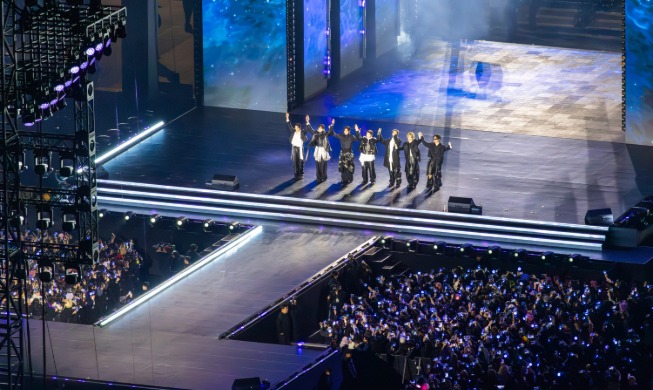
Elena Zhuravleva, a Russian woman in her 40s, traveled for three days to arrive in Korea for BTS' "Arirang" world tour concert on April 11 in Goyang, Gyeonggi-do Province. Buying a ticket was not easy due to international sanctions on her country, but she said she endured everything to see the K-pop supernova in person.

BTS on May 25 wins Artist of the Year at the American Music Awards (AMA) at the MGM Grand Garden Arena in Las Vegas. (AMA's official Facebook page)
Juliane Tomin Rusa, a Brazilian in her 20s, had a similar experience. On June 3, she traveled from Geneva to London to attend a concert of the K-pop girl group TWICE.
"I had already been to a TWICE concert in Brazil, and it was one of the best concerts of my life, so I had very high expectations for the London concert as well, and they exceeded them," she said.
These two are not isolated cases. The Korea Foundation in a 2023 Hallyu (Korean Wave) report said the number of Hallyu fans worldwide surpassed 200 million.
Seven of the world's top 10 bestselling albums last year were by K-pop acts, who also earned 11 honors at the American Music Awards (AMA) on May 25 in Las Vegas.

This is a scene from the girl group TWICE's sixth world tour "This is For" at the O2 Arena in London from June 3-4. (TWICE's official Facebook page)
Topping global music charts like Billboard and Spotify is now standard rather than surprising for K-pop.
The genre is no longer a niche for the few but rather a global cultural phenomenon unrestricted by culture or language. So how did K-pop captivate hearts around the world?
"Above all, the most important factor is that K-pop has become an alternative culture that transcends Western pop culture," said Kim Taeryong, an assistant professor of Christian cultural content at Baekseok University in Cheonan, Chungcheongnam-do Province.
"K-pop has grown into a cultural platform allowing fans worldwide to redefine their identities and connect with various cultures."
On why she became a BTS fan, Zhuravleva said, "I discovered BTS in 2020, the hardest year of my life. When you face hardship and injustice day after day in a world full of cruelty and violence, you desperately yearn for someone who can make you believe in a better future. At the end of the day, people need other people and BTS is exactly that for Army (BTS' fan community)."
K-pop's appeal is far more than just music and performances, as the ways artists interact with fans are main drivers of their global popularity. K-pop acts share not only their on-stage personas but also their everyday lives through platforms like social media, variety shows and YouTube livestreams.
Such communication creates a sense of closeness and solidarity with fans, strengthening the fan base.

K-pop boy band TNX on June 19, 2025, sign autographs at the Korean content gala MyK Festa at SK Olympic Handball Gymnasium of Olympic Park in Seoul's Songpa-gu District. (Ministry of Culture, Sports and Tourism) )
"It's highly likely that K-pop will keep wielding global influence," Kim said. "But K-pop is no longer just Korean content but a global culture enjoyed and reinterpreted by people worldwide."
"It's important to keep expanding our openness and creativity through constant cultural exchange with other countries, thus enriching one another."
aisylu@korea.kr