- 한국어
- English
- 日本語
- 中文
- العربية
- Español
- Français
- Deutsch
- Pусский
- Tiếng Việt
- Indonesian
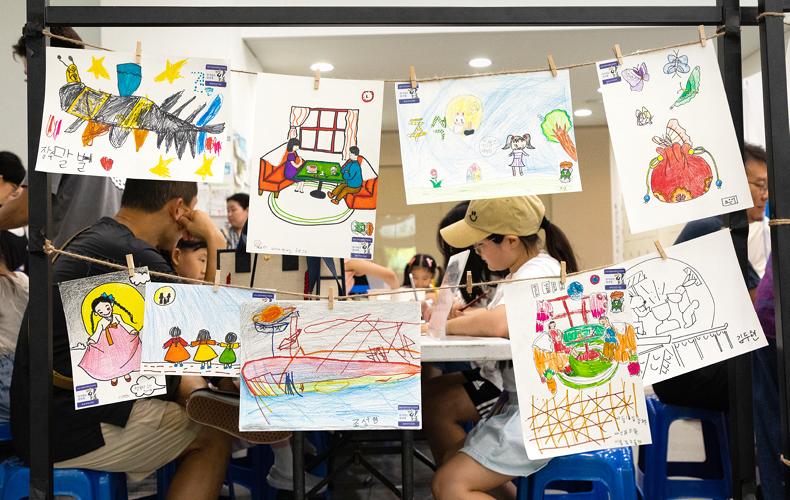
This is a scene from the program "Drawing Chuseok Scenes" held on Sept. 16 and 18, 2024, as part of the event "Be a Hipster in Hangawi!" at the National Folk Museum of Korea in Seoul's Jongno-gu District. (National Folk Museum of Korea)
By Lee Ji Yae
Chuseok (Korean Thanksgiving), one of Korea's two major holidays, is a traditional time when families gather to celebrate the year's harvest. Today, this continues in new ways like relatives living nearby sharing meals or traveling over the break.
For this year's edition, museums nationwide offer a variety of programs featuring the themes of the holiday like traditional games, crafts and performing arts.
The activities and events blend traditional culture with modernity. The following are Chuseok programs at the National Folk Museum of Korea, Daegu National Museum, Jeonju National Museum and Cheongju National Museum.
The folk museum from Sept. 26-27 will host the festival "Together for Chuseok" at its main building lobby and front courtyard and Children's Museum Outdoor Playground in Seoul and its branch in Paju, Gyeonggi-do Province. Visitors can experience programs promoting the spirit of Chuseok with a modern twist.
The activities include relay-style traditional games for families and craft workshops. A ssireum (traditional wrestling) class will be held in collaboration with the Korean Ssireum Association, along with a Chuseok ssireum tournament open to both adults and children.
Other events span making soap shaped like songpyeon, or rice cakes shaped like a half moon, and decorating gold-colored metal bookmarks with bead ornaments. Another lets participants create their own keycap keychains using a variety of Chuseok-themed parts.
The Paju branch will host tours of its storage facilities featuring Chuseok ancestral rites and cheonshingut, a shamanic ritual to give thanks for a harvest. Visitors can also compare Korean holiday traditions with those of other countries through a guided tour of the "Happy Onam" exhibition of India's regional festival Onam.
More information on the event is on the museum's website (www.nfm.go.kr) and that of the Paju branch (www.nfm.go.kr/paju/). Both are in Korean only.
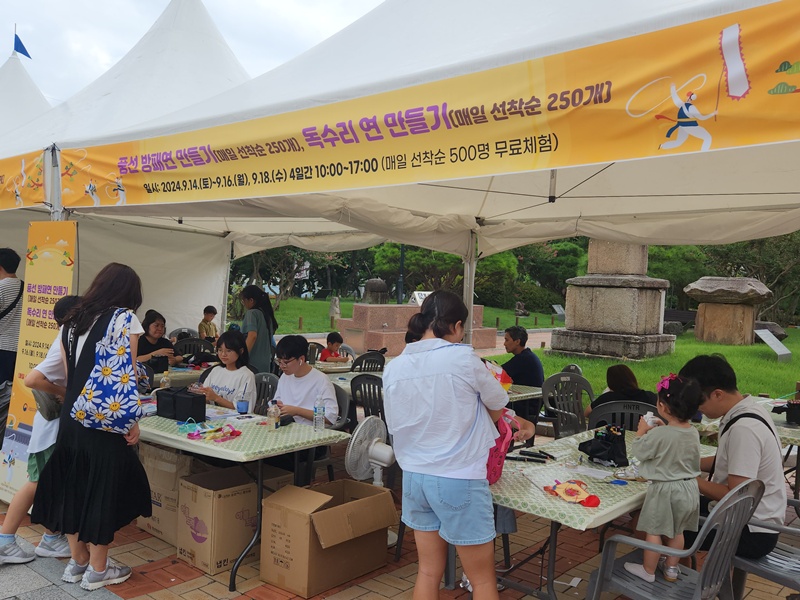
This is a scene from a program for making balloon shield and eagle kites from Sept. 14-16 and 18, 2024, as part of a Chuseok cultural event at Daegu National Museum in Daegu's Suseong-gu District. (Daegu National Museum)
Daegu National Museum in the nation's No. 4 city Daegu will hold Chuseok events on Sept. 24, 26 and 27 at the courtyard of Haesol Hall and Central Plaza. The numerous activities will include craft workshops for traditional folk paintings and unique performing arts.
Visitors can make ddakji, or paper tiles used in the traditional flipping game of the same name, using traditional folk paintings or decorate a jakho-do (tiger-and-magpie painting) bag charm. Other activities combine traditional materials and craft techniques with modern ideas including making kites with character designs or mother-of-pearl inlaid soban (traditional portable table).
Each activity is free and open to the first 500 participants each day during the event.
The lineup also includes "My Dream" from "The Happening Show" and "Rainbow Show," the country's largest diabolo performance, referring to a theatrical or acrobatic routine featuring spinning, tossing and catching the eponymous skill toy often called the Chinese yo-yo using a string tied to two hand sticks.
The schedules and locations of events are on the Daegu museum's website (https://daegu.museum.go.kr/kor/index.do) in Korean only.
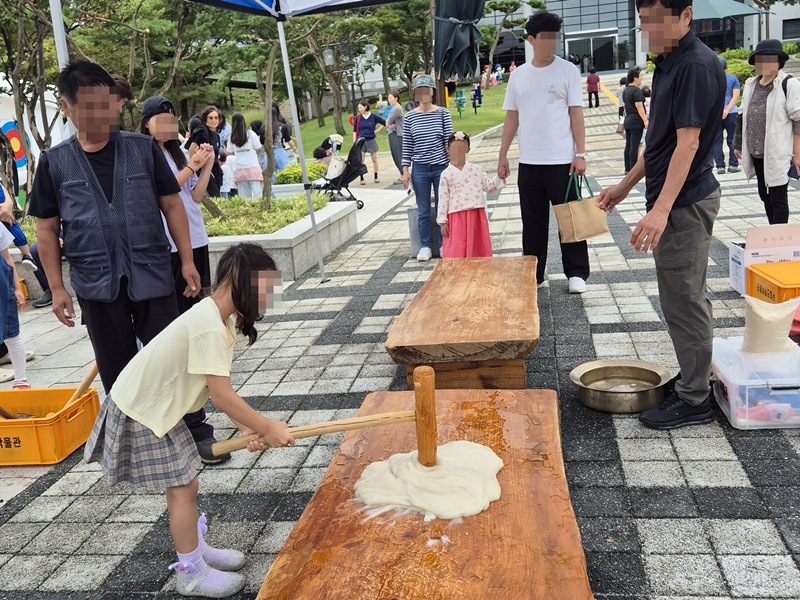
A girl pounds steamed rice for making tteok (rice cake) at a Chuseok cultural event from Oct. 3-7, 2025, at Jeonju National Museum in Jeonju, Jeollabuk-do Province. (Jeonju National Museum)
From Sept. 24-27, Jeonju National Museum in Jeonju, Jeollabuk-do Province, will host the event Chuseok Hangawi Traditional Folk Play Yard at its outdoor courtyard. Aspects of the holiday's culture will be featured through traditional folk games, hands-on activities with old household tools and Chuseok food making.
Visitors can write wishes and hang them on a wishing tree and try folk games such as yunnori (traditional board game), kite flying, jegichagi (shuttlecock kicking) and tuho (pitch pot). They can also revisit childhood memories by playing ddakji and gonggi (jacks) or try using traditional tools such as a millstone, wooden back carrier and mortar.
The food-making program focuses on traditional holiday favorites such as songpyeon and the traditional sweet treat oranda. Performances by percussion arts groups Arihyang and Samatdi will add to the festive atmosphere.
More information on the programs and schedule is on the Jeonju museum's website (https://jeonju.museum.go.kr/korean/) in Korean only.
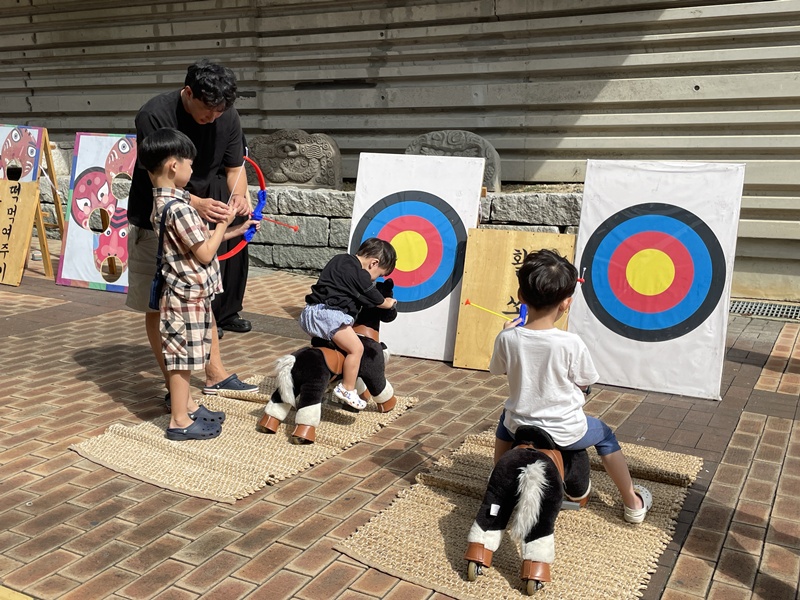
Children try traditional archery at the folk games area of a Chuseok event from Sept. 14-15, 2024, at Cheongju National Museum in Cheongju, Chungcheongbuk-do Province. (Cheongju National Museum)
Cheongju National Museum in Cheongju, Chungcheongbuk-do Province, will host its Chuseok Hanmadang (Festival) from Sept. 26-27 throughout its complex.
The museum's website is accepting reservations until Sept. 22 for activity kits to make traditional flower gangjeong, or fried glutinous nut crackers with edible flowers, and learning to set a traditional table for Chuseok ancestral rituals.
Traditional games such as tuho and archery will be held at the courtyard in front of Cheongmyeonggwan Hall. Sept. 27 will have a performance of traditional farmers' percussion music, aka nongak, by a Cheongju-based troupe and the comedic traditional play "The Farting Daughter-in-Law" at the hall.
The museum's official Instagram account is also hosting a comment event featuring a quiz on Hanja (Chinese script) idioms related to Chuseok.
More information is on the museum's site (https://cheongju.museum.go.kr/www/index.do) in Korean and its official Instagram page (@cj.museum.kr).
Other details on Chuseok programs at the country's 13 national museums is on the National Museum of Korea's site (https://www.museum.go.kr/MUSEUM/main/index.do).
ljyhwa@korea.kr