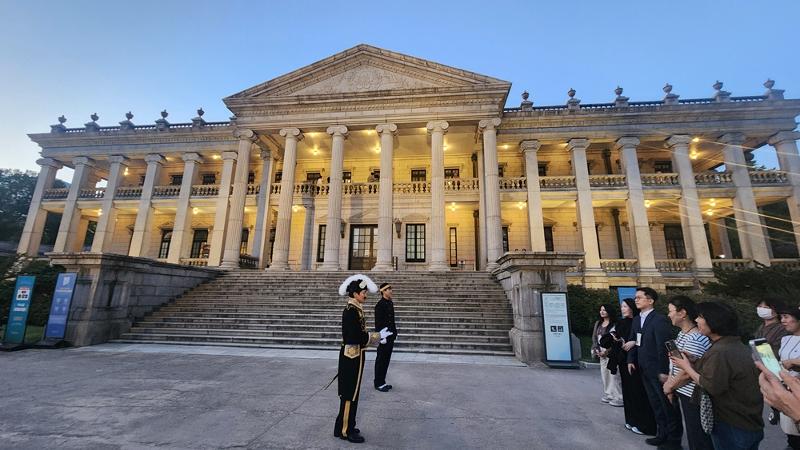
A staff member on Sept. 16 dressed in a military uniform from the Korean Empire (1897-1910) era guides visitors at the tour "Night of Seokjojeon at Deoksugung Palace" at Deoksugung Palace in Seoul. (Lee Jihae)
By Lee Jihae
As night descends, buildings in Seoul light up to show their presence in the darkness.
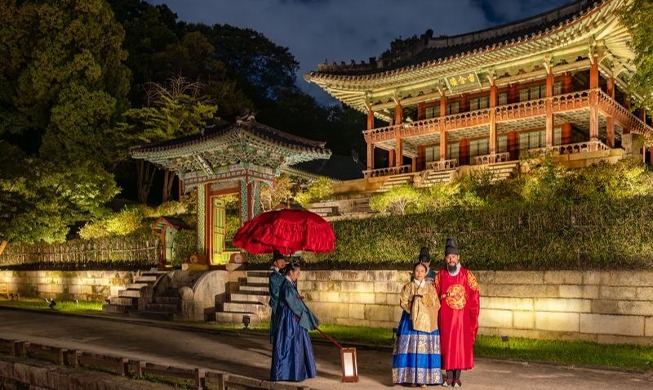
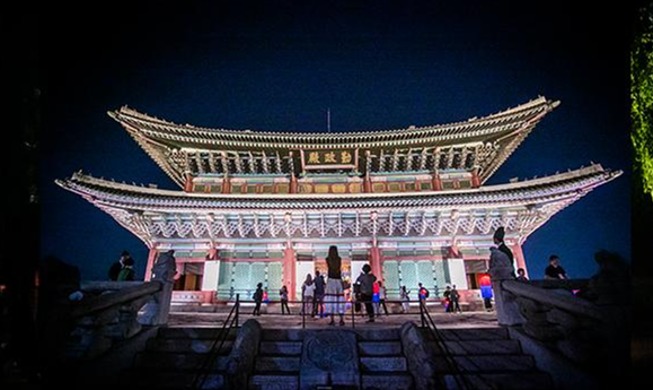
Deoksugung Palace in Jung-gu District is no exception. The buildings within the compound are illuminated by soft lighting, highlighting their evening beauty and attracting visitors.
While each structure has its own charm, the true eye-catcher is Seokjojeon Hall with its imposing scale. Korea.net on Sept. 16 went on the tour "Night of Seokjojeon at Deoksugung Palace."
The program allows visitors to explore Deoksugung, one of Seoul's four major palaces, in the evening. Held once in the first half of the year and once in the second, it accommodates 18 participants per 100-minute session three times a day, with a daily cap of 54 visitors.
Visitors entered Seokjojeon in the evening, explored its interior with a guide, had tea and snacks, and watched a short musical portraying Emperor Gojong's vision for the independent modernization of the Korean Empire (1897-1910).
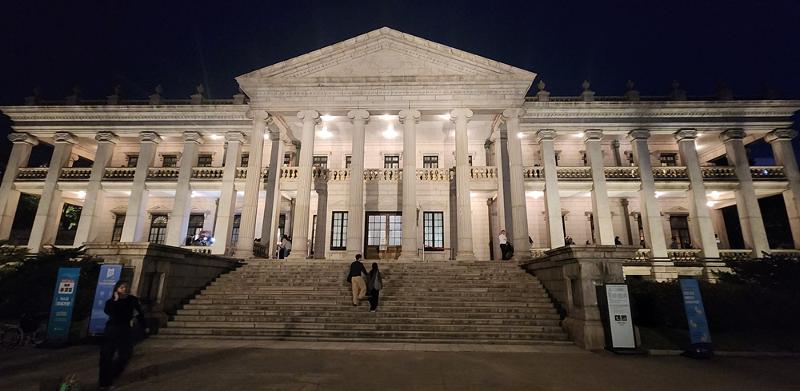
Evening view of Seokjojeon Hall (Lee Jihae)
While the building is beautiful by day, its illuminated facade gives off a more exquisite charm after dark. Its construction in the Neoclassical style was inspired by the architecture of ancient Greece and Rome.
Its symmetrical design, with balanced proportions on either side, and the six Ionic columns arranged at the center punctuate the traits of Neoclassical architecture. Once darkness fell and the building was illuminated, these architectural details stood out more vividly.
Construction began in 1900 and was completed in 1910. Seokjojeon was supposed to serve as the central hall for the emperor to conduct official business and preside over major national ceremonies.
Japan annexed Korea in 1910, the year of the building's completion, so it could not be used for its original purpose. From 1911-22, Seokjojeon was occasionally used as a residence for Crown Prince Yeong when he visited Korea while forced to study in Japan.
During the Japanese colonial period (1910-45), the building was converted into an art museum. From 1946-47 after liberation, it hosted the U.S.-USSR Joint Commission, where Washington and Moscow discussed the governance of the Korean Peninsula.
Later used as a museum, Seokjojeon underwent restoration work from 2009-14. Today, it largely resembles its original appearance at the time of its completion in 1910.
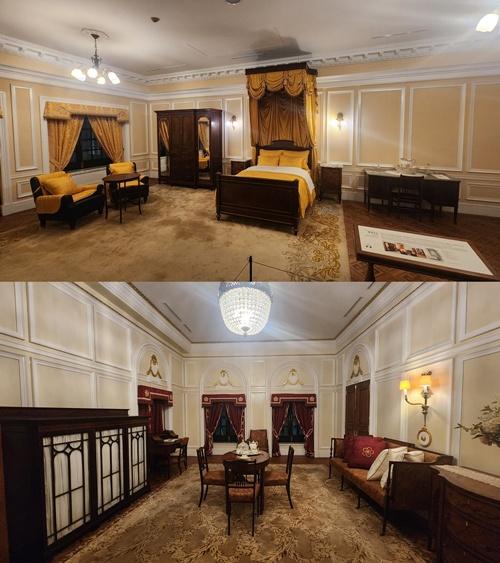
Emperor's bedroom (top) and empress' boudoir (Lee Jihae)
Visitors entered Seokjojeon and toured the VIP waiting room, emperor's bedroom, and the empress's sitting room and bedroom. Patterns featuring the plum blossom, a motif that symbolizes the Yi royal family of the Joseon Dynasty (1392-1910) and the empire, adorned the pillows and parts of the interior.
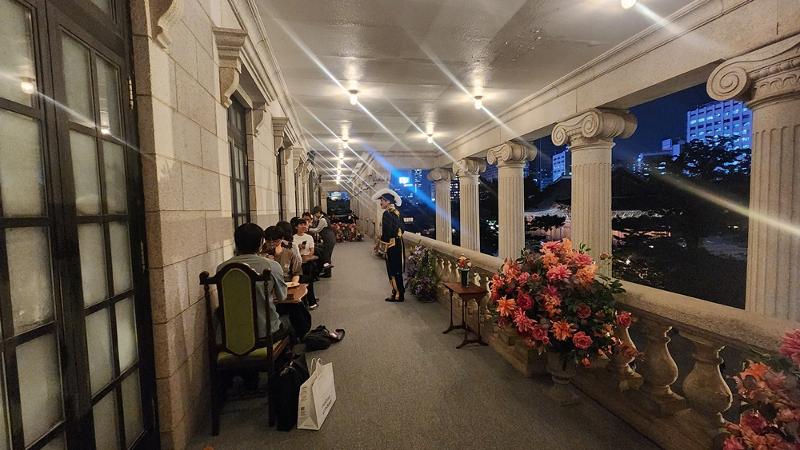
A staff member dressed in a Korean Empire military uniform on Sept. 16 greets visitors while they have drinks and snacks against the backdrop of the evening view from the second-floor terrace of Seokjojeon Hall at Deoksugung Palace in Seoul. (Lee Jihae)
After the guided tour, visitors had desserts against the backdrop of the beautiful night view from the second-floor terrace of Seokjojeon. Their treats included castella cake decorated with plum blossom patterns, chocolate butter cookies and mini lemon pound cakes.
The beverage selection spanned coffee, the traditional tea gambicha, which is made with adlay millet, buckwheat, tangerine peel and mulberry leaves, and sangsimjacha (mulberry tea). Coffee, which at the time was called yangtangguk, meaning "Western-style soup" in reference to its introduction from the West, was known as one of Gojong's favorite drinks.
While visitors ate, a staff member moved between tables to greet guests. He wore a dark-colored uniform with gold trim and a feathered hat, a typical military uniform worn during the empire era.
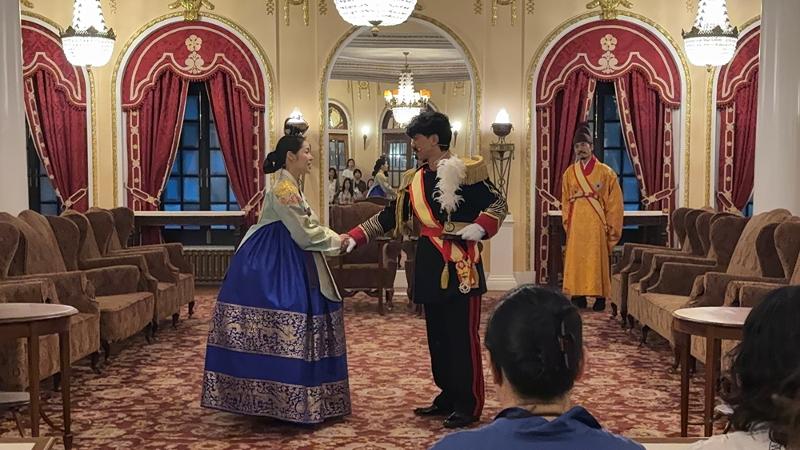
A short musical on Sept. 16 is held at the reception room of Seokjojeon Hall at Deoksugung Palace in Seoul's Jung-gu District. (Royal Palaces and Tombs Center)
Visitors later watched the short musical "A Night at Seokjojeon" at the first-floor reception room. Designed specifically as a space for meeting with the emperor, the room is the most lavishly decorated in the building.
The tour is held once in the first half and once in the second every year, with this year's second-half program to run through Oct. 18. Visitors are selected randomly after applying on Ticketlink (www.ticketlink.co.kr).
The event is open to visitors age 7 or over.
A separate session with commentary in English is held annually in the first half of the year on a first-come, first-served basis via a booking site for foreign visitors. Reservations open about a month before the event.
Like with the Korean-language program, a foreign visitor can purchase up to two tickets at the same price of KRW 35,000 each.
jihlee08@korea.kr