- 한국어
- English
- 日本語
- 中文
- العربية
- Español
- Français
- Deutsch
- Pусский
- Tiếng Việt
- Indonesian
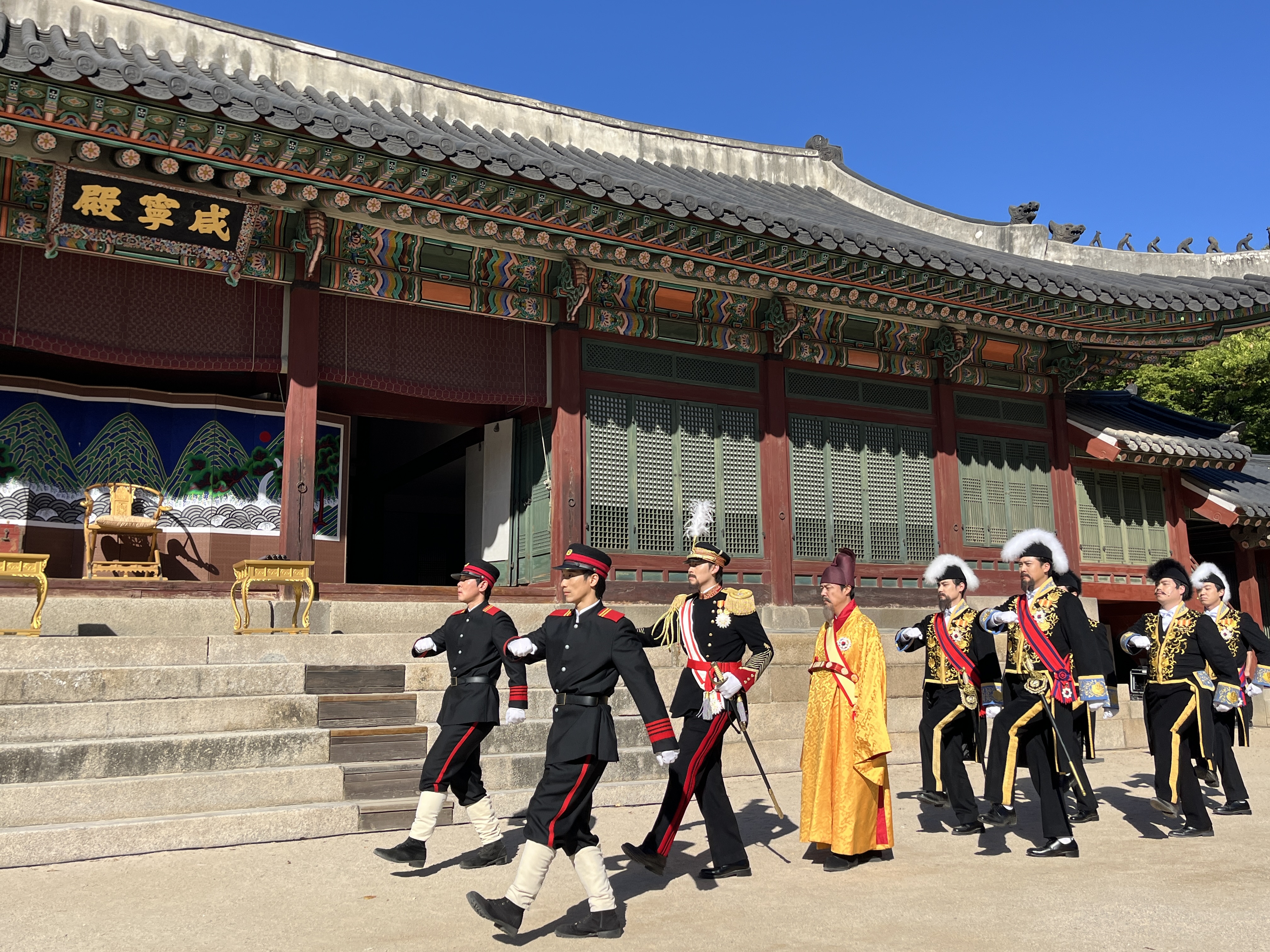
An actor portraying Emperor Gojong (fourth from left) enters Hamnyeongjeon Hall accompanied by officials and soldiers, moving slowly to the rhythm of the gentle background music.
By Oh Jung Eun
Deoksugung Palace in Seoul, which was packed with autumn visitors, on Oct. 2 brought visitors back to the scene of intense diplomatic negotiations of the Korean Empire 125 years ago.
"The Diplomatic Reception for Envoys to the Korean Empire," a reenactment of Emperor Gojong's event for foreign ambassadors, has been held every fall since 2010.
This year's event marked the 140th anniversary of diplomatic relations with France. Set in 1901, it featured Victor Collin de Plancy, the first French minister to Korea, and British Charge d'Affaires John Harington Gubbins.
At the time, the Korean Empire was shifting from assigning one minister to multiple countries to appointing separate ministers to the U.K., France and Germany to strengthen its diplomatic presence. For this, maintaining close ties with foreign diplomats in Korea was of paramount importance.
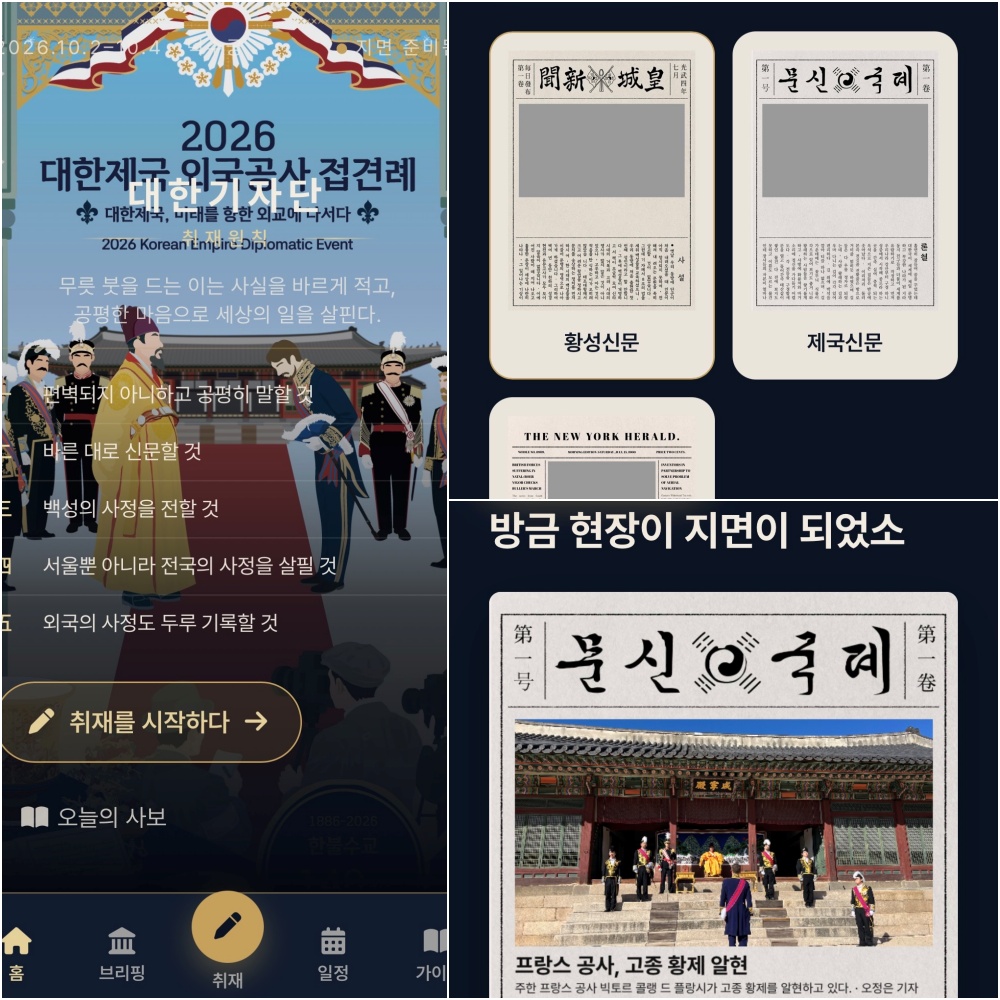
An app allows visitors to select a page from a newspaper from the Korean Empire era, insert their photos and create an article.
Visitors assumed the role of the Korean Press Corps, wearing media armbands and carrying reporter notebooks, pens and an app to cover the event.
At Hamnyeongjeon Hall, foreign envoys paid their respects to Gojong by bowing three times at the waist rather than perform a prostration. This likely reflected an effort to show consideration of the diplomats while observing traditional Korean etiquette.
Afterward, the diplomats held in-depth talks at Jeonggwanheon Pavilion, joined by Hyun Sang-geon, who was fluent in French and handled diplomatic affairs, and Lee Han-eung, a diplomat scheduled to accompany to England Min Young-dong, the empire's minister to the U.K.
The situation reflected the competing interests of world powers surrounding the Korean Empire. France, an ally of Russia, sought a balance of power in East Asia to prevent one country from dominating the peninsula. Britain forged closer ties with Japan for fear of Russia's eastward expansion.
Caught between these powers, the empire sought to remain neutral and independent.
"I heard it takes two to three months to reach Britain," Lee said. "The purpose of this long journey is to convey the Korean Empire's position directly without intermediaries, as well as gain firsthand insight into the situation in Britain and Europe."
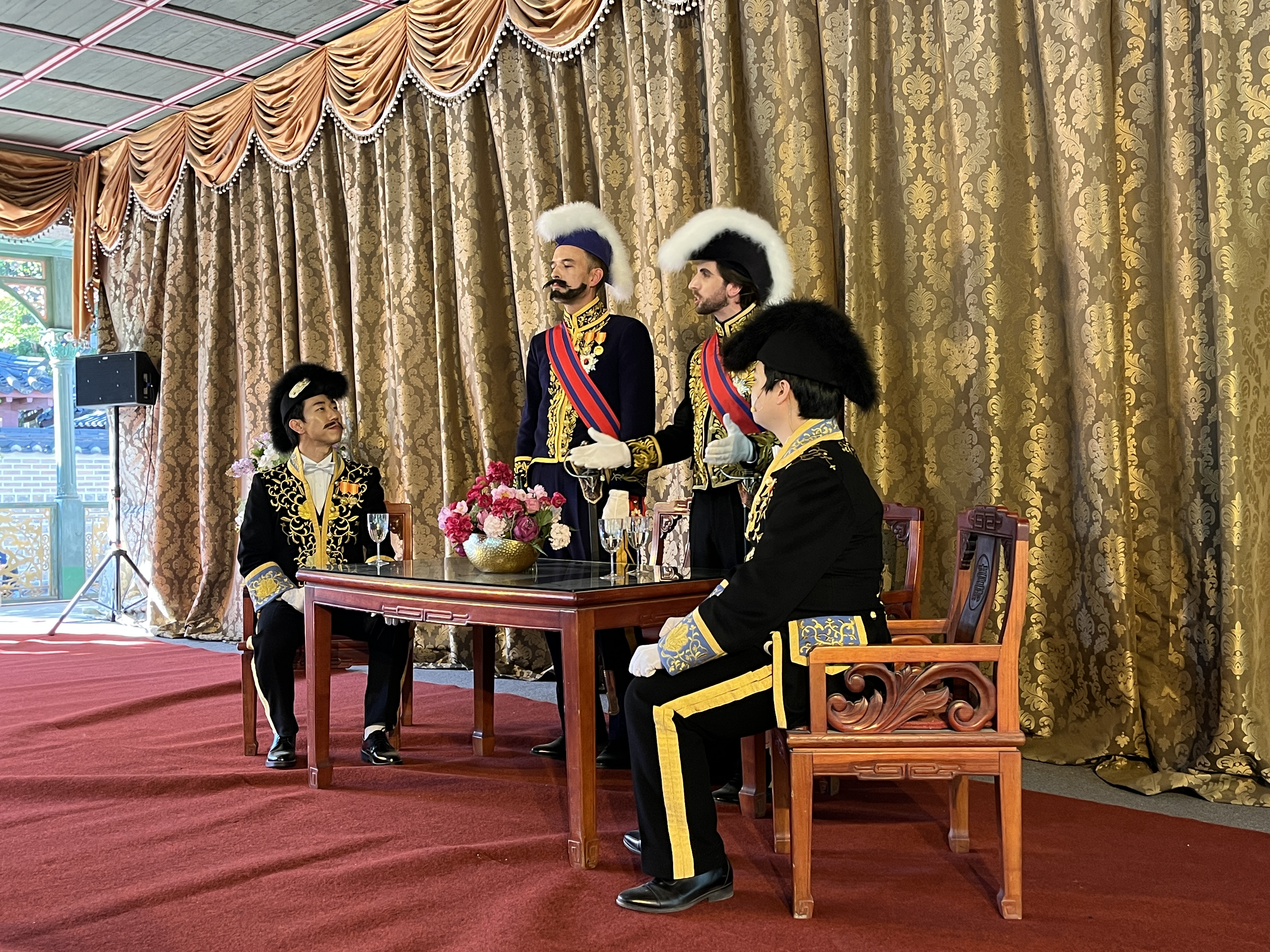
From left are actors portraying Hyun Sang-geon, a diplomat and closer adviser to Emperor Gojong fluent in French; French Minister Victor Collin de Plancy; British Charge d'Affaires John Harington Gubbins; and empire diplomat Lee Han-eung at Jeonggwanheon Pavilion of Deoksugung Palace in Seoul.
The event also highlighted cultural exchanges between the Korean Empire and France. In 1888, French President Sadi Carnot presented Gojong with Sevres porcelain and received in return banhwa, an artisanal craft made from wood, metal and gemstones.
With a deep appreciation for porcelain, de Plancy played a major role in such exchanges. He collected an estimated 2,000 cultural artifacts during his time in Korea.
He exhibited his collection of ceramics at the 1900 World Fair in Paris, alongside the second volume of the Jikji Simche Yojeol (Anthology of Great Buddhist Priests' Zen Teachings). The latter was later presented in 1972 at a Paris exhibition marking International Book Year and officially gained recognition as the world's oldest surviving work printed with movable metal type, predating the Gutenberg Bible of Germany by 78 years.
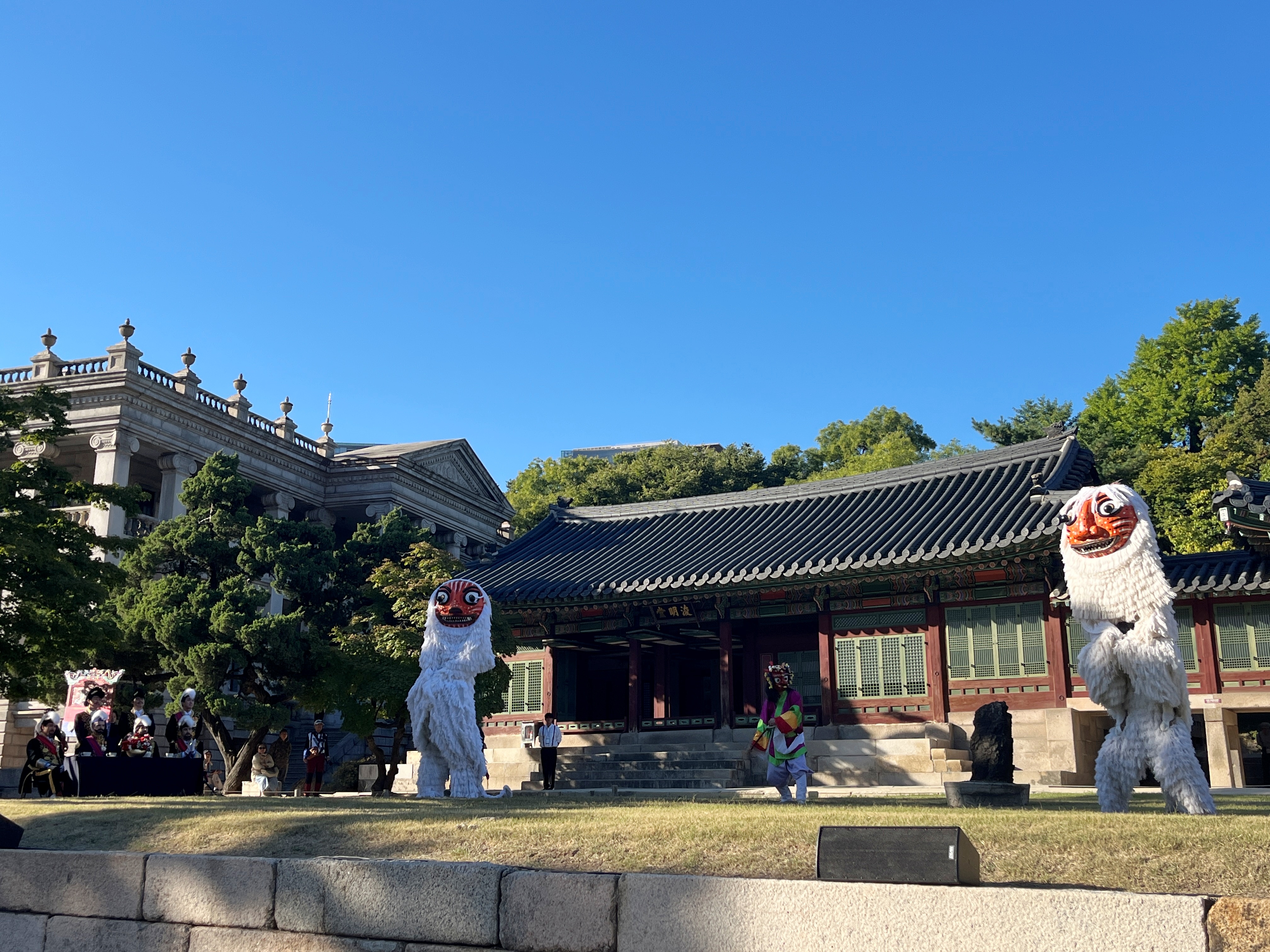
Reenactment of lion dance at courtyard in front of Jikjodang and Junmyeongdang halls at Deoksugung Palace
After the ceremony, a lavish banquet in the courtyards was held at the courtyards in front of the halls Jikjodang and Junmyeongdang. The event opened with a performance by the empire's military band, followed by royal sword and lion dances and pogurak, a traditional court performance combining dance and ball play.
The lion dance elicited the biggest response from the audience. Each time the lions leaped into the air, spectators joined in rhythm by chanting of "Eolssu!" (Woo-hoo).
Visitor Im Seong-eun said, "It felt like stepping into history."
"Wearing a reporter's armband and writing articles in real time made it even more immersive," another participant Kang Buhee said. "The play was easy to understand though I don't know much about what happened at the time, and I enjoyed the performances ranging from music to dance."
As Gubbins once said, "Behind every nation's proclamations of peace and order lie the interests of the great powers."
Amid the competing interests of the great powers, the Korean Empire sought its own diplomatic path toward neutrality and independence. That chapter of history lives on 125 years later at Deoksugung.
cloveroh@korea.kr