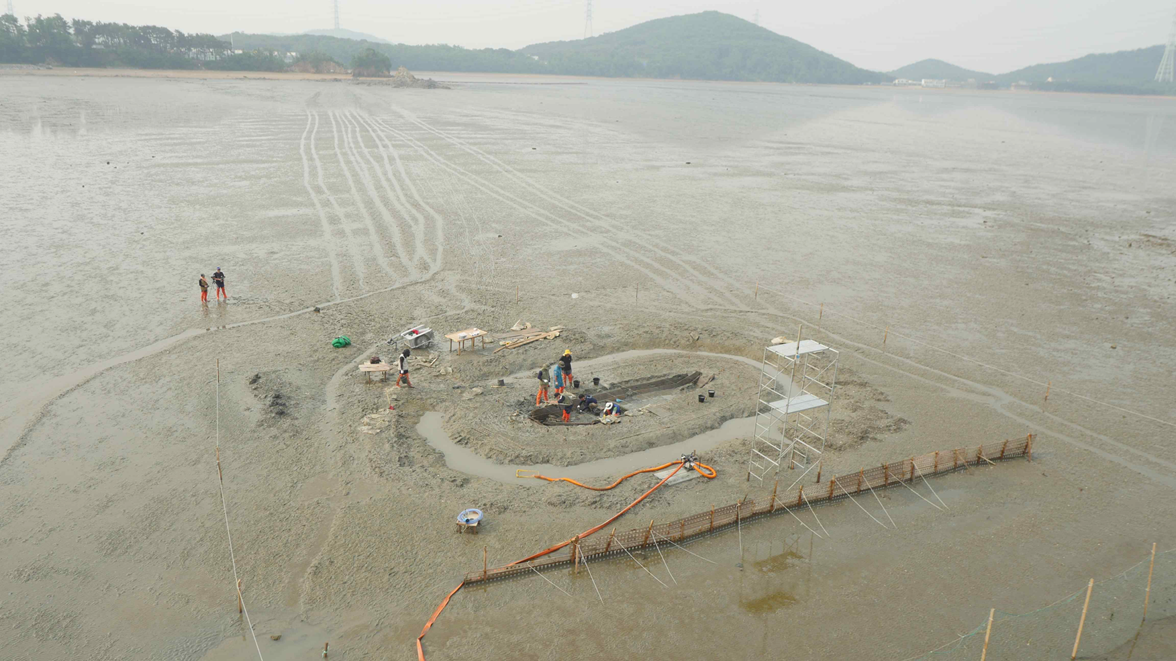
This is the excavation site of the shipwreck of the Daebudo Vessel No. 2 in July 2015 in waters near Bangameori Beach on Daebudo Island off the coast of Ansan, Gyeonggi-do Province. (National Research Institute of Maritime Cultural Heritage)
By Charles Audouin
Underwater archaeology in the country, which began off the coast of Sinan-gun County, Jeollanam-do Province, in 1976, marks its 50th anniversary this year.
To mark the occasion, the Taean Maritime Museum in Taean-gun County, Chungcheongnam-do Province, will host from Nov. 26 through May 2 next year the exhibition "Time of the Sea, Records of Humanity: A Millennium of History Encountered in the Yellow Sea," featuring key underwater archaeological findings and related artifacts recovered from the central waters of the sea.
This display focuses on artifacts recovered from ships that sank off the coasts of Taean-gun and Ansan, Gyeonggi-do Province, during the Goryeo (918-1392) and Joseon (1392-1910) dynasties.
The relics reflect the goods that traveled the sea route a thousand years ago and the food habits of the time. Traces of Goryeo celadon, soybean paste, mussels, persimmon seeds and grains in jars are on display.
Ceramics with ink calligraphy and jars with ears produced during the Song and Yuan dynasties of China show the traits and scope of maritime trade in East Asia at the time.
Twenty-eight wooden and bamboo slips discovered in the shipwreck are also on display. Inscribed with text on wood or bamboo, the slips were tags with shipping information such as place of origin, recipient, and type and quantity of the goods, offering insights into the maritime logistics system of the time and the movement of people and commodities.
Conservation treatment was completed for 26 of these items, which are on display until Dec. 6.
Another highlight is the process of discovering underwater ruins and artifacts. An exhibition space for equipment used at excavation sites and a replica of the Nurian, a vessel for studying underwater archaeology, shows the procedures involved in underwater excavation.
In addition, the Mokpo Maritime Museum of the National Research Institute of Maritime Cultural Heritage in Mokpo, Jeollanam-do, is hosting an exhibition through Feb. 14 featuring jadanmok (red sandalwood) recovered from the Sinan shipwreck, which was the remains of a Chinese merchant vessel from the Goryeo period that sank off the coast of Sinan-gun in 1323.
The display explores the culture surrounding the premium, fragrant wood across East Asia spanning Korea, China and Japan by showcasing everyday objects and Buddhist artifacts crafted from this material, as well as the region's historical traditions involving incense.
caudouin@korea.kr