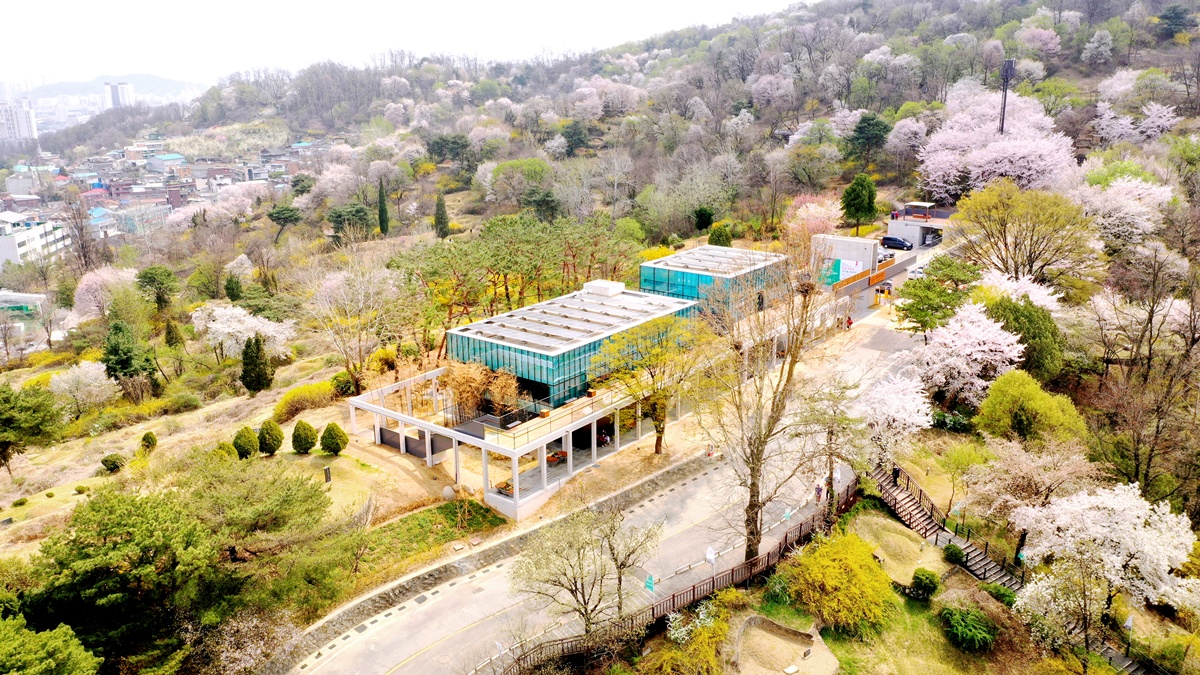
The exhibition "Memory Chest of the Korean Provisional Government" marking the 107th anniversary of the government-in-exile's launch is being held at Mang-U History and Culture Park in Seoul's Jungnang-gu District. (Mang-U History and Culture Park)
By Lee Jihae
The Korean Provisional Government (KPG) endured turbulent 27 years after its 1919 launch in Shanghai, China. An exhibition presents the government-in-exile's unwavering spirit throughout its fierce struggle for the nation's independence, awakening spring at Mang-U History and Culture Park in Seoul's Jungnang-gu District.
"Memory Chest of the Korean Provisional Government" is a multidimensional look at the strenuous journey taken by the KPG, Korea's first democratic regime, in its pursuit of national independence.
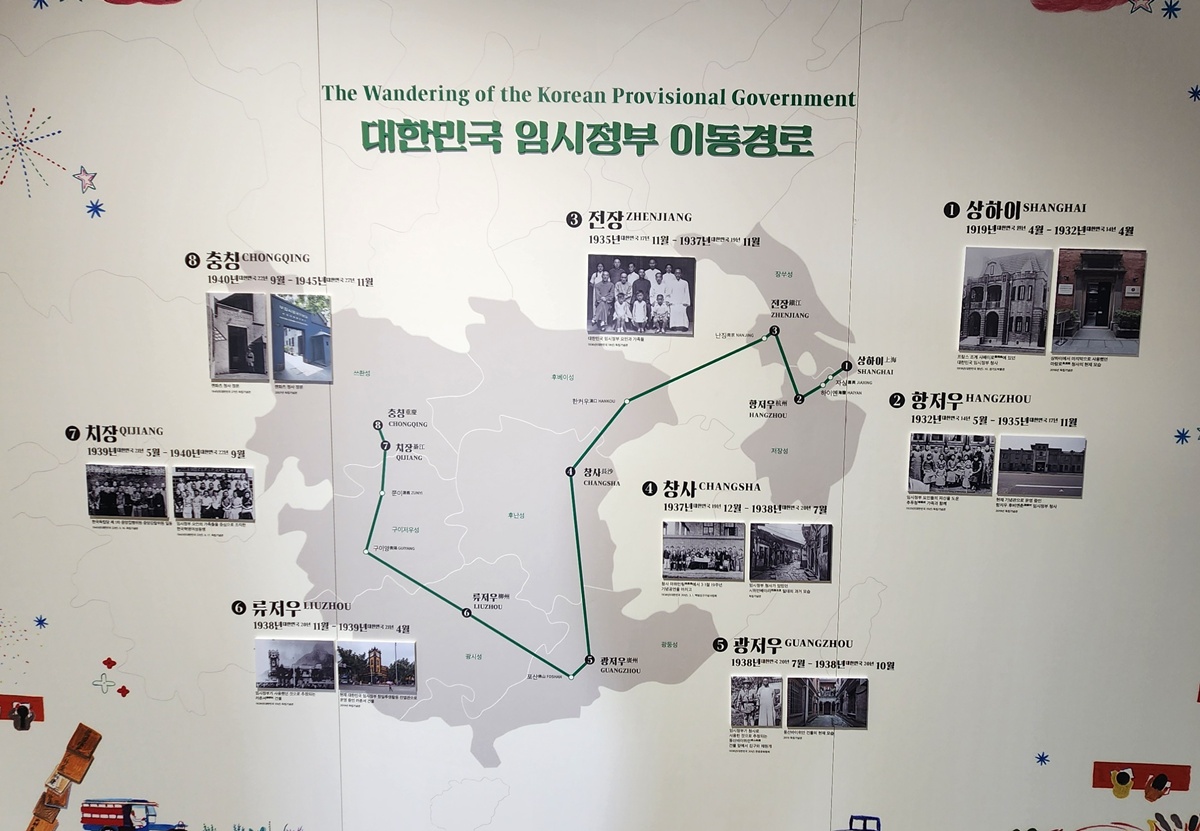
This display presents the 27-year journey of the Korean Provisional Government that endured financial difficulties and heavy surveillance from the Japanese colonial government, showing the routes and dates of the administration-in-exile in its eight locations from 1919-45. (Lee Jihae)
Through diverse visual materials, the exhibition reconstructs the path of the KPG from its launch on April 11, 1919, until liberation on Aug. 15, 1945.
The KPG was founded in the Shanghai French Concession because it was an area where expats lived and were exempt from Chinese law, a strategic stronghold where independence activities could be conducted without Japanese surveillance and repression. Shanghai was also an international hub with a huge global presence, making it a prime place to promote Korea's independence movement to the world.
After independence activist Yun Bong-gil threw a bomb at Japanese military leaders in 1932 at Hongkou Park (now Lu Xu Memorial and Gravesite) in Shanghai, imperial Japan intensified its crackdown on the KPG, leading the latter to relocate.
The outbreak of the Sino-Japanese War in 1937 and financial difficulties forced the government-in-exile to relocate seven times, ultimately settling in Chongqing to continue its struggle for independence.
There are currently memorial halls in Shanghai, Hangzhou and Chongqing, three of the KPG's former sites.
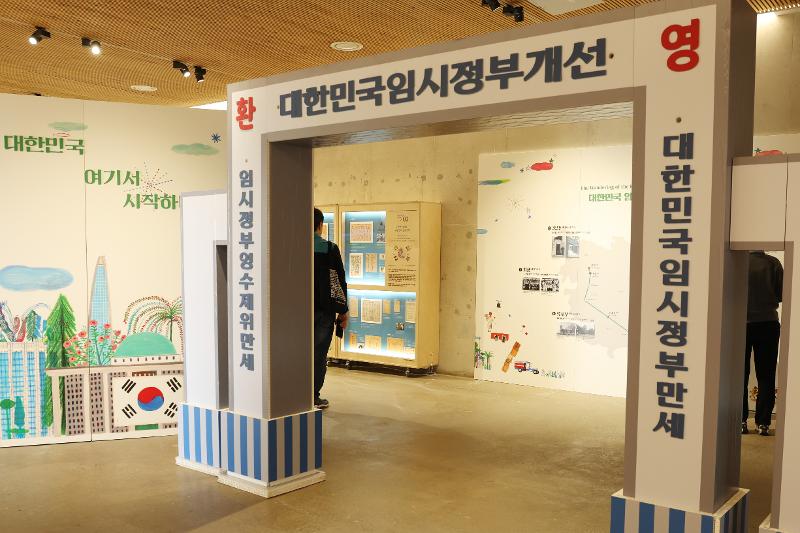
This is a replica of the triumphal arch that used to be in front of Hwasin Department Store in Seoul in 1945 to welcome the return of the Korean Provisional Government to the country. (Lee Jeongwoo)
A notable display item is a replica of a triumphal arch that stood in front of Hwasin Department Store in Seoul after liberation in 1945.
On Nov. 23 and Dec. 2 that year, members of the KPG returned to their homeland as individuals as the government-in-exile was not recognized under international law. No prior announcement of their arrival was made, and because the public did not know about this, no crowds were at Kimpo Airfield (now Gimpo International Airport) when the officials landed.
Yet on Dec. 17 that year, about 150,000 people gathered at Seoul Stadium (now Dongdaemun Design Plaza) to welcome the members' return. The arch on display represents the reception that day.
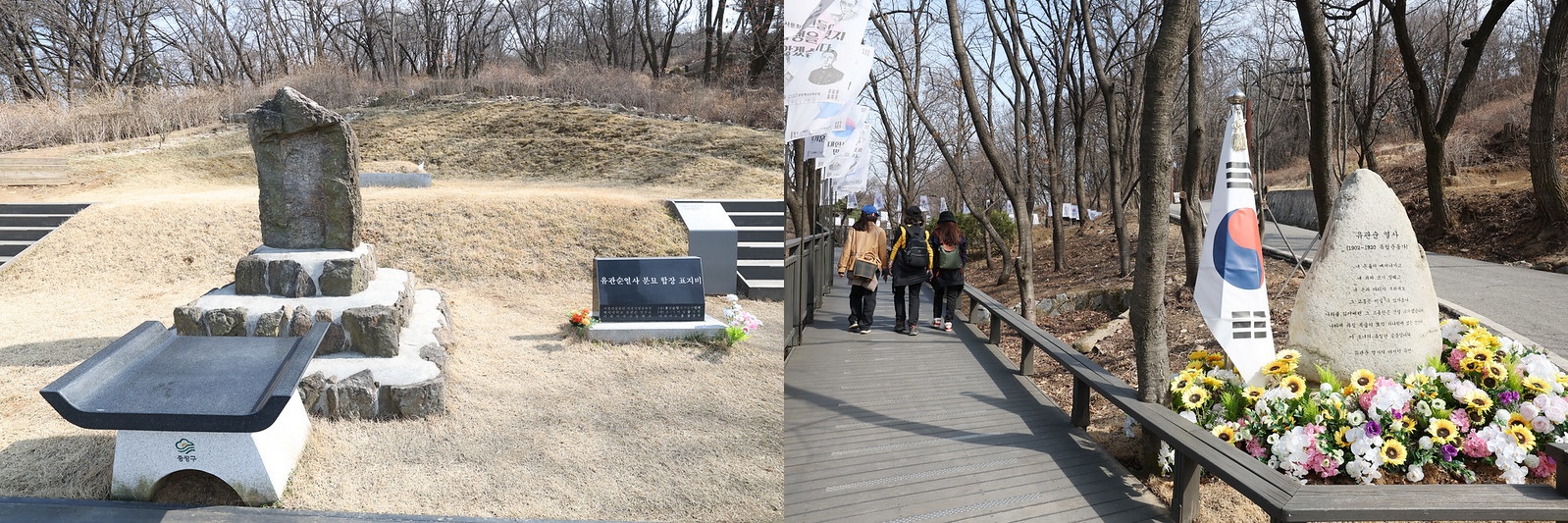
The grave (left) of pro-independence martyr Yu Gwan-sun and a monument inscribed with her last words are both at Mang-U History and Culture Park in Seoul's Jungnang-gu District. (Lee Jeongwoo)
Mang-U History and Culture Park is a site of living history. Launched as Manguri Public Cemetery in 1933, the facility houses the remains of independence activists and modern cultural and artistic figures.
The trail outside the exhibition hall leads to the grave of Yu Gwan-sun (1902-20), a teenage martyr for independence. Along the way, a large natural stone is engraved with her powerful final words: "I can endure the pain of my fingernails being pulled out, my ears and nose cut off, and my arms and legs broken. But the pain of losing my country is something I cannot bear. This young girl's lone sorrow is that I only have one life to give for my country."
The park attracts students who want to learn about the nation's history and others for leisure. The exhibition runs through May 17.
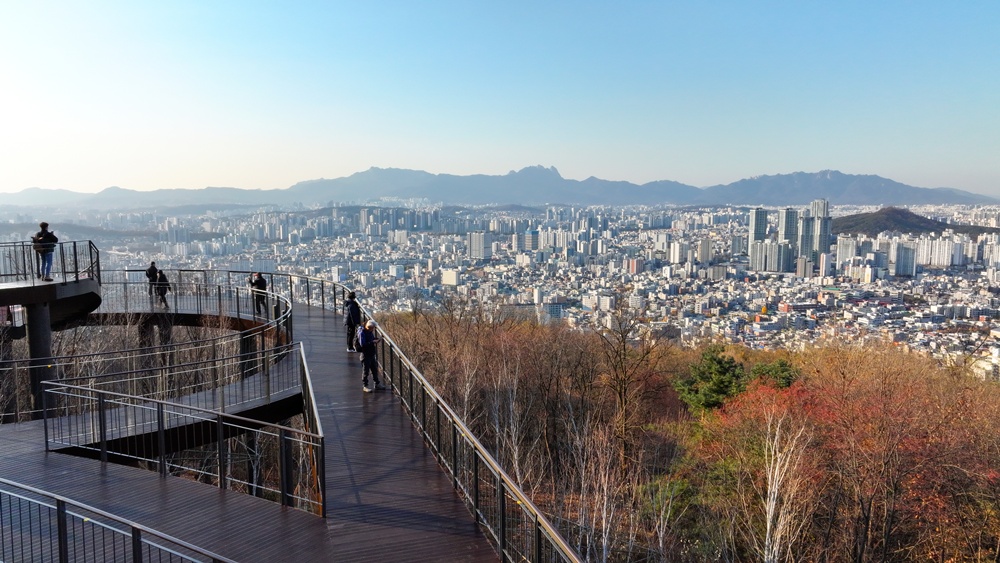
Skywalk at Mang-U History and Culture Park (Jungnang-gu District Office)