The results of a poll for the 100x100 Project to Discover Korea's Top Attractions, a joint program of the Ministry of Culture, Sports and Tourism and the Korea Tourism Organization, have been released on the initiative's official website (https://spot100x100.kr), which is linked to the Visit Korea homepage. This Korea.net series introduces 100 travel themes in eight sectors to highlight attractions recommended by the Korean public for foreign visitors.
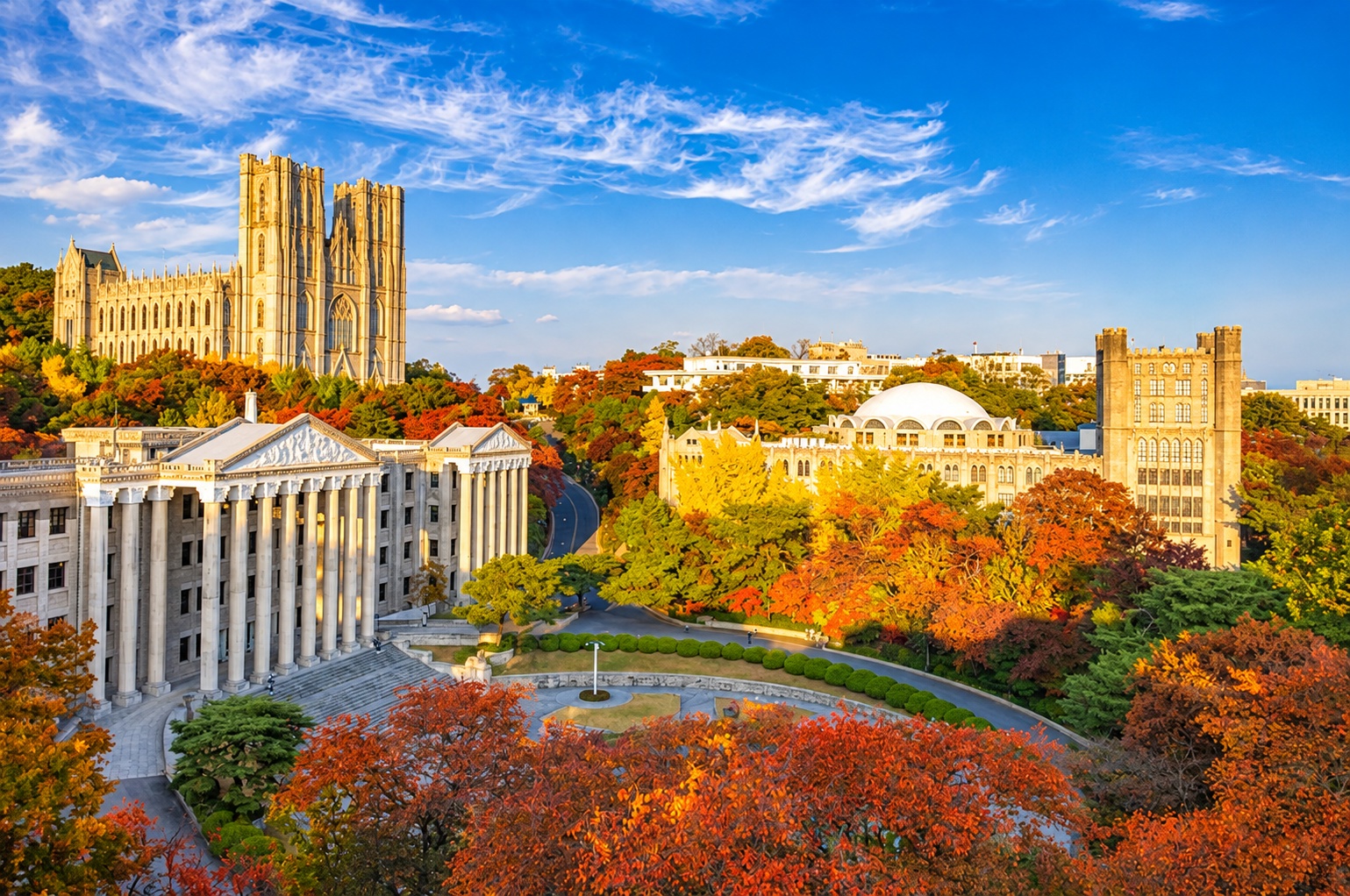
Clockwise from the upper left are Grand Peace Palace, Central Library and Administration Building of Kyung Hee University's main campus in Seoul's Dongdaemun-gu District. (Kyung Hee University)
By Oh Jung Eun
More than a space defined by walls and roofs, a building reflects the character of an era while preserving the lives and stories of the people who pass through them. Thus visiting one is like a journey into a region's history and culture.
"Architecture," one of the eight main sections of the 100x100 Project to Discover Korea's Top Attractions, has subcategories like "Sentimental Train Stations," "Bridge Tours" and "Lighthouse Keeper's Secret Map." Another sub-theme is "Campus Tours," which features university campuses as travel destinations.
Such campuses are emerging as new targets for domestic and international visitors in addition to students, offering unique architecture and colorful scenery that changes with the seasons.
The following are three campuses recommended by Korea.net under the "Campus Tours" category.
Kyung Hee University's main campus in Seoul's Dongdaemun-gu District features architectural styles inspired by ancient Greece and medieval Europe rarely found elsewhere in the country.
Notable examples include Administration Building, which features columns reminiscent of a Greek temple, and Central Library and Grand Peace Palace, which evoke the styles of European medieval castles and cathedrals. The palace is also known for hosting cultural performances.
Beyond its architecture, the campus sports beauty year-round. In spring, cherry blossoms blanket the grounds, creating such spectacular scenery that earned the nickname "Kyung Hee Land."
The campus is right by Hoegi Station on Seoul Subway Line 1. After exploring the compound, stop by the station's pajeon (pancakes) alley, a popular food district that developed in the 1970s alongside the university's commercial area.
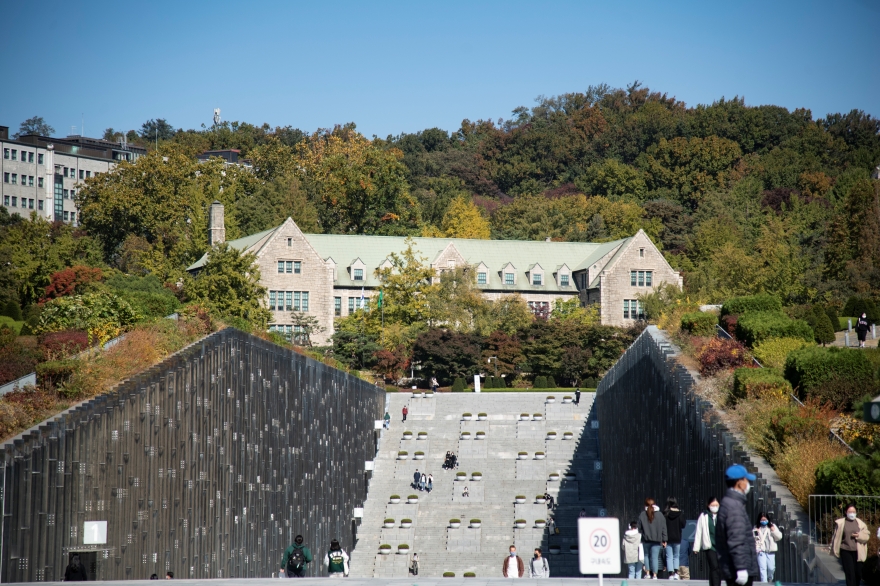
View of Ewha Campus Complex at Ewha Womans University in Seoul's Seodaemun-gu District (Ewha Womans University)
The Ewha Campus Complex (ECC) at Ewha Womans University in Seoul's Seodaemun-gu District is a multifunctional facility designed by renowned French architect Dominique Perrault. Using the former site of an athletic field to create a vast canyon-like space, the facility features glass-and-metal structures rising on either side.
Viewed from above, the glass exterior walls of the buildings reflect the sky and surrounding trees, creating a striking interplay between nature and the future. When seen below, sunlight streams into the open space to inject a sense of tranquility, as if time has slowed.
After dark, light spills from the glass facades to create an atmosphere entirely different from day. In recognition of its architectural design, the ECC in 2008 received the Grand Prize at the Seoul Architecture Awards.
Within the complex are facilities like lecture halls, study rooms, a theater, cafe, bookstore and restaurant. The campus is accessible from Ewha Womans University Station on Seoul Subway Line 2.
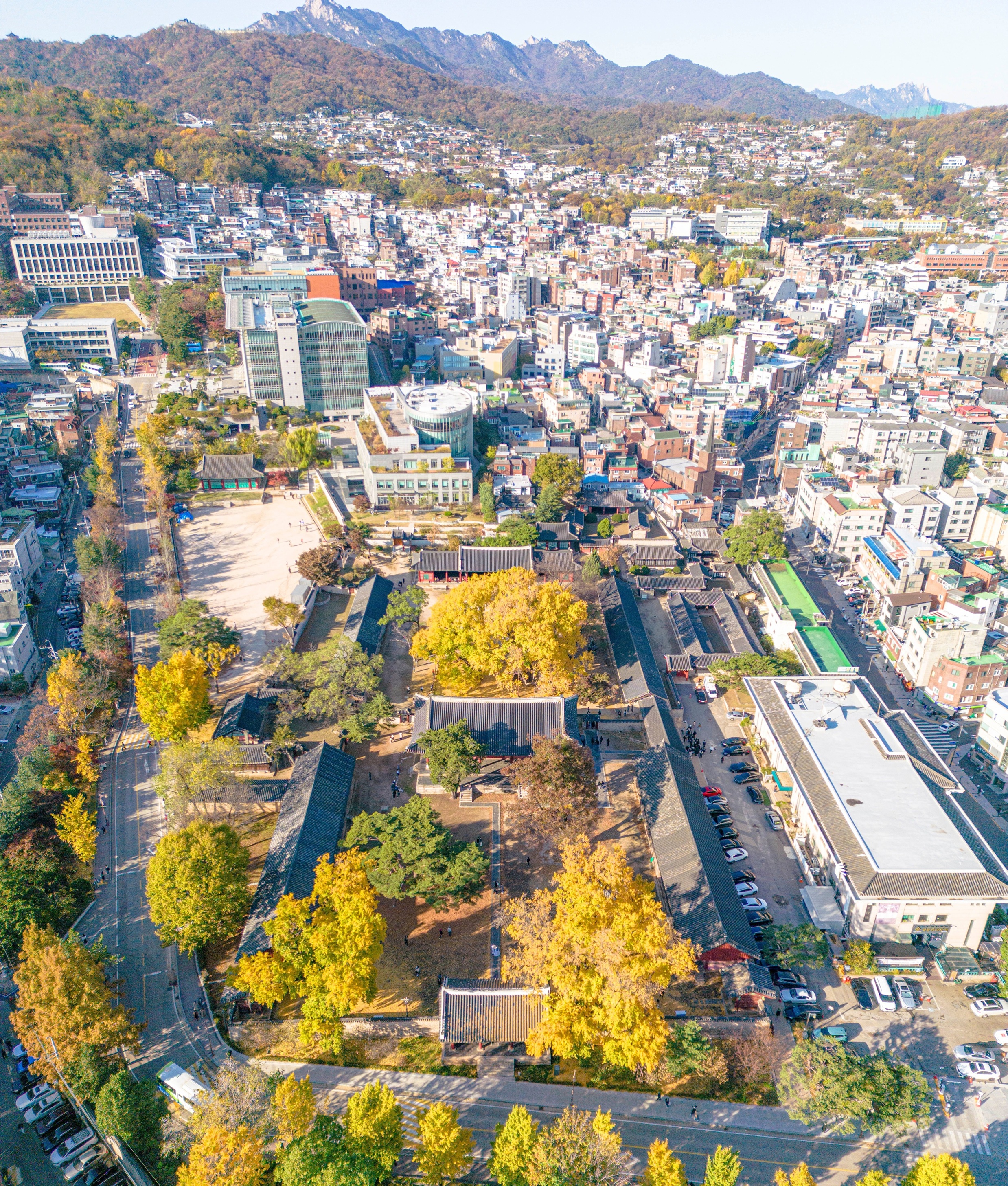
This aerial view shows the Confucian shrine Munmyo and Seonggyungwan, the national Confucian academy that was once the country's leading institution of higher learning, at Sungkyunkwan University's Humanities and Social Sciences Campus in Seoul's Jongno-gu District. (Korea Tourism Content Lab)
The Humanities and Social Sciences Campus of Sungkyunkwan University in Seoul's Jongno-gu District offers a blend of past and present. Its history dates back to 1398, when King Taejo, founder of the Joseon Dynasty (1392-1910), established Seonggyungwan as the kingdom's top institution of higher education.
Beyond the main gate is the Confucian shrine Munmyo, which houses the tablets of outstanding Korean and Chinese scholars, and Seonggyungwan. In front of Myeongnyundang Hall, where Confucian scholars once studied, stands a ginkgo tree believed to be over 400 years old.
In fall, the golden foliage of yellow-leaved ginkgo trees blends with traditional architecture to create a tranquil setting for a leisurely stroll.
Located by Hyehwa Station on Seoul Subway Line 4, the campus has a surrounding area famous for live theater, art galleries and other cultural venues.
cloveroh@korea.kr