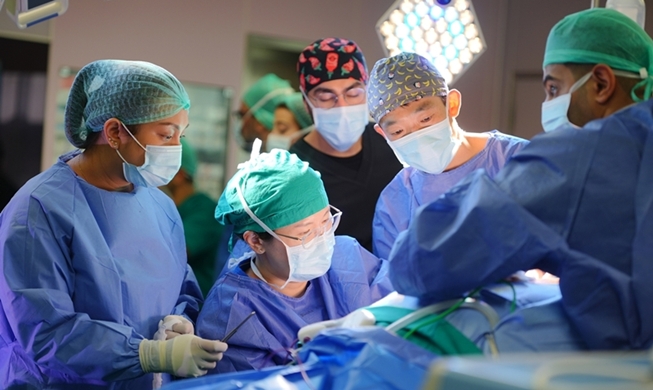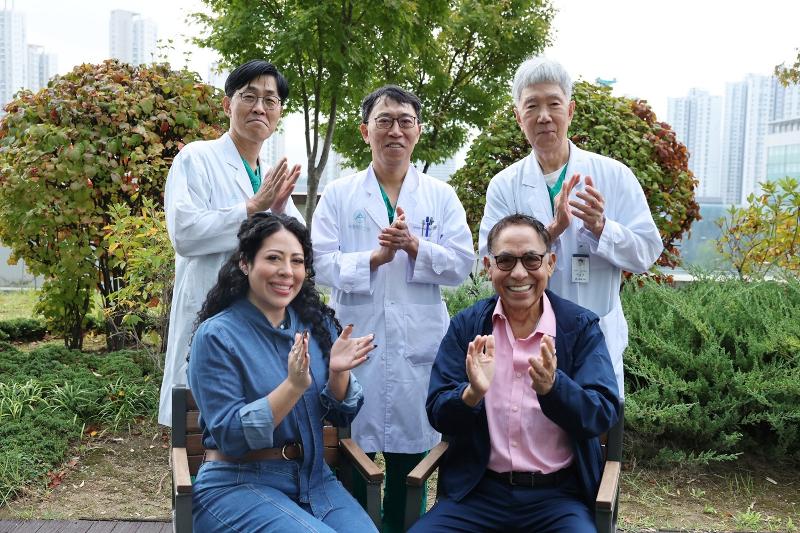
Peruvian American philanthropist Marco Antonio Quiroz (seated on right, front row), who underwent a liver transplant in Korea, and his daughter Kimberly, who donated a portion of her liver to her father, on Oct. 21 pose for photos with doctors from the Division of Liver Transplantation and Hepatobiliary Surgery at Asan Medical Center in Seoul at the outdoor garden of the hospital's new wing. (Asan Medical Center)
By Yoo Yeon Gyeong
The number of foreign patients who visited medical institutions in Seoul last year broke a record high with 1.76 million.
The Seoul Metropolitan Government, citing statistics from the Korea Health Industry Development Institute, on Nov. 2 said the number of such patients in 2025 saw a 3.7-fold jump from some 470,000 in 2023. This meant that 87.2% of the country's 2.01 million foreign patients last year received care in Seoul.
Given the growth of medical tourism, the city in partnership with the Seoul Tourism Organization has designated this year 19 "Seoul Medical-friendly Accommodations" in a first. Such facilities provide an environment suitable for long-term stays whether for medical treatment, accompanying caregivers or support for recovery following surgery or other procedures.
The 19 venues were chosen from 40 that applied via an open call involving thorough screening of document reviews, on-site inspections and evaluations by experts. Key criteria included accessibility to medical institutions, feasibility of long-term stays, availability of living amenities and services such as cooking and laundry, and a 24-hour emergency response system.
The selections get a related certificate valid for the coming year. The city will feature information on such venues in multiple languages on the capital's official medical tourism website (medical.visitseoul.net) for sharing with medical institutions and agencies catering to foreign patients.
The city will gradually raise the number of such accommodations and boost their links with medical institutions.
"The competitiveness of medical tourism depends on how comfortably and safely international patients and their families can stay before and after treatment as well as on high-quality medical services," said Cho Sung-ho, director-general of the city government's Tourism and Sports Bureau.
"We will keep looking for lodging infrastructure tailored to the specific needs of such patients and boost partnerships with medical institutions to create a medical tourism environment in Seoul where patients feel at ease throughout their journey from treatment to recovery."
dusrud21@korea.kr