View this article in another language
- 한국어
- English
- 日本語
- 中文
- العربية
- Español
- Français
- Deutsch
- Pусский
- Tiếng Việt
- Indonesian
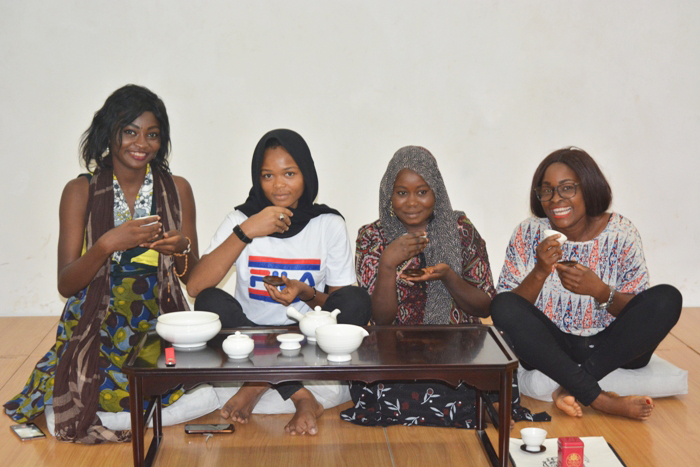
Visitors learn about traditional tea ceremonies at the Korean Cultural Center in Nigeria.
By Korea.net Honorary Reporter <font color="#0070c0">Edward Olivet Chiamaka</font> from Nigeria
Photos = Korean Cultural Center in Nigeria
Video = <font color="#0070c0">Edward Olivet Chiamaka</font>
On Wednesday, Feb. 21, the Korean Cultural Center in Nigeria hosted its monthly Cultural Day. The focus was on traditional Korean tea ceremonies, also known as dado. Tea ceremonies are practiced to relax the mind and the senses with their precise, calm and repetitive movements. The program began with a presentation and a video of an actual tea ceremony with over 50 guests in attendance. Then Jee Meeyoun, a tea expert, proceeded to reenact the ceremony. Some people from the audience were invited to sit at the table as guests while she was the tea ceremony’s host.
She started by heating the teapot, cups and decanting bowl with hot water and then poured it out into the waste bowl. Then she put tea leaves into the teapot and poured hot water over them and quickly poured the water into the waste bowl. This was done to rinse the tea leaves and to "waken" them. Next, she poured hot water into the decanting bowl and let it sit for a while in order for it to cool to the proper temperature at which to brew tea. When it reached the proper temperature, she poured it over the tea leaves and let it steep for some time before pouring it into the cups for serving: hers first, and then those of the guests. She poured the tea into the cups a little at a time, back and forward, three times each, until the tea in the teapot was finished. This was done in order to spread equally the stronger tea that settles at the bottom of the teapot and also to maintain an even temperature in all the cups. She then served the tea and drank first before the guests, as is proper tea ceremony etiquette. All these motions are carried out serenely and calmly with no rush. The whole ceremony was very relaxing.
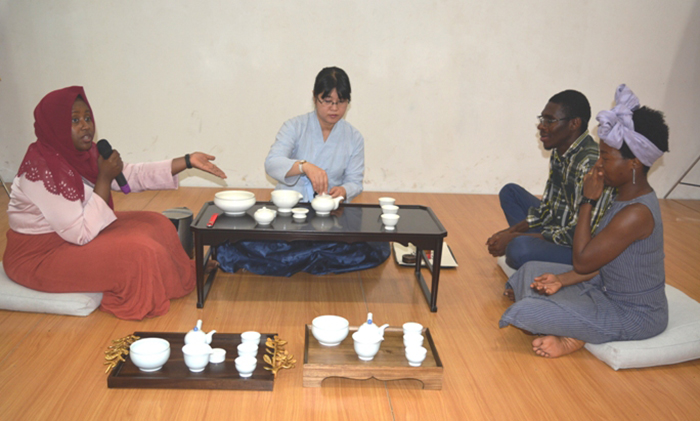
Visitors learn about traditional tea ceremonies at the Korean Cultural Center in Nigeria.
Afterward, the audience was served some yuja tea, which is a traditional tea made with citrus and honey. It contains a lot of vitamin C that helps to fight colds and the flu, and it's popular with people seeking a healthy lifestyle. It's also said to help with indigestion, coughs and even hangovers. According to the Annals of King Sejong, Sejong Sillok, King Sejong the Great was one of its first and most famous advocates.
The tea was warmly received by all in attendance. You could see it in the nods and smiles as they sampled the tea, with some people going for seconds and even thirds. Based on my own taste, the tea was very aromatic with a strong clear citrus aroma, and it tasted very sweet. This was in a good way, not like processed sugar, but with the natural sweetness you get from a sweet orange or tangerine. It was also very comforting.
Then it was photo time. We snapped a lot of pictures while performing the tea ceremony. I realized that the tea ceremony can be a source of relaxation or meditation. Due to the repetition and procedural steps I had to take while performing it, I realized that I was completely zoned out and focused on just the tea preparation, a sense of serenity and a Zen atmosphere was created. We had to sit in the traditional style, cross-legged on cushions, because of the low tea table, so it wasn't very comfortable for first-timers. However, I knew that the little discomfort was worth it when we drunk the delicious tea that was prepared.
Overall, the experience was nice, fun and relaxing. I strongly encourage everyone to try a traditional tea ceremony at least once in their life, or whenever they want to relax after a hectic day or week.
You can watch a video here or visit my YouTube channel.
wisdom117@korea.kr
* This article is written by a Korea.net Honorary Reporter. Our group of Honorary Reporters are from all around the world, and they share with Korea.net their love and passion for all things Korean.