- 한국어
- English
- 日本語
- 中文
- العربية
- Español
- Français
- Deutsch
- Pусский
- Tiếng Việt
- Indonesian
By Honorary reporter Susana Matondo from Spain
Photos = Korean Film Council

"Parasite"(2019) by Bong Joon-ho
"Parasite" by director Bong Joon-ho on Jan. 5 won the Golden Globe for best foreign-language film, having emerged as a cinematic phenomenon last year.
This movie has also been successful in Europe, winning the top prize at the Cannes Film Festival and grossing EUR 1 million in Spain just a month after its release in November last year. Film critics and audiences agree that "Parasite" is thrilling, shocking and witty, and the movie has symbolism and social criticism that are initially subtle but brutally clear afterwards.
So what do Spaniards think of this film? Most audiences love it despite a few points that seem unclear to some. "Parasite" enhances the feeling that something is wrong with the privileged class and capitalism, but it goes further.
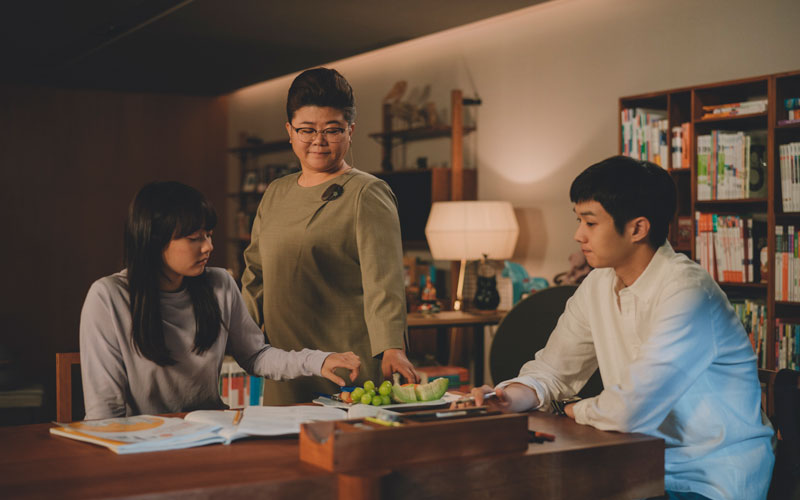
"Parasite"(2019) by Bong Joon-ho
One viewer named Javi said he was infatuated with Bong's style, adding that he loved "how the narrative was built and how it was conducted to the very end. The movie becomes agonizing when the action moves into the basement. The dark lighting and uncertainty made me feel like I was watching a terror movie at some points."
What was most surprising, he said, was the ingenious way the film set social differences between both families, the poor's capacity to adapt and "the fact of being unable to expect what will happen next though you sense it won't be a happy ending, but one to make you reflect."
Another viewer, Isabel, said she felt something similar, adding that the film had an undeniable tension. "I liked the pace and the plot twists, though sometimes I felt that the rich family being unaware of anything happening in their house seemed unrealistic."
She also offered a view of what the film could have been, saying how "interesting it would've been if they also showed us the rich family as 'parasites', as if there was some corruption in their lives." This opinion connects with the critics who said the privileged family is also a kind of parasite that needs its own parasites to survive. After all, what would they be without servants, chauffeurs and private tutors?
On what impressed her the most, viewer Laura said she cannot choose just one thing, but she signaled out the sensitivity of the chosen spaces, saying "the open, wide and bright spaces are reserved for the rich while the dark and narrow spaces are for the poor."
And on the hopelessness displayed in the final scene, she mentioned how "the poor family has no chance to change its life since society is ruled in a way in which change doesn't come easily." This is shown how in the first and final scenes of the movie are exactly the same. "The necessary replacement of one parasite with another to keep the established social system alive is a huge social metaphor," she said in giving her final thoughts on the movie.

"Parasite"(2019) by Bong Joon-ho
Personally, I found a few impressive key points. From the first scene, the poor family literally live like parasites as its humble semi-basement apartment is being fumigated. The thrilling discovery of the rich family's basement also indicates the necessity of "parasites" to maintain the status quo. And the meaning behind "the smell" is that it is the essential symbol of selfishness and ignorance of the privileged. This subtle element represents the huge gap between social classes and ultimately becomes the key to the masterful ending.
My conclusion is that Bong's work is a new breed of cult film but the following powerful interpretation by Javi has merit: "Parasite" is not a film you watch to kill time but to reflect on. The film elicits empathy from the audience. We must figure out the film's intent and our opinion doesn't have to be the same as everyone else's.
chaey0726@korea.kr
*This article is written by a Korea.net Honorary Reporter. Our group of Honorary Reporters are from all around the world, and they share with Korea.net their love and passion for all things Korean.