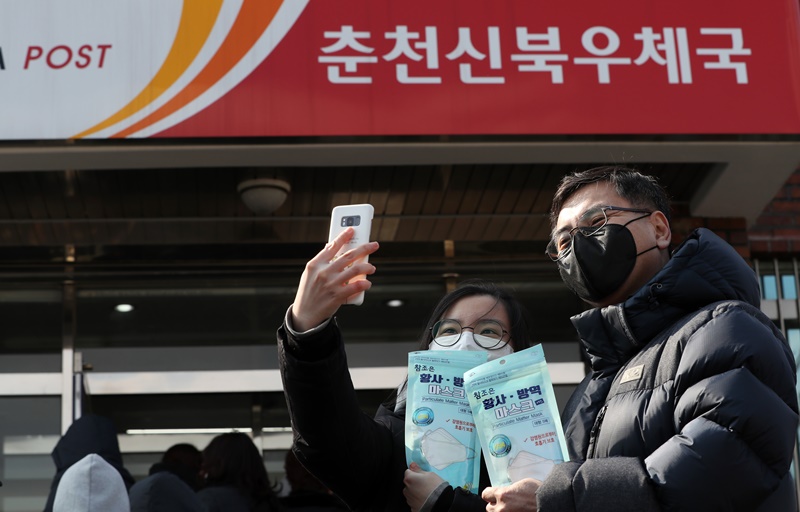
Two people on March 2 take a selfie after buying government-supplied masks at a post office in Chuncheon, Gangwon-do Province. (Yonhap News)
Following Korea, France has been heavily hit by COVID-19. As of March 5, the number of confirmed cases in France exceeded 200 and the number keeps rising.
On one hand, it is comforting for both Korea and France to suffer from the same hardship together, but on the other hand, it is always best not to have the same situation.
Having been interested in Asian culture for more than 30 years, I have grown interested in something due to the COVID-19 outbreak: face masks.
In Korea, like in other Asian countries nowadays, it is easy to spot someone wearing a mask. In this country, both children and grown-ups all wear masks. This is an exemplary case of manners to protect both themselves and others as well help society to keep functioning well. It also shows the lingering effect of Confucian culture that is deeply rooted in Korean society.
Masks in Korea, however, vary in size and color nowadays. You can see black masks or masks with checkered or other patterns. These can serve as a good fashion tool and express an individual's personality regardless of Confucian culture.
Meanwhile in France, wearing a mask is considered rude and far from fashionable. Around two or three years ago, seeing someone wearing a mask on the street was unimaginable because of the uncomfortable and astonished stares the wearer would get from others. People say Koreans are extremely mindful of how others look at them. Yet I wonder if French are even more sensitive than Koreans about how others judge them.
A few reasons explain the unfamiliarity of the French with wearing masks. In the past, the French considered it taboo for someone to say he or she was sick, especially in the sick was in grave condition. If a person got cancer, he or she did not tell others about it right away. It took a few years for the sick to eventually tell others of his or her condition. As such, there is a big gap in France between what people say and how they are seen externally. So to the French, wearing a mask means that the wearer has announced that he or she has a disease.
Another reason the French are not used to wearing a mask is because of their unique "contact culture." This insight from one of my Korean friends makes sense, I think. The French often have physical contact with people like shaking hands and exchanging light kisses on the cheek when greeting others. Wearing a mask makes such actions uncomfortable and creates distance from others, which make the French feel uneasy. People often think of the French as very individualistic but interestingly, the opposite is true.
Because of the COVID-19 outbreak, I strongly hope that France reconsiders its preventive measures for infectious diseases and make improvements. To overcome this hardship, I hope the country places top priority on the public interest and transparently shares all information with the people. France should also take a closer look at Korea's example as the latter has shared all information on the ongoing situation with the public and made all-out efforts against the outbreak.
arete@korea.kr
*This article was written by a Korea.net Honorary Reporter. Our group of Honorary Reporters are from all around the world, and they share with Korea.net their love and passion for all things Korean.