- 한국어
- English
- 日本語
- 中文
- العربية
- Español
- Français
- Deutsch
- Pусский
- Tiếng Việt
- Indonesian
By Honorary Reporter Preeti Rawat from India
Photo = Anubhuti Kakati
The King Sejong Institute Foundation of Korea holds annual contests for speaking and writing in the Korean language every year to mark Hangeul Day (Oct. 9). Students at branches of the institute worldwide compete for the grand prize, which is a full scholarship to study in Korea.
This year's speech competition saw participation from 2,071 learners at 234 branches in 82 countries. With an entry consisting of a presentation and interview, just 10 advanced to the final round on Oct. 8. Anubhuti Kakati of India emerged as the grand prize winner.
This was her second straight win in a foundation-sponsored contest, having claimed the writing competition the year before.
Kakati's affection for East Asian cultures and languages piqued her interest in not just Hallyu but also Korean society, traditions and history. A student at the King Sejong branch of the Korean Cultural Center in New Delhi for 3 1/2 years, she holds a master's degree in politics with a specialization in international studies.
She said she grew deeply interested in Korean culture in 2017 through K-pop. "While listening to artists like IU, BTS and Seventeen, I got drawn not just to the rhythm and melody of their songs but also to the sound of each word and phrase. This made me want to understand the lyrics at a deeper level and more vividly," she said.
So Kakati began taking classes at the institute's branch in New Delhi in 2018. After completing her master's, she decided to focus on Korean-language education. Last year, she completed the institute's training for Korean-language teachers and has since taught beginner-level Korean at the center.
On going from learning Korean to teaching it, she said, "This journey began with interest and curiosity and over the years, it developed into a passion that I want to dedicate myself to. Learning Korean has its challenges, but I realized while learning that it's quite charming as it keeps getting interesting the more I learn. The cultural significance and connotations of idioms and phrases, the immense variety of the color-based vocabulary, onomatopoeia and mimetic words — everything makes the language-learning process exciting."
Kakati seeks to teach Korean and share the joys of the learning process.
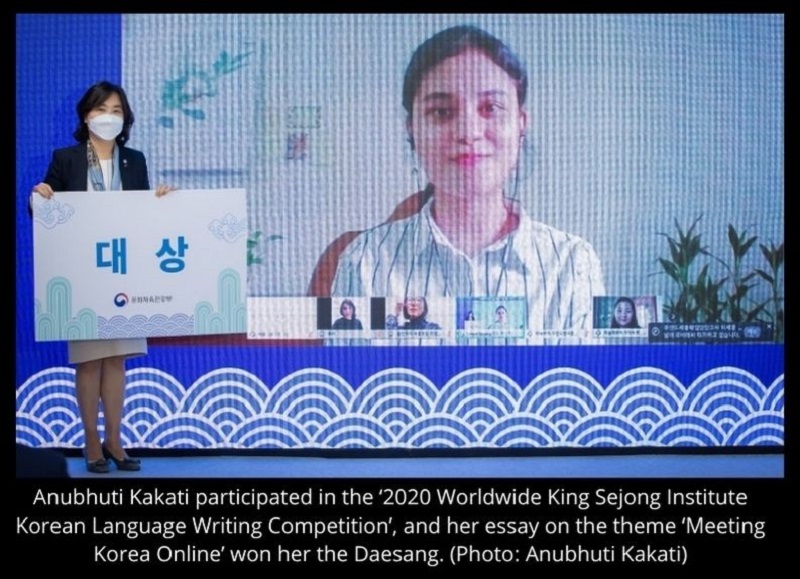
Last year, she won the King Sejong writing competition with her preliminary submission "If I Were to Become a Korean Teacher" and the one for the final, "Meeting Korea Online."
This year, she claimed the speech contest with a speech on "Characteristics of the Korean Language," focusing on onomatopoeia and mimetic words. For the final, she spoke on "A Challenge I Want to Make."
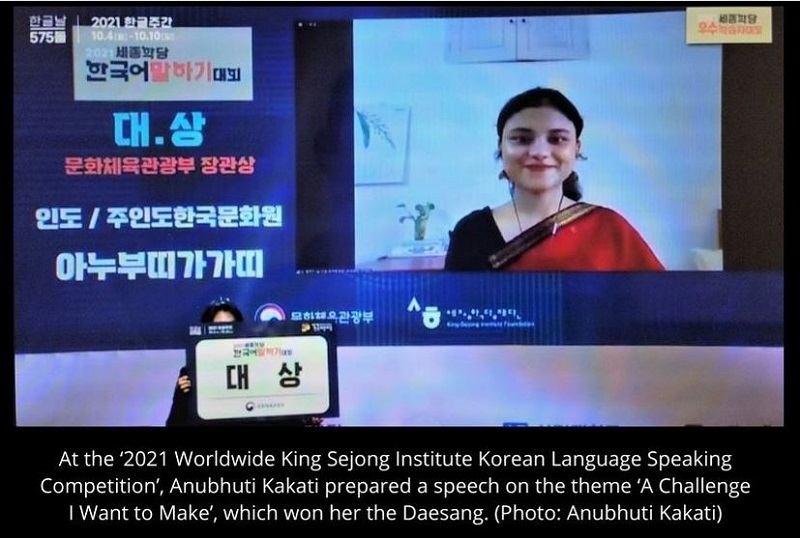
On her prize-winning speech this year, she said, "I spoke of how my teachers have inspired me in my Korean-language learning journey, motivating me to 'learn for others.' Sharing what I've learned brings me genuine happiness, so I talked about taking on the challenge of creating a YouTube channel specifically for Indian learners of Korean, given how Indians speak multiple languages and the many Indians interested in Korean language and culture."
Kakati gave advice to people who want to enter such contests. "I think having confidence in your skills and preparation is the key. Additionally, actively reading and listening can tremendously improve how we express our ideas and deliver our message to the audience. This can include watching Korean experts from different fields speak about themes that interest us, listening to podcasts and radio, and practicing writing and summarizing sections on reading comprehension in textbooks," she said.
On her plans, she said she hopes to continue teaching this year while preparing to study in Korea next year, adding, "I'm very excited to experience facets of Korean culture firsthand once I'm there."
enny0611@korea.kr
*This article is written by a Korea.net Honorary Reporter. Our group of Honorary Reporters are from all around the world, and they share with Korea.net their love and passion for all things Korean.