- 한국어
- English
- 日本語
- 中文
- العربية
- Español
- Français
- Deutsch
- Pусский
- Tiếng Việt
- Indonesian
By Honorary Reporter Eman Elashker from Egypt
As a Korean literature enthusiast, I was thrilled when the Literature Translation Institute (LTI) of Korea announced Korean National Reading Month.
The event's highlight was the Seoul International Writers Festival from Sept. 6-11, which promotes global literary exchange and Korean literature. And the Korean Lit E-book Bingo Bonanza from Sept. 6-30 was a contest to promote interest in Korean e-books with prizes.
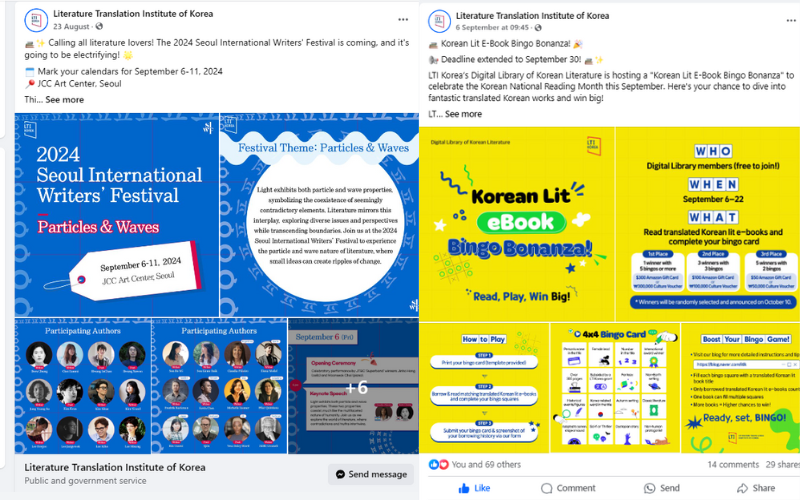
LTI Korea promoted both the Seoul International Writers' Festival and Korean Lit eBook Bingo Bonanza on social media. (LTI Korea's official Facebook page)
All lectures were broadcast live on LTI Korea's official YouTube channel, and I especially liked three talks on famous and new writers.
The first featured Korean novelist Bora Chung and Argentine writer Claudia Pineiro under the theme "Particles & Waves." Chung emphasized embracing one's diverse traits, saying how literature can connect people. I like her unique blend of genres like science fiction, horror and magical realism and Pineiro's crime fiction.
The second had Jung Young Su and Kim Kitae of Korea and Fredrik Backman of Sweden discuss comedy in literature. They shared insights into their daily lives and how they balance routine and office jobs, saying an extraordinary life is not needed to have a sense of humor, which is found in everyday experiences.
Leading the third were poets Hwang Yuwon and Kim Keun from Korea and Sjon from Iceland, all of whom explored the challenges of translating poetry. Showing a remarkable connection despite the language barrier, they impressed me with their discussion on the essence of poetry, something that deepened my respect for translators.
For the contest, I read four novels: "Your Utopia" by Chung; "Miss Kim Knows and Other Stories" by Cho Nam-ju, "The Picture Bride" by Lee Geum-yi; and "Seopyeonje" by Yi Chong-jun.
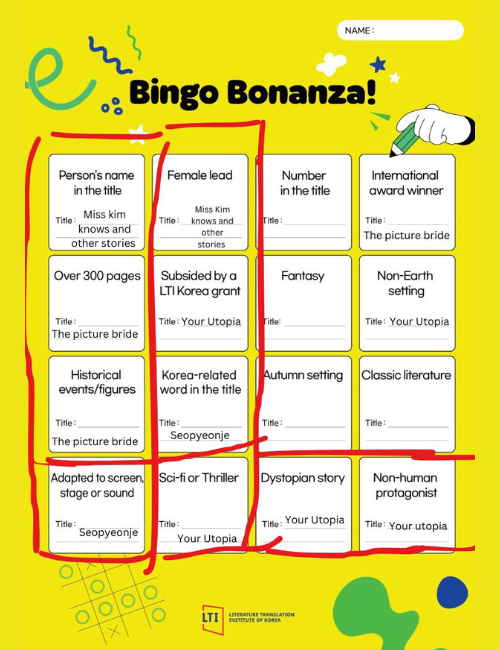
Screenshot of Bingo reading contest submission (Eman Ahmed)
"Your Utopia" is a collection of sci-fi and dystopian short stories set in outer space with non-human protagonists. "Miss Kim" explores the daily lives and struggles of women at different ages, incorporating a subtle thriller element to stay engaging.
"The Picture Bride," a historical novel set in 1918, is about three mail-order brides who move to Hawaii for marriage, showing the hardships of Korean immigrants during political conflict. And "Seopyeonje," set in the 1950s, follows a traveling family troupe of pansori (traditional lyrical opera) who face a rapidly changing society.
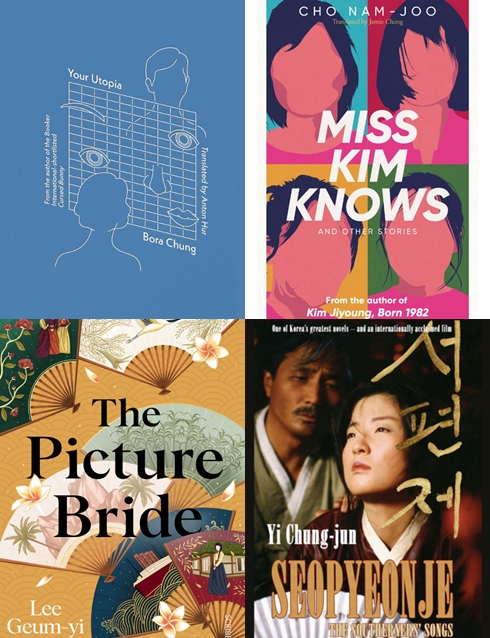
From left to right clockwise are the covers of "Your Utopia," "Miss Kim Knows and Other Stories," "The Picture Bride" and "Seopyeonje."
Both events not only deepened my appreciation for Korean writers but also reinforced how literature can bridge cultures and form meaningful connections.
msjeon22@korea.kr
*This article is written by a Korea.net Honorary Reporter. Our group of Honorary Reporters are from all around the world, and they share with Korea.net their love and passion for all things Korean.