- 한국어
- English
- 日本語
- 中文
- العربية
- Español
- Français
- Deutsch
- Pусский
- Tiếng Việt
- Indonesian
By Honorary Reporter Simran Singh from India
Amitav Ghosh is a New York-based Indian writer of fiction and nonfiction whose work explores how memory, colonial history and ecological change shape the human experience.
His works such as "The Great Derangement," "The Nutmeg's Curse" and the Ibis trilogy raise environmental awareness and revisit Asia, Europe and the Indian Ocean's complex histories.
A recipient of major international honors like the Dan David Prize (2010), Jnanpith Award (2018) and Erasmus Prize (2024), he added on Oct. 23 at the Hotel Inter-Burgo in Wonju, Gangwon-do Province, the Pak Kyongni Prize of Korea, which honors novelists worldwide who have greatly influenced the flow of literature while preserving its intrinsic value.
The following are excerpts from an email interview with Ghosh conducted from Oct. 28 to Nov. 13.
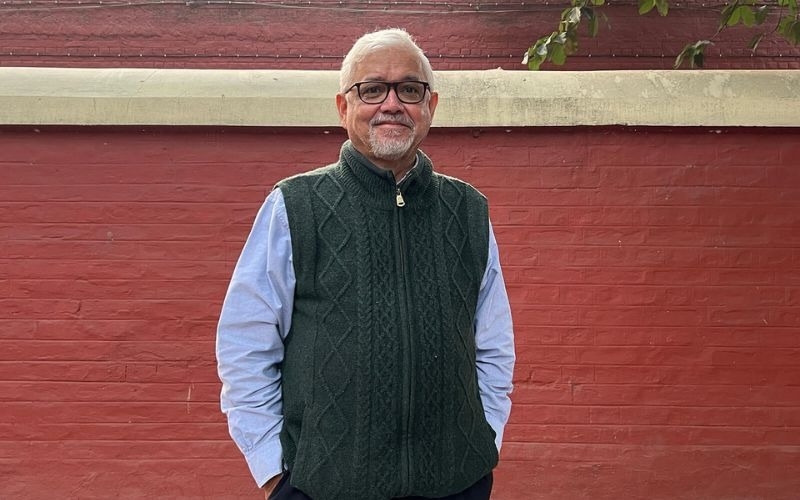
Author Amitav Ghosh (Aradhana Seth)
What does receiving the Pak Kyongni Prize mean to you?
To see my work resonate in Korea is a source of immense gratification for me. It suggests that the stories emerging from the Asian experience, with all its complex engagements with history, modernity and ecology, are finding a powerful, shared resonance.
The Pak Kyongni Prize is particularly meaningful to me because of its recognition of the questions I've grappled with of history, land, and the epic scale of human and non-human life as part of a larger conversation across our continent.
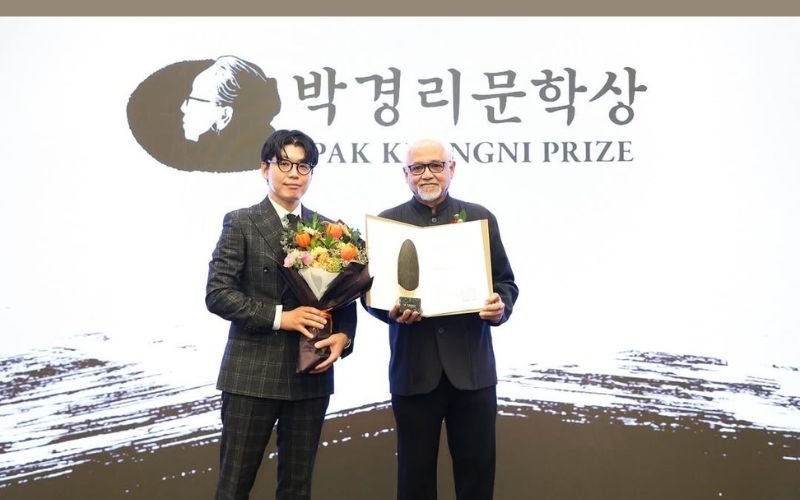
Amitav Ghosh (right) receives the Pak Kyongni Prize at the awards ceremony held at the Hotel Inter-Burgo in Wonju, Gangwon-do Province. (Toji Cultural Foundation)
The prize commemorates Pak's epic novel "Toji" (The Land). Do you find a thematic kinship between this work and your own approach to long-form storytelling?
Like "Toji," my own work, particularly the Ibis trilogy, attempts to capture the immense, sprawling currents of history as they move through the lives of ordinary people, shaping their destinies across generations and geographies. We share a belief in the novel's capacity to be an epic vessel that can hold the intricate relationships between people and the land they inhabit, love and struggle with.
What potential do you see for cultural exchange among writers, translators and readers, especially as Asian narratives gain global attention?
The potential is limitless. For too long, the global literary conversation has been filtered through a Western lens. Now as Asian narratives rightly claim the world's attention, we have an unprecedented opportunity to speak directly to one another. We can find in each other's stories shared histories, ancient philosophical traditions and contemporary struggles with environmental crises. I would love to see more translations, residencies and collaborative projects. We have so much to learn from the ways Korean writers, for instance, are exploring the frontiers of technology and tradition or memory and war.
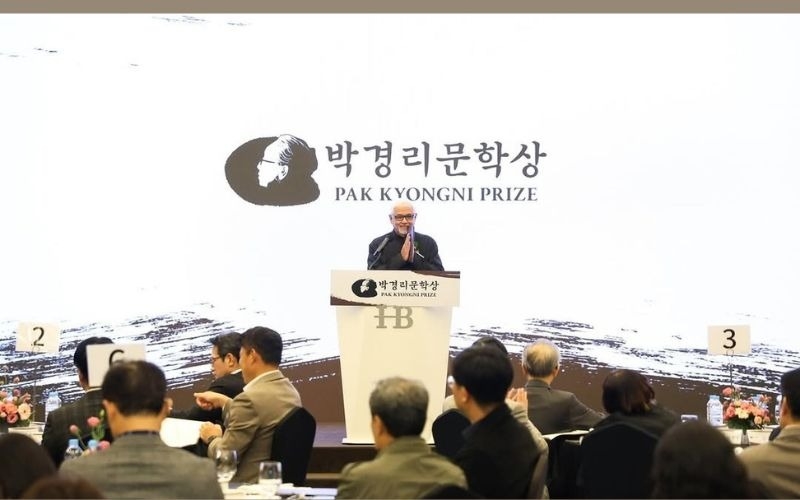
Amitav Ghosh delivers his acceptance speech at the awards ceremony for the Pak Kyongni Prize at the Hotel Inter-Burgo in Wonju, Gangwon-do Province. (Toji Cultural Foundation)
What message do you have for younger readers interested in global literature?
To younger readers in Korea, don't be daunted by the scale of the crises we face. Literature is one of the most powerful tools to understand them and imagine new paths forward. Your perspective, as young people living in a society that has navigated the tumultuous currents of the 20th and 21st centuries with such dynamism, is essential. Read widely and across borders and seek stories of the land, sea and interconnectedness of life. Your generation holds the key to forging new narratives that we desperately need. I would be deeply grateful if my work can be a small part of your journey.
msjeon22@korea.kr
*This article is written by a Korea.net Honorary Reporter. Our group of Honorary Reporters are from all around the world, and they share with Korea.net their love and passion for all things Korean.