- 한국어
- English
- 日本語
- 中文
- العربية
- Español
- Français
- Deutsch
- Pусский
- Tiếng Việt
- Indonesian
By Honorary Reporter Simran Singh from India
Photos = Kang Hyungwon
Based in Los Angeles, he has spent almost 40 years covering world events and using photography to document reality across borders. He is the first Korean to win the Pulitzer twice, covering the 1992 Los Angeles riots, the impeachment of U.S. President Bill Clinton, North Korea and the Olympics.
More recently, Kang has shifted his interest to promoting Korean civilization and cultural heritage for foreign readers through his books "Visual History of Korea" and "Seonbi Country Korea: Seeking Sagehood," the latter of which was featured at this year's Frankfurt Book Fair in Germany.
Below are excerpts from an email interview with Kang from June 9 to Dec. 15.
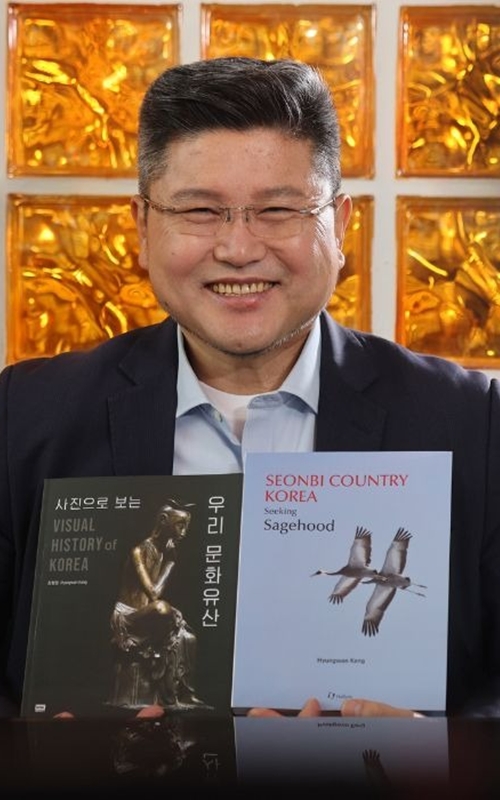
Kang Hyungwon holds his books "Visual History of Korea" and "Seonbi Country Korea, Seeking Sagehood."
What led you to shift your focus toward Korean heritage and identity?
As a Korean American who has worked in U.S. mainstream media for over three decades, I recognized a significant gap in accessible, English-language resources on Korean history and culture. To promote a more balanced understanding of world history, I saw the need to present Korean civilization, history and perspectives through Western storytelling formats in English for journalists and the broader English-speaking audience.
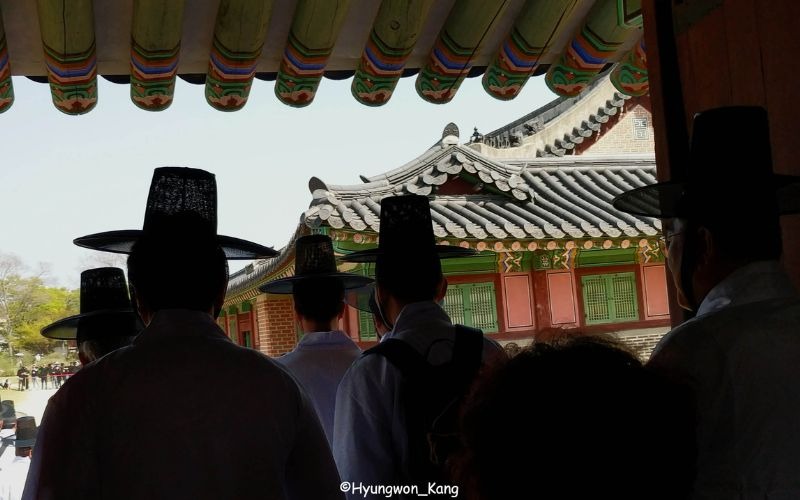
Photo of seonbi (neo-Confucian scholars) by Kang Hyungwon
What aspects of Korean heritage is underrepresented or misunderstood abroad?
First, Korea was among the first civilizations to use a maritime compass to navigate in open seas without visible landmarks, even when stars were obscured. This is rarely acknowledged in global histories of science and exploration. Second, ancient Korean cavalries used stirrups centuries before their adoption in Europe, greatly enhancing mounted warfare and contributing to Korea’s military effectiveness.
Third, Korean civilization was rarely fully conquered by external forces despite repeated invasions. And Korean naval strategy under Admiral Yi Sun-sin used the hakikjin (crane wing formation), which was instrumental in defeating the enemy during the Imjin Waeran (Japanese invasion of Korea) in 1592.
What other Korean values do you hope spreads other than cultural content?
I hope that international audiences will appreciate the deeper cultural values that underpin Korean identity, as Korea is one of the oldest continuous civilizations in East Asia.
Throughout history, Korea has remained at the forefront of innovation, from early mastery of sophisticated bronze technology to advanced steel production for weapons and armor. Korea also led one of history's earliest printing revolutions through woodblocks at least five centuries before Europe.
Equally significant is intellectual traditions shaped by two writing systems: Hanja (Chinese script), which was shared across East Asia, and Hunminjeongeum, a scientific and inclusive alphabet that promoted universal literacy and could transcribe all sounds invented by King Sejong the Great.
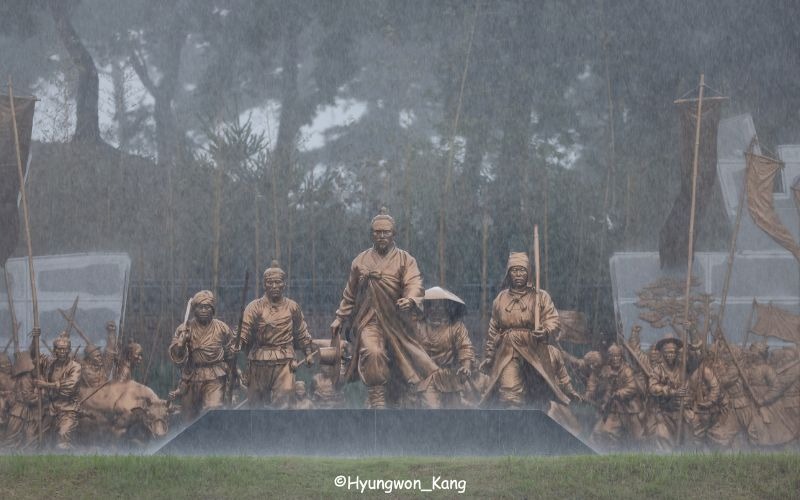
Photo of Donghak Peasant Revolution in Statues by Kang Hyungwon in Jeongeup, Jeollabuk-do Province.
How has winning two Pulitzers affected your mission of sharing Korean stories?
The recognition has deepened my sense of responsibility to chronicle Korean stories for the world. Outside the Korean-language ecosystem, the global intellectual community knows remarkably little about Korean history and culture.
So I chose to focus full time on documenting and narrating Korean history and culture through the lens of a 21st-century journalist. My goal is not only to inform contemporary audiences but also to ensure that accurate Korean narratives become part of global knowledge.
Why did you write your latest book "Seonbi Country Korea: Seeking Sagehood?"
Korean civilization has been shaped by the institutionalized formation and sustained practice of seonbi (neo-Confucian scholar) virtues. Seonbi ideals emphasize moral integrity, intellectual rigor and social responsibility and form the foundational framework for Korean society. Even today, Korean leaders are evaluated not only by their intellectual abilities but also how closely they embody such values.
jcy0531@korea.kr
*This article is written by a Korea.net Honorary Reporter. Our group of Honorary Reporters are from all around the world, and they share with Korea.net their love and passion for all things Korean.