- 한국어
- English
- 日本語
- 中文
- العربية
- Español
- Français
- Deutsch
- Pусский
- Tiếng Việt
- Indonesian
By Honorary Reporter Foteini Chatzoudi from Greece
Photo = Barbara J. Zitwer
Barbara J. Zitwer is an award-winning American literary agent and founder of her eponymous literary agency, which has promoted Korean literature in English-language publishing like "Please Look After Mom" by Shin Kyung-sook, "A Thousand Blues" by Cheon Seonran and "The Vegetarian" by Nobel Prize laureate Han Kang.
Receiving the International Literary Agent Award in 2017 and hailed by Korea's Ministry of Culture, Sports and Tourism in 2016 for promoting Korean literature globally, Zitwer also authored the self-help book "The Korean Book of Happiness" and the novel "When the Sea Belonged to Us."
At the Korean Cultural Center in Los Angeles, Zitwer last month also won Person of the Year at the Dari (Bridge) Awards, which honor individuals and organizations contributing to cultural exchange between Korea and the U.S.
The following are excerpts from a Jan. 6-7 email interview with Zitwer.
What first drew you to a career in literary representation?
I had always been a great reader and loved books and after deciding to change careers from film, I applied for a job for a literary scout without knowing anything about the field. But I got the job, which marked the beginning of my education in international publishing. I quickly fell in love with the work and the international publishing community.
While on vacation in Switzerland, I discovered "Vurt" by Jeff Noon. When I returned to New York, I tracked down the author, a bookseller at Waterstones in Manchester, England, who had no agent and self-published the book. I offered to represent it, which became the first book I sold as a literary agent and won the Arthur C. Clarke Award (for science fiction).
What sparked your interest in representing Korean authors?
When I discovered Korean literature around 2010, I was looking for great books to represent. I had dinner with a Korean literary agent in New York and asked if Korea had any notable writers since few were familiar with Korean books then. He simply answered yes, and this marked the beginning of my journey into Korean literature.
Kim Young-ha's novel ("I Have the Right to Destroy Myself") was the first Korean book I sold. Soon after, readers and publishers in Korea, the U.S., U.K. and elsewhere grew interested in other Korean books I represented. When Shin Kyung-sook's "Please Look After Mom" was sold to Knopf and around the world, it was a major breakthrough for both Korean literature and my career.
What has surprised you most about the global reception of Korean literature?
I was surprised that the world took so long to catch up with what I knew and felt about Korean literature. I saw extraordinary talent and strong commercial potential. It took many years to sell "The Vegetarian," and I spoke about Han Kang long before publishers finally acquired her work.
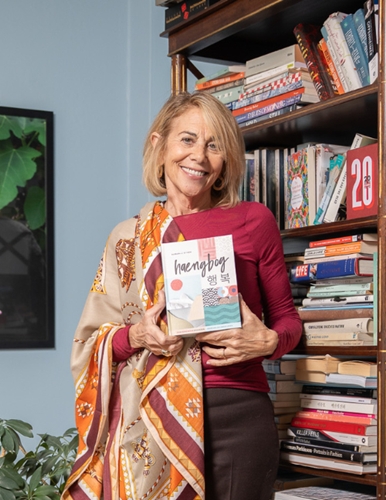
Barbara J. Zitwer poses with "Haengbog," the Dutch-language translation of her self-help work "The Korean Book of Happiness."
Which Korean author has influenced you the most and why?
Shin Kyung-sook has influenced me the most because of her character and talent. In my view, her works are among the greatest writings from Korea. I see her as the Anne Tyler or Jane Austen of Korea. Her writing is poetic and tender, giving voice to women who are often unheard. Her books also speak to me because of their feminist themes and she's a breakthrough author in Korea who opened doors for others.
I also deeply admire her discipline and work ethic; despite personal trials, she continues to write with unwavering dedication. Beyond writing, she treats readers with remarkable warmth and generosity, patiently engaging with them and making each feel valued. Despite her fame, she remains humble and unpretentious. From her, I have learned discipline, resilience and kindness.
What are your plans?
I will do more work on film adaptations of Korean novels. I've been working a lot in the film business with my Korean authors.
I also plan to visit Korea this year and go to Busan, where I haven't been yet. When I visit Korea, I don't just go to book fairs or meet publishers; instead my authors take me on little adventures. And I want to connect with new and young Korean writers and find the latest trends; I've always felt that Korean writers are ahead of the world in their sensibilities.
jcy0531@korea.kr
*This article is written by a Korea.net Honorary Reporter. Our group of Honorary Reporters are from all around the world, and they share with Korea.net their love and passion for all things Korean.