- 한국어
- English
- 日本語
- 中文
- العربية
- Español
- Français
- Deutsch
- Pусский
- Tiếng Việt
- Indonesian
By Honorary Reporter Foteini Chatzoudi from Greece
Photos = PL Entertainment
"Swag Age: Shout Out, Joseon!" is a growingly popular musical that uses a Joseon Dynasty (1392-1910) setting to feature contemporary Korean music and street dance.
Originally a 2017 student project at the Seoul Institute of the Arts, the work has won awards in Seoul and London, becoming the first Korean musical to win Best Concert Production at last year's BroadwayWorld UK / West End Awards.
The story is about Dan, a young man whose father is wrongly accused of treason and who uses a secret group who uses rap-style poetry and dance to fight for freedom and justice.
The following are excerpts from an email interview from Jan. 15-21 with key members of the musical's production staff.
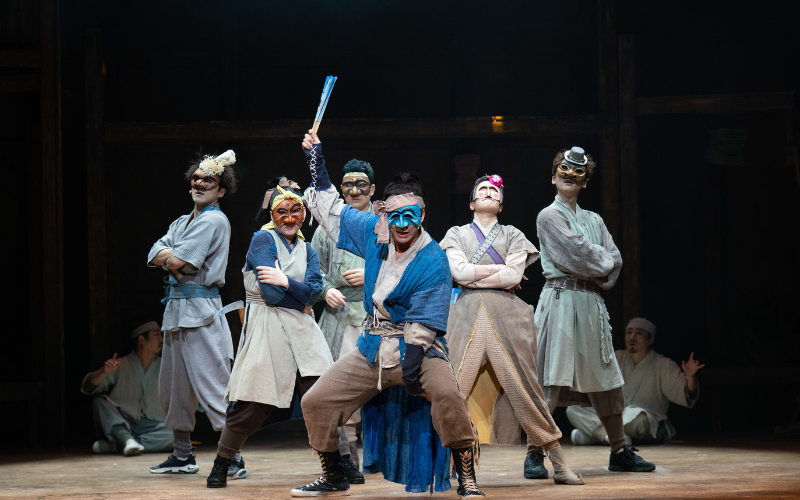
This scene from "Swag Age: Shout Out, Joseon!" features the use of the traditional mask Hahoe tal.
What inspired the creation of the musical?
Writer Park Chan-min: I conceived this work during a period of major social change in Korea, watching citizens gather to bring political change. Witnessing the resignation of the highest authority made me reflect on the collective power of speech. This led to a central question: What if a society prohibited such voices altogether? So I imagined a world where speech is a crime, using the Joseon Dynasty to clearly portray this oppression. By pairing this with rap, I aimed to connect past and present. Though the work does not reference specific events, the emotions and power of collective voice from that time are embedded in its foundation.
How did you balance Korean history and contemporary expression?
Park: What mattered most to me was not historical reproduction but the inheritance of spirit. Rather than strictly reconstructing Joseon, I focused on preserving its structures of oppression, emotional reality and relational dynamics while boldly adopting modern forms of expression. To avoid awkward fusion, I ensured that every element functioned as narrative language rather than decoration.
I wanted rap to feel natural to Dan, not like an added gimmick. In the Joseon era, people competed by reciting sijo (traditional poetry), much like modern rap battles. That connection helped me harmonize historical subject matter with contemporary expression.
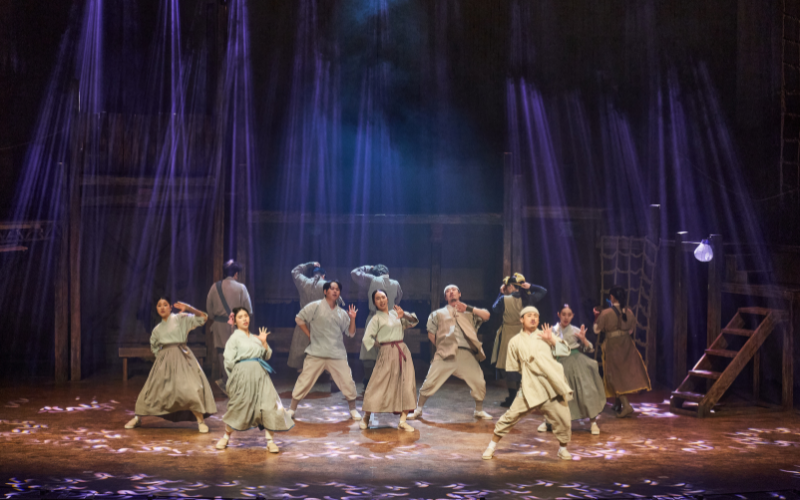
Dance number in "Swag Age: Shout Out, Joseon!"
How did you translate hip-hop movements into a Joseon-era setting?
Choreographer Kim Eun-chong: I consider hip-hop a language of resistance and survival. The oppressed commoners in Joseon were also beings who found it difficult to directly express their emotions within the social structure. Therefore, rather than the ostentatious movements of hip-hop, I created the choreography around a sense of rhythm that lowers the body, shrinks and moves quickly. This was to show commoners who were intimidated in front of power while allowing their emotions like pent-up anger to erupt through street dance.
Ultimately, hip-hop was incorporated not as a foreign element, but as a body language that oppressed people across eras have commonly chosen.
What inspired the music in "Swag Age?"
Composer Lee Jeong-yeon: It started from a desire for a wider public to enjoy the beautiful tones and sentiments of traditional Korean instruments. The sentiments of han (feeling of regret and sorrowful longing) and heung (excitement) I felt when learning about such instruments in college left a lasting impression, and I sought to blend this with modern popular genres such as pop, hip-hop and dance.
I also wanted for sijo, a key element of the work, to be easily accepted and experienced as entertainment. By expressing this traditional poetic form through different musical styles based on each character's status and personality, I aimed to sharpen contrasts and deepen the drama.
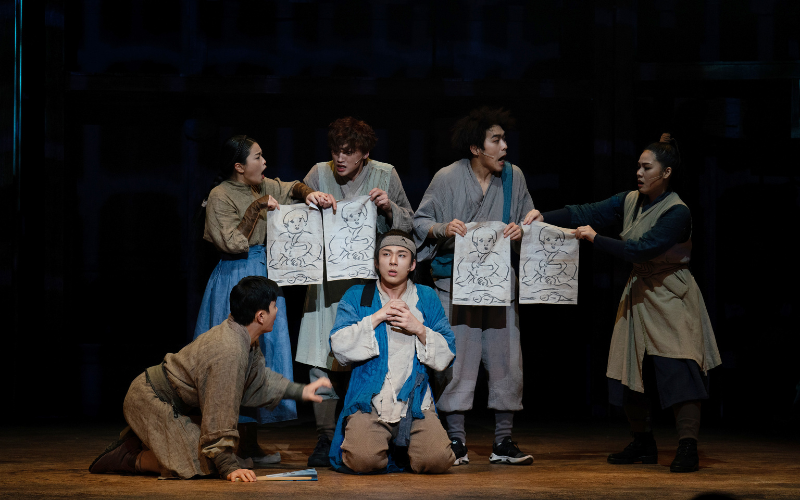
Scene from "Swag Age: Shout Out, Joseon!"
What do you think best captures the spirit of this musical?
Park: I believe the core spirit of our work is captured in a single line Dan delivers in the final scene: "You can take our lives but not our shouts." It reflects our belief that while authority can oppress the body, it cannot erase the voice from within or the emotion that ultimately moves the world.
What does the success of "Swag Age" mean for the future of Korean musicals?
Producer Song Hye-sun: This work highlights the power of original content possessed by Korean creative musicals and the outstanding capabilities of the cast. I hope it's an opportunity for Korean musical actors and technical staff to be recognized worldwide. "Swag Age" will stoke global interest in other Korean musicals.
jcy0531@korea.kr
*This article was written by a Korea.net Honorary Reporter. Our group of Honorary Reporters are from all around the world, and they share with Korea.net their love and passion for all things Korean.