- 한국어
- English
- 日本語
- 中文
- العربية
- Español
- Français
- Deutsch
- Pусский
- Tiếng Việt
- Indonesian
By Honorary Reporter Foteini Chatzoudi from Greece
Kim Eunji, who also goes by Kklily, is a traditional percussionist and educator based in Toronto. She plays the janggu (traditional drum) and teaches traditional Korean rhythms and percussion instruments in the Canadian capital.
She also has a YouTube podcast that introduces traditional Korean music in English.
Kim performed at the Toronto Korean Festival in August last year and a reception marking National Foundation Day and Armed Forces Day in Korea later that October in Ottawa. On June 28, she will perform with Dokebi, a four-member fusion band rooted in traditional Korean music, at the Korean Cultural Centre in Canada.
In an email interview from Feb. 23 to March 5, she discussed her art and educational journey in Toronto.
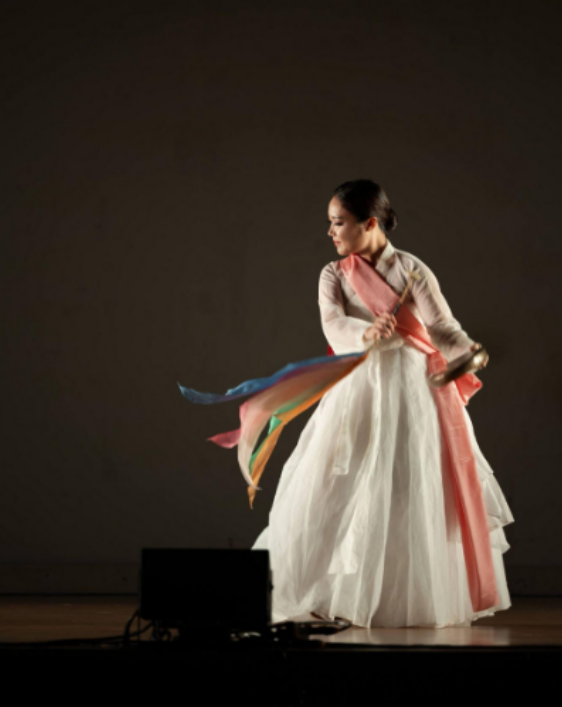
Kim Eunji on Aug. 10, 2024, performs at the Soo Ryu Dance Festival at the main auditorium of the Korean Canadian Cultural Association in Toronto. (Kim Eunji)
Why did you decide to pursue traditional Korean percussion?
My journey began in elementary school after I watched a "Nanta" (non-verbal comedy show) performance with my mother. I was captivated by the sheer power and excitement of percussion. What I love most about percussion is its ability to take on many roles, whether as a solo instrument, accompaniment or part of an ensemble. Performing with others, sharing energy on stage and creating musical synergy together made traditional Korean percussion deeply meaningful to me.
How does teaching your art in Toronto affect your students?
Many students join my classes because they're curious about Korean culture or want to learn janggu. As they learn, they not only develop rhythm, coordination and memorization but also a deeper understanding of Korean cultural values. I often cover the cultural elements embedded in the drum, from the way we sit and hold the janggu to the philosophies and traditions reflected in Korean performing arts.
Ensemble-based learning also fosters teamwork and community. Seeing students build connections by listening to one another and moving together as a group is the most rewarding aspect of my teaching.
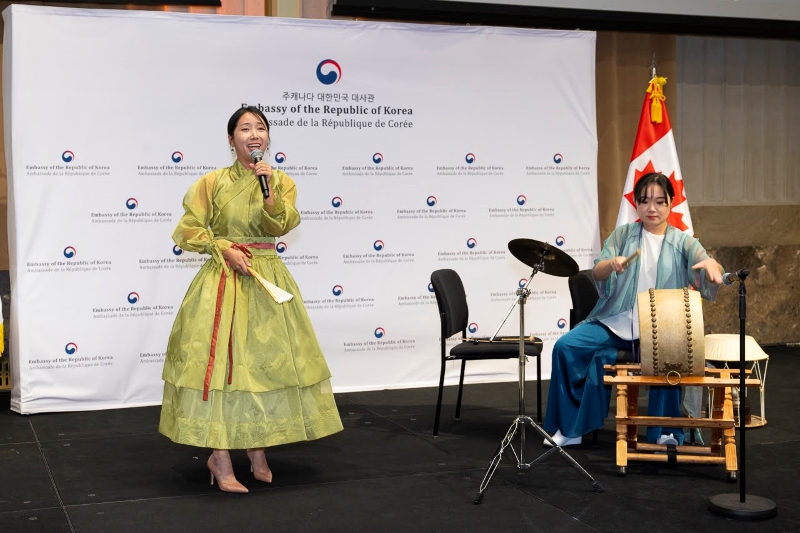
Dokebi members Lee Sangah (left) and Kim Eunji (right) on Oct. 8, 2025, perform at a reception marking Korea's National Foundation Day and Armed Forces Day at Sir John A. Macdonald Building in Ottawa. (Korean Embassy in Canada)
What are the biggest challenges of teaching traditional Korean music abroad?
The main challenge is accessibility. Traditional Korean percussion requires specialized equipment and venues capable of accommodating its specific acoustic and spatial needs. Because the janggu is still relatively unfamiliar in Toronto, many venues are unaccustomed to its volume and performance setup. This often requires extensive coordination with venue staff to optimize acoustics and find practical solutions. But I view these logistical challenges as an essential part of introducing Korean music to new communities.
What are your goals?
I intend to explore the creative possibilities of percussion through musical projects and continue to expand educational opportunities in Canada. With Dokebi, I hope to reach even wider audiences through collaborative performances. As global interest in Korean culture grows, I believe traditional Korean music is a bridge that promotes Korea's depth, history and spirit to the world.
ljyhwa@korea.kr
*This article was written by a Korea.net Honorary Reporter. Our group of Honorary Reporters are from all around the world, and they share with Korea.net their love and passion for all things Korean.