- 한국어
- English
- 日本語
- 中文
- العربية
- Español
- Français
- Deutsch
- Pусский
- Tiếng Việt
- Indonesian
By Honorary Reporter Foteini Chatzoudi from Greece
Photos = Hong Yeonji
Hong Yeonji is a dancer and choreographer based in Toronto, Canada, who holds a Ph.D. in traditional Korean dance from Sejong University in Seoul. Her awards include the Minister of Culture, Sports and Tourism Award (2010) and Presidential Award (2012).
She completed training in Pyeongyang geommu (sword dance) in 2024 and was designated last year a transmitter of this art, which is designated Pyeongannam-do Intangible Cultural Heritage. Since 2018, she has taught traditional dance at the Korean Cultural Centre (KCC) in Ottawa.
In an email interview from May 14-15, Hong discussed promoting and preserving geommu and other traditional dances.
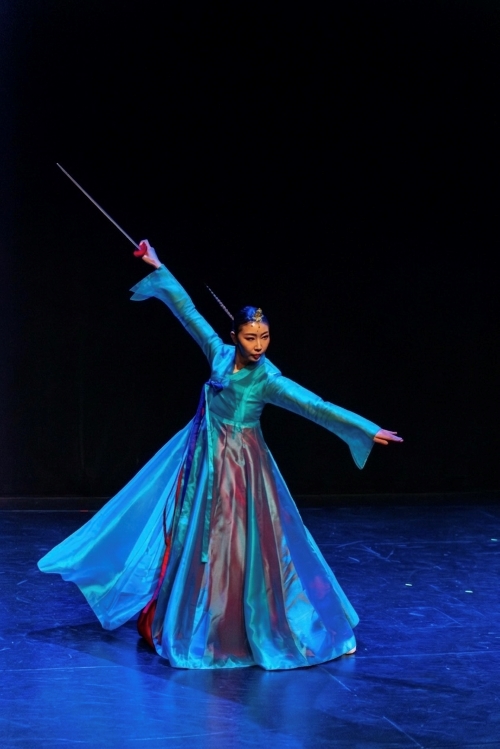
Hong Yeonji on June 5 performs a janggeommu (long sword dance) at the event "Sword Dance: The Warrior, The Artist and The Woman" at the Arts Court Theater in Ottawa, Canada.
What drew you to geommu?
What fascinated me most was its balance of strength and grace. I loved how a weapon of war became an art form. It brings together the disciplined power of a warrior and the dynamic movement of a dancer, creating a refined and beautiful harmony.
What aspects of your art are the most difficult?
I would say the physical weight of the sword. It places significant pressure on the shoulders and requires strong control, stability and precise movement. Another is adaptation to different types and sizes of swords, each of which demands a different technique and spatial awareness.
What are the main elements of a geommu performance?
The work is composed of three distinct acts, each centered around different types of Korean swords and their corresponding choreographic languages. Through these variations, the sword isn't treated as a weapon but as a symbolic object with layered meanings.
Do you perform with real swords?
I use replicas rather than real swords. The blades are intentionally blunt to allow the dancers to safely rotate and manipulate them as part of the choreography. In janggeommu (long sword dance), the sword is a wooden prop while in ssanggeommu (twin sword dance), the swords are made of stainless steel.
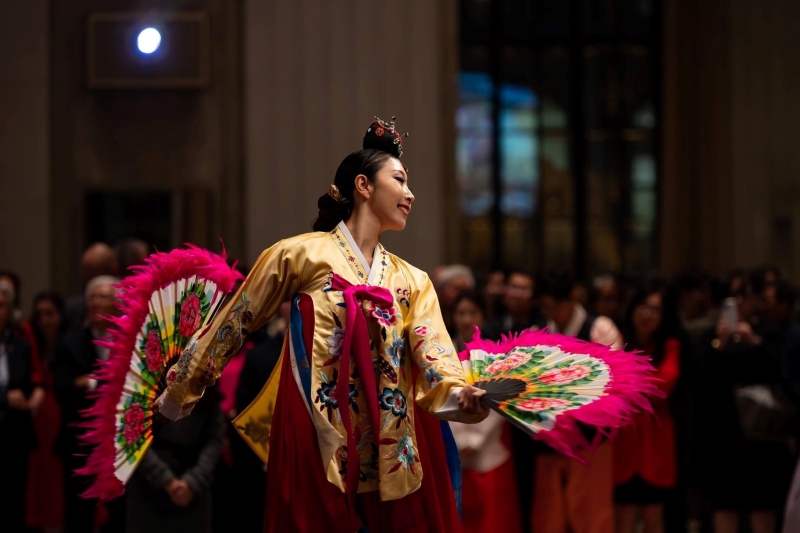
Hong Yeonji on Oct. 7, 2024, performs a buchaechum (traditional fan dance) at a Korean Cultural Heritage Month event at the Sir John A. Macdonald Building in Ottawa, Canada.
What other traditional dances do you perform?
During my time with the National Dance Company of Korea, I performed in their signature production "Korea Fantasy," which showcased a wide range of traditional performing arts like taepyeongmu (great peace dance), buchaechum (fan dance), janggu (traditional drum), sogo (small drum) and samgomu (standing drum).
While I'm deeply rooted in traditional forms, my artistic practice has expanded into creative Korean dance, where I explore how traditional movement can evolve within contemporary choreography. For me, performing across traditional repertoire and creative works is not a separation but a continuous dialogue that keeps Korean dance alive and evolving.
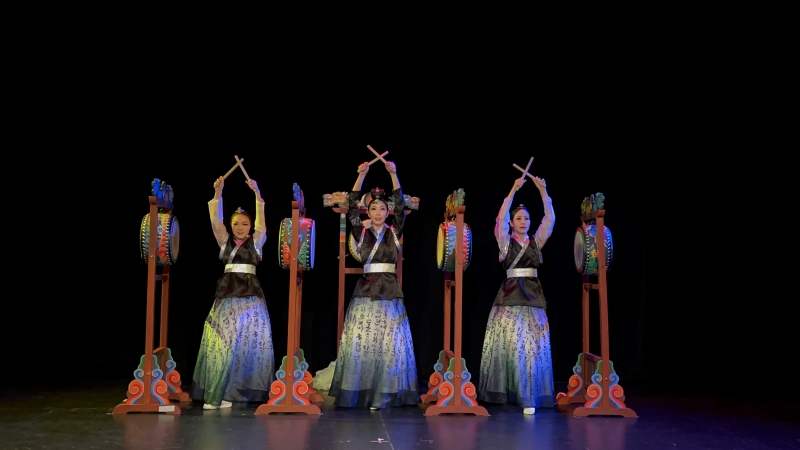
Hong Yeonji (center) on May 27, 2023, performs a samgomu (traditional standing drum dance) during the event "Re:Awaken" at the Arts Court Theater in Ottawa, Canada.
What should be done to preserve and promote geommu and other Korean dances?
I believe three key directions should preserve and globalize geommu and other traditional dances. First, sustainable government and institutional support is needed for long-term preservation and development. Second, traditional dance should be presented alongside popular arts such as K-pop to expand global visibility and audience engagement. Third, establishing more Korean dance academies and structured training systems worldwide is essential.
From my eight years of teaching at the KCC in Canada, I've seen that with proper support and opportunities, international students can develop into dedicated practitioners and continue sharing the dances in their communities.
What are your goals?
I want to keep presenting traditional dance more widely while serving as a cultural bridge between traditional and contemporary expression. As a member of the National Unification Advisory Council, I also hope to share Pyongyang geommu more actively as an artistic expression that symbolizes inter-Korean peace and cultural connection.
This year, I'm developing the new dance production "Gat," inspired by the traditional men's hat.
ljyhwa@korea.kr
*This article was written by a Korea.net Honorary Reporter. Our group of Honorary Reporters are from all around the world, and they share with Korea.net their love and passion for all things Korean.