- 한국어
- English
- 日本語
- 中文
- العربية
- Español
- Français
- Deutsch
- Pусский
- Tiếng Việt
- Indonesian
By Honorary Reporter Foteini Chatzoudi from Greece
Photos = Kim Jandee
Go Boh-kyung is a textile artist based in Gwangju, who creates sculptural works with Hanji (traditional paper) yarn and ottchil (otchil) (traditional lacquer).
Through the slow and repetitive process of weaving Hanji yarn and applying layers of lacquer, she explores how time can be expressed through material, texture and form.
In the past, Hanji was an essential part of everyday life, valued for its durability and practical uses. By shaping Hanji into forms inspired by traditional Korean vases and incorporating techniques such as otchil, Go highlights the beauty of Korean culture while showing how a traditional material can be reimagined in modern art.
Go has displayed her art at exhibitions in Korea and abroad including "That's Korea: Hanji" at the National Marciana Library (2023) in Venice, Italy; "That's Korea" (2025) at the Korean Cultural Center in Brussels; Korean Crafts Exhibition at the Asia-Pacific Economic Cooperation forum (2025) at Cheongun Complex Cultural Space in Gyeongju, Gyeongsangbuk-do Province; and "Room of Chaekgado" (2026) at the space LOFA Seoul of 63 Square (63 Building) in the capital.
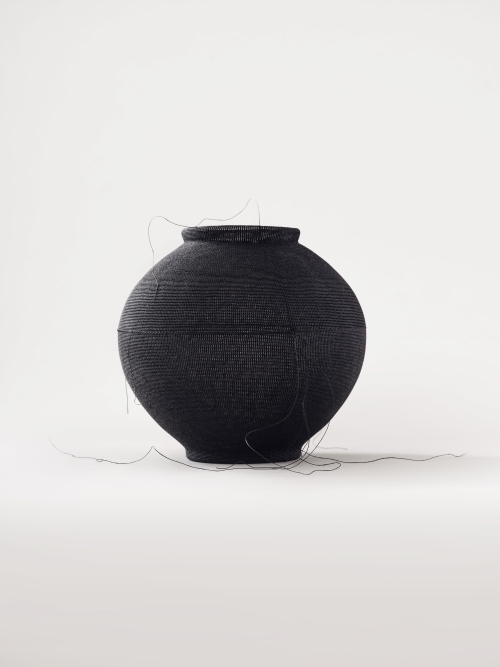
Moon jar-shaped work "Time Woven, Space Timed," made with Hanji yarn and ottchil (December 2025)
The following are excerpts from an email interview with Go from June 11-23.
Why do many of your works focus on Korean vases and bowls?
I choose as forms timeless objects such as glass bottles and bowls that condense the familiarity of everyday life, or the moon jar (traditional white porcelain vessel), which has a long history. Instead of being mere vessels to hold things, these objects are a "framework for weaving time." I summon the collective memories left within familiar everyday forms and store my own physical and emotional traces inside them, presenting a holistic world where times cross and overlap.
Describe the materials and methods you use.
I focus on weaving Hanji yarn to build forms and then layering ottchil over it. This process in which flexible textile meets lacquer creates a sculptural structure where objects, memories, materials and time intertwine. And the realization that fragile threads gain greater strength as they interlace and connect stems from a childhood experience of watching my mother knit.
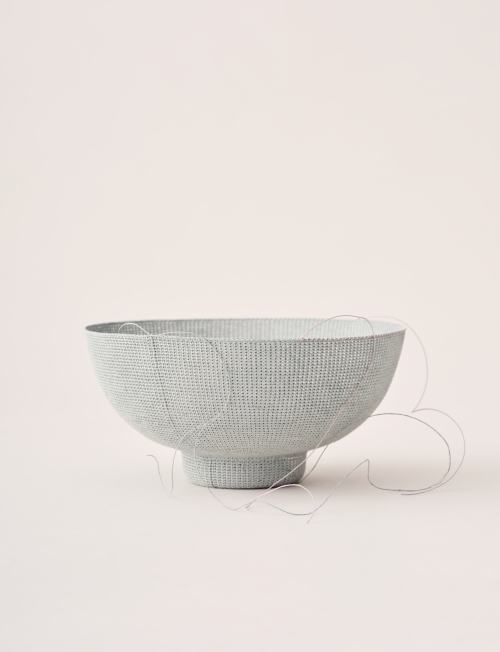
Bowl-shaped work "Time Woven, Space Timed" made with Hanji yarn and ottchil (December 2025)
What do you feel stands out most in your artistic style?
It lies in the "reversal of materiality and the translation of time," where delicate materials are structured into solid forms through repetitive actions. Grounded in the perception I absorbed in my youth from my mother’s knitting that even a fragile thread grows stronger when connected, I engage in a performative process of weaving fiber and adding lacquer.
In your view, how do artists keep Korean traditional crafts alive?
It's crucial not to view tradition as a fixed heritage frozen in the past, but as a foundation continuously recreated here and now. I believe artists today keep tradition alive and breathing by expanding traditional materials and techniques into contemporary visual culture and frameworks of thought, allowing viewers to experience the deep sensory strata beyond the material.
ljyhwa@korea.kr
*This article was written by a Korea.net Honorary Reporter. Our group of Honorary Reporters are from all around the world, and they share with Korea.net their love and passion for all things Korean.