- 한국어
- English
- 日本語
- 中文
- العربية
- Español
- Français
- Deutsch
- Pусский
- Tiếng Việt
- Indonesian
By Honorary Reporter Preeti Rawat from India
Photos = Preeti Rawat
The Korean Cultural Centre in New Delhi, India, through Aug. 19 is hosting the touring exhibition "Aqua Paradiso" as part of the program "Touring K-Arts" sponsored by the Korean Ministry of Culture, Sports and Tourism and the Korea Foundation for International Cultural Exchange.
The display features works by three Korean artists that explore water as a lively being, ecological subject and record of human activity.
The first of the three is Boo Jihyun, whose works are part of the collections of Art Bank, an affiliate of the National Museum of Modern and Contemporary Art, Korea, Jeju Museum of Contemporary Art and Jeju Museum of Art.
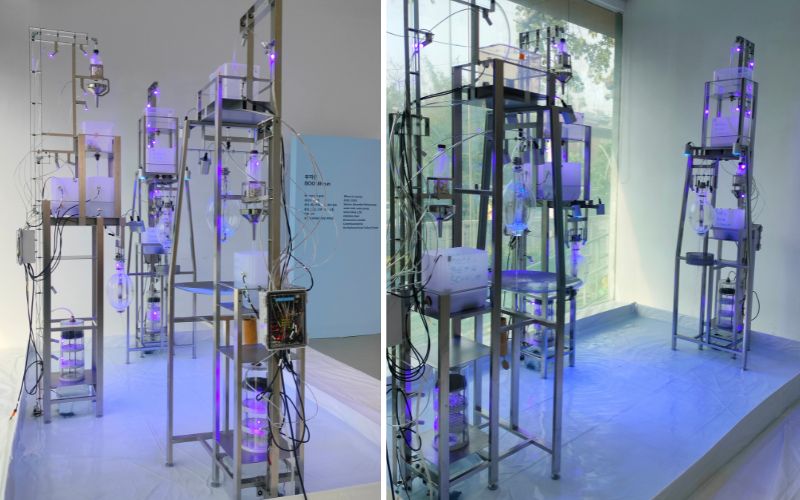
Boo Jihyun’s "Where Is It Going"
Her 2025 edition of the installation "Where Is It Going" was made from discarded plastic containers as an explicit reference to industrial waste and contemporary environmental concerns to examine the cyclical nature of water and life, as well as the relationship between humans and nature.
In an artist's note, Boo said, "I hope to create an opportunity for viewers who experience the installation to consider questions about the proper use of water, attention toward the environment and the difficult issues that water shortages cause."
The second artist, Kwon Hyewon, uses video and installation to explore time, space, nature, technology and history not yet formally recorded. Named to the list of Bloomberg New Contemporaries of the UK in 2011, she has had her works included in the collections of the Museum of Contemporary Art Busan and Art Bank.
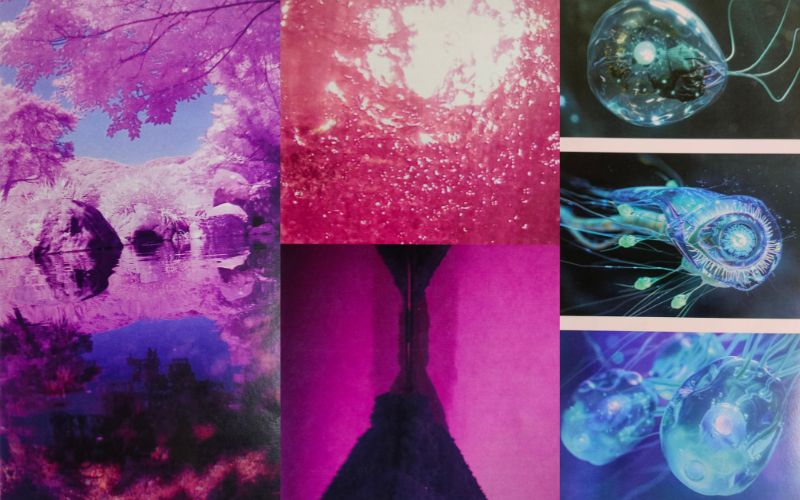
Kwon Hyewon's "Liquid Vision"
Presented as a video report, Kwon's 2025 version of "Liquid Vision" presents the perspective of an exploratory robot that comes to Earth from outer space.
In her artist's note, she said, "By looking at Earth through alien eyes, it renders our environment strange and encourages us to reflect on the inherent meanings of water, light and touch."
Rounding out the trio is Jung Eunhae, an eco-artist and director of the art and environment organization Jeju Eco Project OROT. She received Green Korea United's Beautiful Earthling Award in 2021 for her contributions to environmental activism.
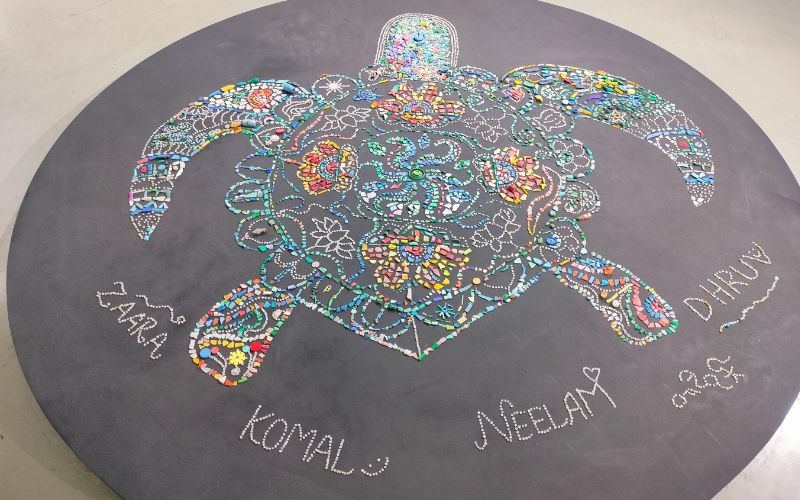
Jung Eunhae's "Plastic Mandala"
In "Plastic Mandala," she used discarded plastic from the sea to repeatedly construct and dismantle mandalas, which symbolize cycles and blessings. This year's version of her work was inspired by a red sea turtle that died after consuming plastic and a green sea turtle that travels many km to reach its home.
Her second installation, "Ocean Tears," combines tree branches with discarded fishing nets, microplastics, glass bottles and other waste from the ocean.
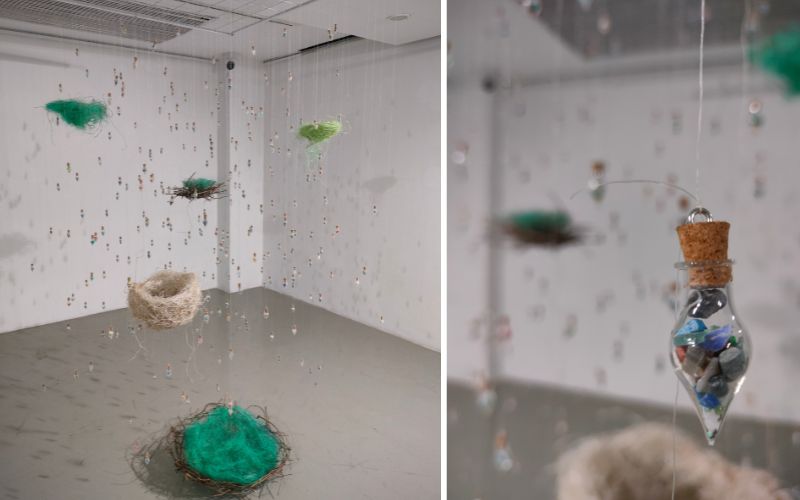
Jung Eunhae's "Ocean Tears"
In her artist’s note, Jung said about "Ocean Tears," "As I was creating this work, I spent a lot of time thinking about what role art can play in the climate crisis era. Perhaps art can serve to evoke compatible emotions in us—feelings of joy and guilt, for example."
ljyhwa@korea.kr
*This article was written by a Korea.net Honorary Reporter. Our group of Honorary Reporters are from all around the world, and they share with Korea.net their love and passion for all things Korean.