- 한국어
- English
- 日本語
- 中文
- العربية
- Español
- Français
- Deutsch
- Pусский
- Tiếng Việt
- Indonesian
By Honorary Reporter Debolina Ghosh from India
Photos = Kim Jinho
For centuries, gold has symbolized everlasting beauty, timelessness and elegance, something that lives on in Kumbakyeon, a family workshop for traditional gold leaf decoration spanning six generations.
Kumbakyeon in Seoul's Jongno-gu District has preserved the traditional craft of applying extremely thin sheets of gold leaf onto fabric to create intricate patterns. Every motif carries a wish for happiness, long life, prosperity and good fortune.
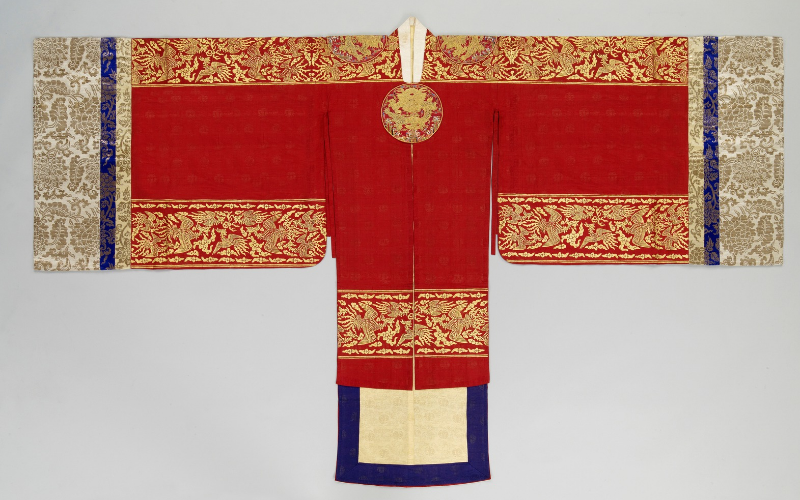
Hongwonsam, the 1922 ceremonial robe of Crown Princess Yeong with intricate gold leaf imprinting work made by an earlier generation of the Kim family, is displayed at the National Palace Museum of Korea in Seoul's Jongno-gu District.
A gold leaf is so delicate that even a slight change in pressure, movement temperature or humidity can affect the result. This tradition has been preserved for 170 years by the Kim family.
The followings are excerpts from an email interview from Aug. 7-20 with masters Kim Gi-ho and Park Soo-young and sixth-generation trainee Kim Jinho.
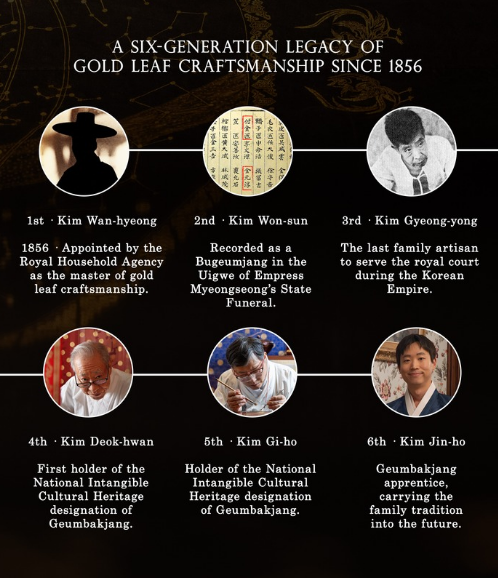
Six-generation lineage of Kim family's gold leaf workshop since 1856
The workshop began in 1856 when Kim Wan-hyeong was appointed master gold leaf artisan during the reign of King Cheoljong of the Joseon Dynasty (1392-1910). The fourth artisan, Kim Deok-hwan, was the first to earn the designation National Intangible Cultural Heritage of geumbakjang (gold imprinting craft). Fifth-generation artisan Kim Gi-ho grew up watching his father practicing the family craft.
"Gold leaf is not simply a profession, it's part of my family's history and an important part of traditional Korean culture," Kim Gi-ho said. "I believe tradition is not about simply repeating what was done in past but preserving its spirit and techniques while passing them on to the next generation."
Forcing tradition into unfamiliar forms can lead to loss of identity, he added, while creating new patterns requires the courage to explore. "Patterns are not simply decorative elements -- they're an important part of expressing a work's identity," he said.
![Gold Leaf Imprinting work on Traditional Royal Court Daenggi( Dae Daenggi) for a Princess's Wedding and Ceremonial Occasion[October 2025]. Picture credit- Kim Jinho Cheonsang Yeolcha Bunya Jido, a Korean Celestial map carved in stone(September 2025). Picture credit- Kim Jinho](/upload/content/editImage/20260908100419858_XHAJE7JF.jpg)
On the left is gold leaf imprinting work on traditional royal daenggi (hair ribbons) for a princess' wedding and ceremonial occasion and on the right is the celestial stone map Cheonsang Yeolcha Bunya Jido.
This balance between preservation and change is also central to Park's experience. After marrying into the family, she began living with her parents-in-law, whose workshop was part of their home.
At first, she simply helped their work but gradually grew fascinated by the patience and care behind every piece. Watching her in-laws devote enormous attention to a single sheet of gold taught her that geumbak was far more than technique.
"Gold leaf isn't something I consciously chose as a profession, Rather, it was a path I naturally encountered through my family's way of life and one I was drawn to because of the spirit of craftmanship I found within it," she said.
The tradition is taking another step forward through Kim Jinho, the sixth-generation trainee of the family. Gold leaf was always a part of his childhood, as he remembered seeing his grandparents and parents working in the same room.
Despite growing up surrounded by geumbak, he never expected to make it his career but his roots led him to gradually learn the family craft. "Being the sixth generation gives me a strong sense of pride but also a great deal of responsibility," he said.
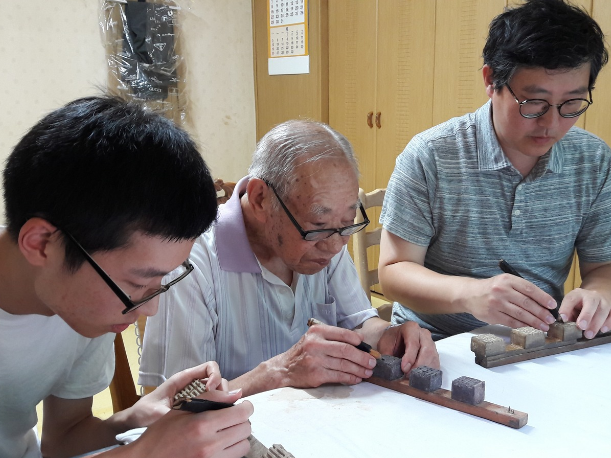
Sixth-generation family trainee Kim Jinho (from left), fourth-generation grand master Kim Deok-hwan and fifth-generation master Kim Gi-ho on Aug. 16, 2016, carve wooden printing blocks for gold leaf imprinting at their workshop in Buckchon Hanok Village in Seoul's Jongno-gu District.
ljyhwa@korea.kr
*This article was written by a Korea.net Honorary Reporter. Our group of Honorary Reporters are from all around the world, and they share with Korea.net their love and passion for all things Korean.