- 한국어
- English
- 日本語
- 中文
- العربية
- Español
- Français
- Deutsch
- Pусский
- Tiếng Việt
- Indonesian
By Honorary Reporter Preeti Rawat from India
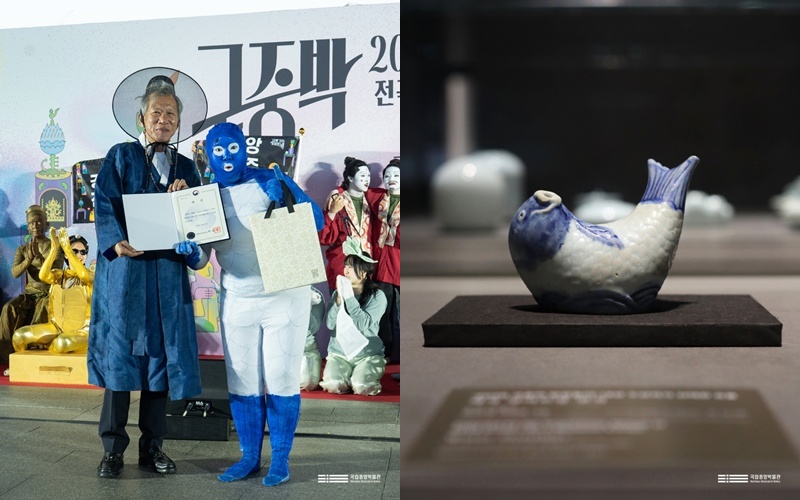
Jeon Eun-seul (right in left photo), the grand prize winner of the contest "Dress Like a Museum Exhibit," on Sept. 19 poses for a photo at the National Museum of Korea with the latter's director You Hong June after receiving her award for the white porcelain water dropper (right) shaped like a carp she recreated. (Museum's official Instagram page)
The National Museum of Korea on Sept. 19 held the finals of the contest "Dress Like a Museum Exhibit" in Seoul, with 25 competitors in costume showing off their artifact recreations from Korean historical periods and regions. Now in its third year, the event was held on a nationwide scale for the first time, attracting 643 participants on 275 teams.
Jeon Eun-seul, a senior nursing student at Joongbu University in Geumsan-gun County, Chungcheongnam-do Province, won the grand prize of KRW 3 million for her rendition of a white porcelain water dropper shaped like a carp from the Joseon Dynasty (1392-1910).
In an email interview from Sept. 19-25, she discussed what inspired her to make her winning entry, how she brought it to life and what winning the grand prize meant to her.
What inspired you to participate in "Dress Like a Museum Exhibit?"
I used to simply appreciate artifacts with my eyes and look at them lightly, focusing mainly on the overall shape. But while researching materials and looking at images to become the artifact myself, I felt the details that our ancestors put into them. After discovering details seen only when looking closely, I decided that when I visit museums, I will focus on observing each artifact in detail instead of just looking through many of them.
Why did you decide to recreate the white porcelain carp-shaped water dropper?
When I first saw this artifact, I suddenly thought that it looked like a freshly caught carp flapping around. It had an expression of being wronged because it was caught. I incorporated this interesting characteristic into a stage performance, and by adopting a lively concept based on a live fish, I gave the artifact personality and dynamic movement.
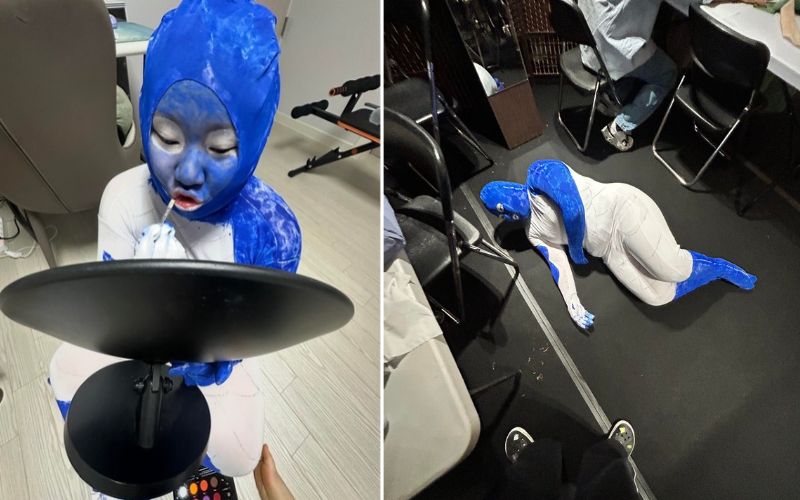
Jeon Eun-seul (left) finishes up her interpretation of the white porcelain carp-shaped water dropper at home and takes a break (right) after practicing at the waiting room of Daegu National Museum in Daegu's Suseong-gu District. (Jeon Eun-seul)
How did you balance creativity and humor when creating your costume?
While conveying humor, I sought not to damage the original value of the cultural heritage. If the expression got too excessive, I thought it could weaken the essence of the artifact, so I wanted to maintain the item's unique shape and form as much as possible.
When making the costume, I also considered drawing the scales with a shiny pen, but thought that would remove the still and calm beauty unique to white porcelain. So to accentuate the elegance of white porcelain, I expressed the scales with light and subtle lines as if slightly shaded, conveying respect.
Can events like this make Korean heritage more accessible to youth and the world?
I feel that the younger generation is forming a relationship with cultural heritage in a completely different way. After competing in "Dress Like a Museum Exhibit," I saw how participants and visitors didn't stop at simply viewing the event as a one-time experience but enjoyed it together. I think the practice of artifacts coming out to move and perform instead of just quietly remaining behind glass is a powerful and original way to grab public attention in Korea and the world.
What do you hope people will take away from this event?
I hope that overseas audiences will first develop curiosity after seeing my performance, thinking, "Oh, Korea has such a witty and unique artifact." I also hope that this fuels curiosity over what the artifact used for and why it was made. I want people to appreciate the historical meaning and emotions within the artifact and discover Korea's rich history and cultural heritage.
ljyhwa@korea.kr
*This article was written by a Korea.net Honorary Reporter. Our group of Honorary Reporters are from all around the world, and they share with Korea.net their love and passion for all things Korean.