- 한국어
- English
- 日本語
- 中文
- العربية
- Español
- Français
- Deutsch
- Pусский
- Tiếng Việt
- Indonesian
By Honorary Reporter Debolina Ghosh from India
Photos = Jung Chan Hee
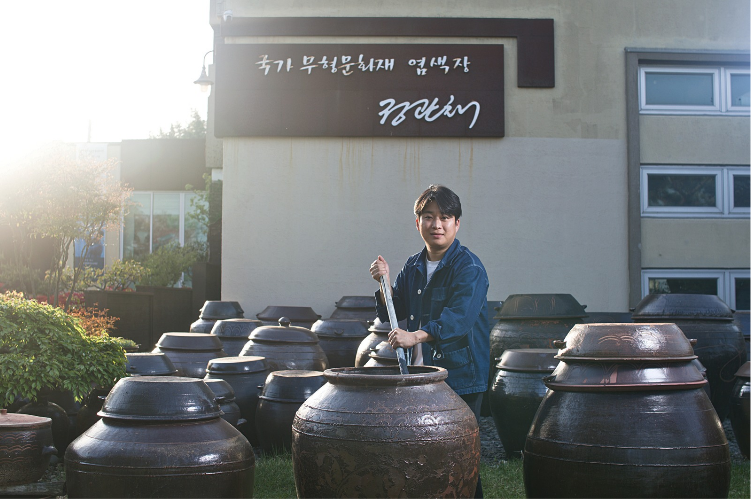
Jung Chan Hee in March, 2026, poses at his father's indigo dyeing heritage center in Naju, Jeollanam-do Province.
Traditional indigo dyeing is more than an art -- it connects nature, technology and masters of the craft. This tradition has been part of Korean culture since before the Three Kingdoms period, and its value as a cultural heritage practice worth preserving has gained greater recognition today amid growing emphasis on environmental conservation.
Jung Chan Hee is a certified apprentice in the discipline. His father Kwan Chae, who is designated a National Intangible Cultural Heritage of Korea and holds the title of yeomsaekjang (traditional dyeing master), runs an indigo dyeing heritage center bearing his name in Naju, Jeollanam-do Province.
Drawing on his family tradition and expertise in polymer and fiber engineering, the junior Jung searches for new ways to combine traditional craftsmanship with modern techniques.
The following are excerpts from an email interview with the trainee from Sept. 30 to Oct. 8 on his vision for the art.
How did you grow interested in traditional indigo dyeing?
Indigo dyeing has always been a natural part of my life. I grew up watching my father work and grew familiar with the process from an early age. To find my own way to carry on the family tradition, I studied polymer and fiber engineering at university.
My Ph.D. research focused on the fermentation and reduction processes of traditional indigo dyeing, exploring how to apply these ancient techniques to modern settings. Today, my interests have broadened to other traditional textile crafts and intangible cultural heritage.
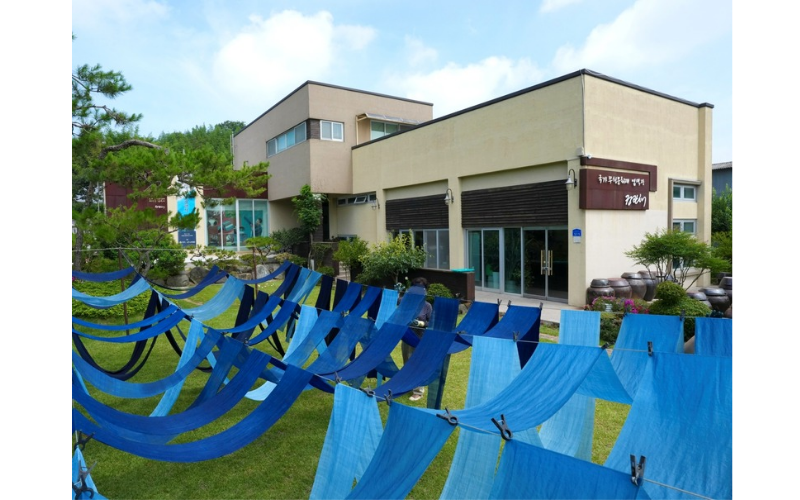
Indigo-dyed fabrics in July 2025 hang to dry at Jung Kwan Chae's indigo dyeing heritage center in Naju, Jeollanam-do Province.
When people think of traditional indigo dyeing, they often imagine dipping fabric into a large jar of blue dye. But our process begins much earlier. We sow the seeds in early spring and harvest them during the hot summer to extract the blue indigo pigment.
Once the pigment has been prepared, it undergoes a traditional fermentation-based reduction process that makes it suitable for dyeing. We can then dye fabrics and use them to create textile and craft products. The main materials we use are natural indigo extracted from plants, slaked lime and alkaline ash water.
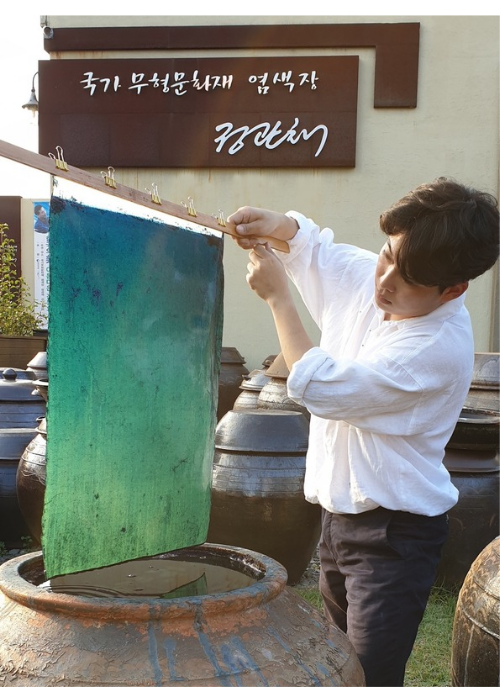
Jung Chan Hee in July 2022 applies natural indigo dye to Hanji (traditional paper) at his father's dyeing heritage center in Naju, Jeollanam-do Province.
What was your biggest challenge in dyeing and how did you overcome it?
The greatest challenge was understanding what it really means to preserve a traditional craft as a practitioner and finding my own role within that tradition. I often asked myself what needed to be preserved and what could be developed further.
Finding balance between these two hasn't always been easy. But rather than a problem to solve once and for all, I've come to see it as an ongoing process of learning and discovery.
What is your approach to practice this traditional craft in a modern setting?
Today, I see many opportunities to introduce traditional crafts to contemporary life through various spaces, experiences and cultural programs. I believe that how we communicate the value of a tradition is just as important as the tradition itself.
So we recently built a showroom and guest accommodation near our heritage center to create an environment that allows deeper appreciation for the craft. We also need to improve the working and living conditions of the people who carry them forward.
ljyhwa@korea.kr
*This article was written by a Korea.net Honorary Reporter. Our group of Honorary Reporters are from all around the world, and they share with Korea.net their love and passion for all things Korean.