- 한국어
- English
- 日本語
- 中文
- العربية
- Español
- Français
- Deutsch
- Pусский
- Tiếng Việt
- Indonesian
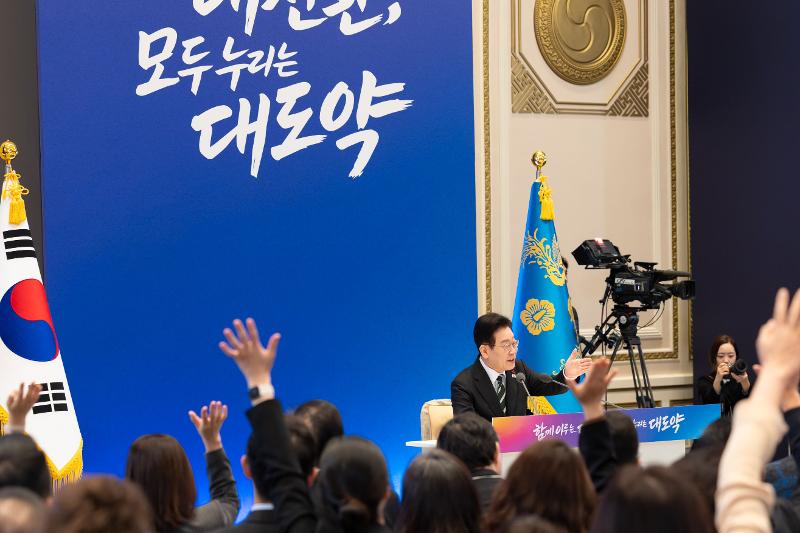
President Lee Jae Myung on Jan. 21 announces his intent to restore the September 19 Military Agreement with North Korea and strive for the early resumption of dialogue with Pyeongyang and between the U.S. and the North at a news conference held at the state guesthouse Yeongbingwan of Cheong Wa Dae in Seoul. (Cheong Wa Dae)

Yang Moo-Jin, chair professor and former president
University of North Korean Studies
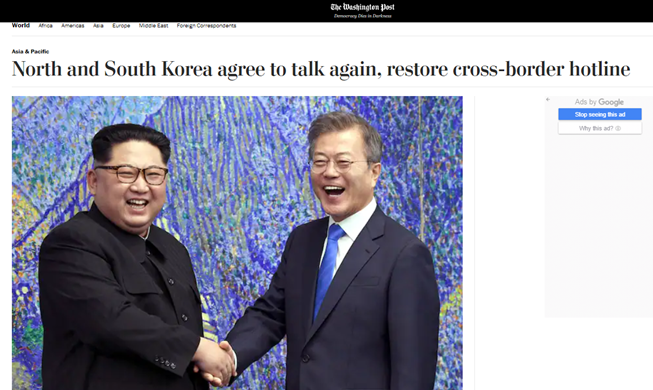
April 27, 2026, marks the eighth anniversary of the historic adoption of the April 27 Panmunjeom Declaration. In spring 2018, the sight of President Moon Jae-in and North Korean leader Kim Jong Un holding hands across the Military Demarcation Line made the world feel that peace on the Korean Peninsula was possible. At the time, both leaders solemnly declared no more war on the peninsula and pledged the full-fledged development of inter-Korean relations and setup of a peace regime.
Yet the memory of that passionate spring soon went cold, and inter-Korean ties are now stuck in a long winter.
Eight years later, the situation in the world and on the peninsula have changed. The geopolitical order has grown more complicated and severe than ever. Following the prolonged war in Ukraine, the conflict in the Middle East has entered its second month. Fears over skyrocketing oil prices and inflation due to the blockade of the Strait of Hormuz are posing a heavy burden on the livelihoods of the people.
What is the lesson can be learned from this? Undoubtedly, it is the importance of peace. Regardless of context, the cry of a Vietnam War veteran writer that "even the worst peace is better than the best war" forces contemplation on how to uphold the value of peace in a global reality riddled with war and conflict.
The Lee administration, launched in June last year, has inherited and developed the spirit of that fateful declaration signed on April 27, 2018. Under the principle of President Lee Jae Myung, who said, "The most certain security is creating a state with no need to fight," the government has developed a policy of a peaceful coexistence that places peace as the highest value to enable the two Koreas to coexist and prosper together. Furthermore, Seoul has pursued bold, preemptive measures toward Pyeongyang to restore bilateral relations — a contrast to the hard-line stance of the previous administration -- back to the path of reconciliation and cooperation. At the core of this lies a pragmatic, two-track approach that seeks space for dialogue while preventing provocation and escalation of tension.
Unsurprisingly, ties between the two Koreas are quite different from what they were in 2018. Unlike the North Korea-U.S. summit in Singapore, whose atmosphere was aided by the warm winds of peace starting from the 2018 PyeongChang Winter Olympics, the North shut the door on inter-Korean dialogue following the collapse the following year of Pyeongyang-Washington talks in Hanoi, Vietnam.
As a result, the hard-line policy of the previous Yoon Suk Yeol administration emerged as a factor behind the North's shift toward a policy of "two hostile states." Pyeongyang has since severed ties with Seoul, strengthened its nuclear capabilities, and reinforced relations with socialist countries such as Russia and China as alternatives to the Republic of Korea.
The crux is if the North's two-state theory has "totally" slammed the door on inter-Korean relations. In 1974, East Germany officially abandoned the concept of a "German nation" through a constitutional amendment to effectively adopt a "two-nation, two-state" theory. Yet the door to dialogue and exchange with West Germany was not completely closed, and reunification ultimately occurred in the most unexpected and peaceful manner. History has repeatedly demonstrated the lesson that "even closed doors can open someday."
Amid this harsh reality, how should the Lee administration open the door to inter-Korean dialogue? It needs a strategy to build long-term trust without obsessing over short-term results.
The first task is to ease military tensions on the Korean Peninsula. Restoring minimal military communication channels to prevent accidental clashes is a top priority. Also important is to demonstrate commitment to building trust through restoration of the September 19 Military Agreement.
Second, humanitarian cooperation must be used as a catalyst for dialogue. Sectors like disaster and infectious disease prevention, health care cooperation and joint use of shared rivers are pursuable separate from political conditions. Humanitarian collaboration can also be allowed even within the framework of global sanctions, and building contact points for dialogue through these means is a necessity.
Third, an indirect approach through multilateral diplomacy is needed. The North refuses bilateral dialogue with its southern neighbor, so a diplomacy of peace leveraging major players such as the U.S., China and Russia is crucial to convey indirect messages and foster a favorable environment. The key is to set up a structure where inter-Korean dialogue and negotiations between Pyeongyang and Washington complement each other, based on foundations such as Seoul's ties with Washington and Beijing.
Fourth, active support for civic exchanges and the role of civil society are essential. While inter-Korean exchanges in academia, culture and sports as well as civilian contacts centered on religious groups and NGOs are hardly easy now, the sowing of seeds to these ends must not stop.
Finally, the Republic of Korea must resolve internal conflicts and broaden the foundation for social consensus on North Korea policy. More must be done to raise the sustainability of such policy by forming bipartisan dialogue mechanisms or public-private platforms that embrace the ruling and opposition parties. A commitment to peace can serve as a rock-solid pillar for policy that achieves peaceful coexistence.
The April 27 Panmunjeom Declaration of 2018 conveyed the universal aspiration of everyone living on the Korean Peninsula for peace and no war. Eight years later, that dream has not faded and has instead grown more urgent. No matter how much North Korea sticks to its hostile two-state policy, the geopolitical reality of both Koreas sharing the same land, the same heritage of history and culture spanning millennia, and a national identity rooted in a common language remain unchanged. The present situation cannot discourage efforts toward peace. Even if the door to inter-Korean dialogue remains closed, we can never stop knocking on it. This is today's task on the eighth anniversary of the declaration.
Professor Yang Moo-Jin for decades has studied inter-Korean relations and North Korean politics. He is an adviser to the National Unification Advisory Council, chairman of the council's Planning and Coordination Subcommittee, and distinguished professor at the University of North Korean Studies.
arete@korea.kr