- 한국어
- English
- 日本語
- 中文
- العربية
- Español
- Français
- Deutsch
- Pусский
- Tiếng Việt
- Indonesian
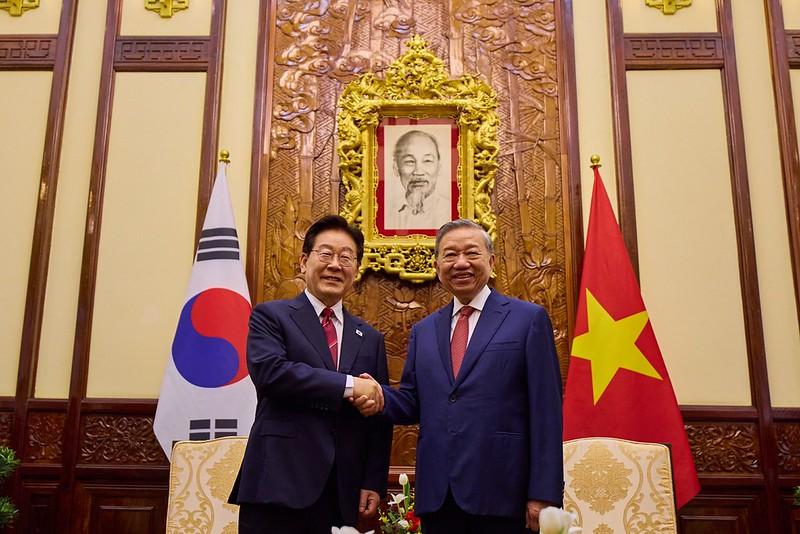
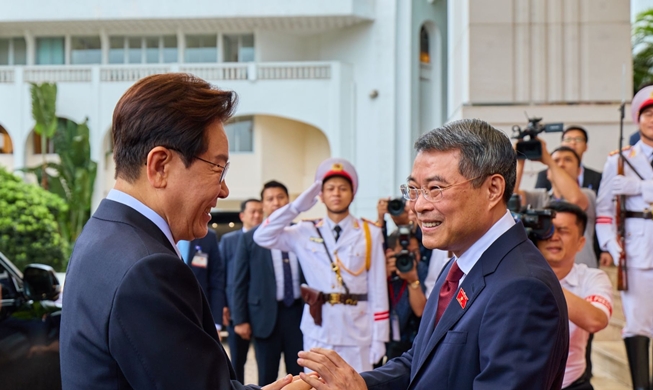
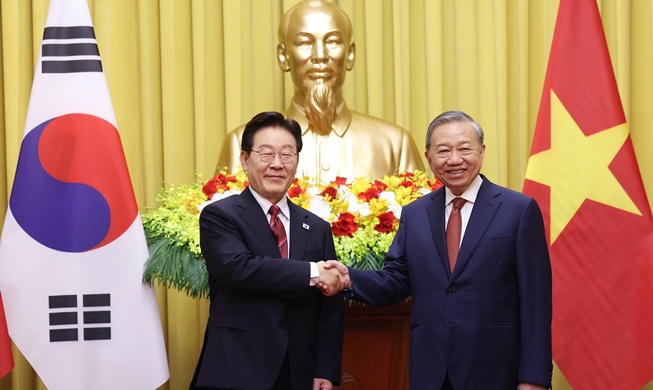
President Lee Jae Myung (left) on April 22 poses for photos with his Vietnamese counterpart To Lam at the Presidential Palace in Hanoi, Vietnam, after their joint news conference. (Cheong Wa Dae)
By Hong Hyun-Ik
Secretary General, Korean National Commission UNESCO
Challenging global politics and President Lee's pragmatic diplomacy
The world is reeling from a rapid shift in the unilateral global strategy of the superpower U.S. Making its alliance with America the cornerstone of its foreign strategy, Korea also faces a challenging climate. Trust in the relationship is weakening due to Washington's policy of national interests first, with the very nature of ties in flux. For example, the unilateral U.S. imposition of high tariffs has dealt a severe blow to Korean trade.
To stably manage the alliance, the administration of President Lee Jae Myung has actively responded to U.S. demands for adjustments and patiently sought a compromise on the tariffs. Korea has also built the basis for cooperation with Japan through developing trust between their leaders. Relations with China, fraught with difficulties under the previous administration in Seoul, were fully restored after President Lee's visit to China in January. As a result, Korea laid the framework for cooperation to achieve peace and mutual prosperity with the four major powers surrounding the Korean Peninsula, except for Russia.
Yet skyrocketing oil prices and supply chain disruptions caused by the war with Iran caused a serious crisis in the Korean economy, which is highly dependent on foreign trade. To resolve this, President Lee further expanded the scope of his pragmatic diplomacy.
President Lee's state visits to India and Vietnam
In this context, President Lee on April 19 arrived in India for a state visit and greatly raised bilateral relations with Indian Prime Minister Narendra Modi. As the world's fourth-largest economy, India is the world's most populous state with over 1.4 billion people and possesses world-leading capabilities in artificial intelligence (AI) and software. Based on annual average growth of 7%, the country is predicted to rank third in the world economic hierarchy by 2050 and is considered an alternative to China as a key hub for diversifying production and supply chains.
New Delhi is in conflict with Beijing over territory but pursues economic cooperation with its neighbor. India also maintains friendly relations with the U.S. while being a quasi-ally of Russia. Since the launch of the Non-Aligned Movement after World War II, India has positioned itself as a leader of the Global South. So for Seoul, bolstering relations with New Delhi brings not only economic advantages such as production and supply chains but also elevates Korea's international standing and builds close ties with the Global South.
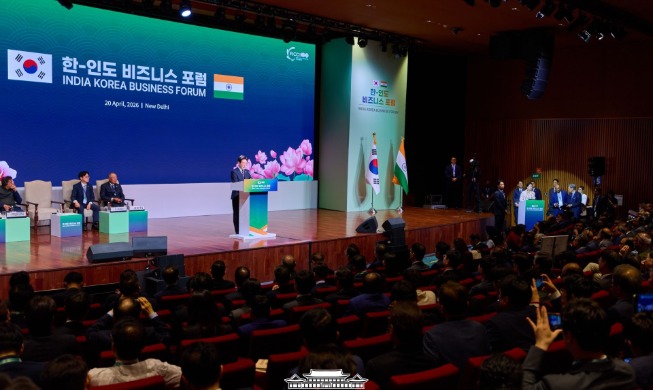
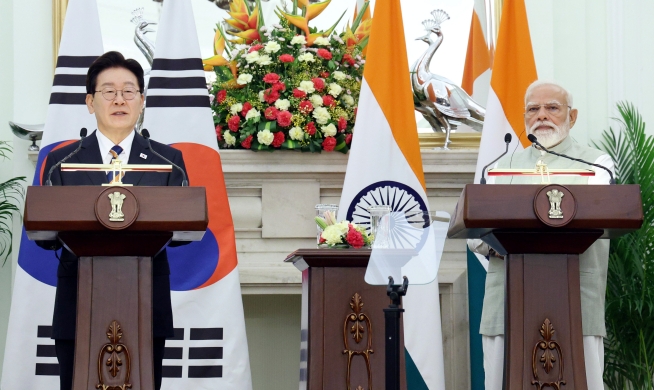
President Lee and Prime Minister Modi agreed to pursue multilateralism and announced the resumption of talks to upgrade their bilateral Comprehensive Economic Partnership Agreement, which took effect in 2010. They also pledged to double bilateral trade from USD 25 billion to USD 50 billion by 2030.
Based on a joint declaration on energy and resource security announced as an annex to the summit's joint statement, both sides set up a bilateral industrial cooperation committee to build a stable supply system for petrochemical raw materials such as naphtha, as well as widen the scope of cooperation to include shipbuilding and maritime affairs. They also decided to combine India's economies of scale with Korea's speed and expand collaboration from cars and home appliances to finance, AI, defense and the defense industry.
After India, President Lee flew to Vietnam, a country whose ties with Korea constitute an economic alliance after they formed diplomatic ties in 1992. In August last year, he welcomed to Korea Vietnam's top leader To Lam as his first state guest since taking office, a gesture that was reciprocated in April this year after Lam was concurrently named president. The two countries are each other's third-largest trading partners. Korea is Vietnam's largest investor, with over 10,000 Korean companies operating in the Southeast Asian country.
At a business forum during President Lee's trip, both sides signed 73 memorandums of understanding and contracts, agreeing to raise bilateral trade from USD 94.6 billion to USD 150 billion by 2030. Korean companies also achieved record progress in business consultations, signing export contracts worth USD 82 million.
Seoul-Hanoi ties are now moving beyond simple quantitative expansion and toward qualitative growth. Vietnam is an oil-producing country that also has the world’s second-largest reserves of rare earth minerals after China and is also rich in urea solution. Korea is not just a trading partner but an ideal and symbiotic economic collaborator who can jointly build an industrial ecosystem covering energy, supply chains and more. Through its technological prowess and capital, Korea can conduct mutually beneficial and complementary cooperation with Vietnam, which has grown an average of 7% per year under the goal of becoming an advanced high-income country by 2045.
A prime example of bilateral cooperation is Korea's participation in large-scale infrastructure projects in Vietnam such as nuclear power plants, power infrastructure, high-speed rail, new city development and transportation, water security and resource management, and AI data centers, while also providing support for digital and scientific technologies. Thus President Lee, through his state visits to India and Vietnam, laid the foundation for international cooperation to overcome economic and trade instability and supply chain disruptions.
Challenges for Seoul's diplomacy
South Korea has firmly established a foundation for pragmatic diplomacy and becoming a responsible global power through summits with Global South powers such as South Africa, Brazil, India and Vietnam as well as with the U.S., Japan and China. The remaining tasks are restoring ties with North Korea and Russia, both of which formed alliance-like ties through the war in Ukraine, and the transfer of wartime operational control from Washington to Seoul. Moscow continues its war of aggression while Pyeongyang keeps developing weapons of mass destruction and even avoids contact. But the normalization of South Korea's relations with both states, however, is an absolute necessity for national security and the stable lives of its citizens.
Seoul can achieve a breakthrough by paying attention to three points. First, the U.S. is open to dialogue with the North and Russia, and the latter two seek such negotiations, though not open about it. So Washington's resumption of talks with Pyeongyang and Moscow should not cause alarm. Second, Pyeongyang and Moscow are reluctant to hold dialogue with Seoul because they consider the latter lacking autonomy in its foreign strategy and military operational command. The focus should thus be on strengthening South Korea's self-defense capabilities while speeding up the transfer of wartime operational control. And third, Russia actively hopes to restore ties with South Korea and boost economic cooperation, and the North clearly knows the inevitability of economic cooperation with its southern neighbor for economic recovery and development.
So the answer is a proactive and confident approach based on Seoul's elevated status in areas such as economy, technology, defense, the defense industry and culture. The remaining challenges can be fully resolved if the pursuit of economic cooperation is done in a creative and forward-looking manner while acknowledging diplomatic status and avoiding getting bogged down in defense or security logic.
Hong Hyun-ik since 1997 has researched national security and strategy at the Sejong Institute, covering North Korea's nuclear program, inter-Korean relations, Seoul's alliance with Washington and ties with Moscow, and formation of a peace regime on the Korean Peninsula. He formerly served as head of the foreign affairs and security subcommittee of the Presidential Commission on Policy Planning and chancellor of the Korea National Diplomatic Academy.
arete@korea.kr