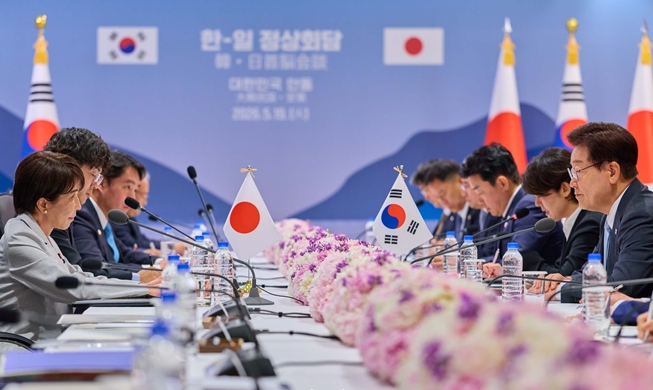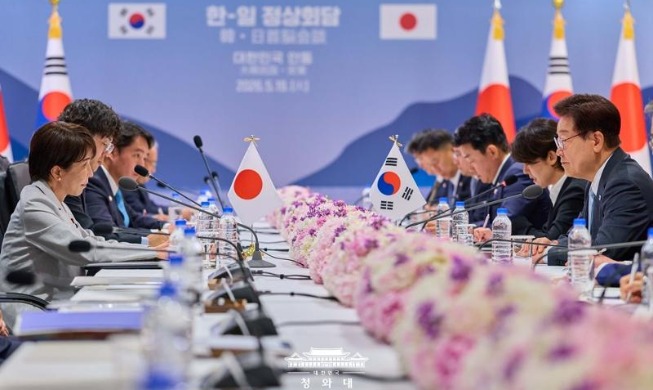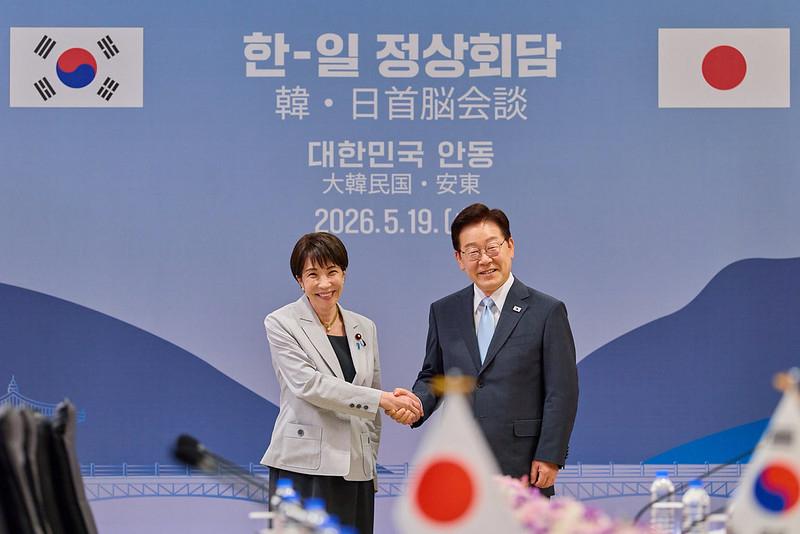
President Lee Jae Myung (right) and Japanese Prime Minister Sanae Takaichi on May 19 pose for a photo at their joint news conference at a hotel in Andong, Gyeongsangbuk-do Province.
By Yuji Hosaka, special professor
Graduate School of Public Administration, Korea University
President Lee Jae Myung from May 19-20 held his third summit with Japanese Prime Minister Sanae Takaichi in Andong, Gyeongsangbuk-do Province. In a cordial atmosphere, both leaders in wide-ranging talks covered topics ranging from economic security and energy cooperation to responses to North Korea. Many said this showed that shuttle diplomacy between both sides was back on track. Despite this glossy exterior, the situation is far more complicated beneath the surface. Bilateral ties are at a critical juncture where the "reality of inevitable cooperation" and "deep-seated mistrust not easily mendable" clash head on.
A prime example is developments surrounding security cooperation. Tokyo wants to conclude a bilateral acquisition and compensation service agreement (ACSA), a framework for the mutual provision of ammunition, fuel and transportation support. Japan has similar deals with major allies such as the U.S., Australia and U.K.
Tokyo seeks to set up a working-level system of military cooperation with Seoul amid escalating threats from China's maritime expansion and North Korea's nuclear and missile programs. During its first "two plus two" meeting of vice foreign and defense ministers on May 7 with South Korea, Japan also requested the conclusion of the ACSA.
But South Korea's sense of wariness runs deep as the public still shows strong aversion to "military integration" with Japan. The progressive camp is especially opposed to the ACSA, calling it "a de facto formation of a bilateral military alliance." Public sentiment also does not back expanded military cooperation with Tokyo because of unresolved issues in history and territory.
For this reason, Japan is starting with limited rather than comprehensive military cooperation. A prime example of this is "mutual refueling" between military aircraft of both sides. Japan, at least partially, wants a system in which fighter jets and patrol aircraft can refuel at bases in either country, with an eye toward any contingency in the Taiwan Strait or on the Korean Peninsula. In fall last year, both sides explored joint training and refueling cooperation in waters near Okinawa.
This plan, however, has been thwarted. This is because Japan in November last year objected to and refused scheduled refueling support in Okinawa when the Republic of Korea Air Force's aerobatics team, the Black Eagles, flew over Dokdo Island. Tokyo officially explained its action based on an "operational judgment," but this sparked massive mistrust in Korea that Japan "exploited" military cooperation to assert its territorial claims. Criticism within Japan also surged, with some asking why Korea demanded cooperation only from Japan while provoking it over territorial issues. From Korea's perspective, such criticism from Japan is hard to accept.
Both governments in early June were reportedly negotiating to readjust refueling cooperation. But how will this really work out? Regardless of technical feasibility, such collaboration is bound to be extremely unstable, politically speaking.
From the outset, the biggest Achilles' heel in bilateral ties with Japan lies in the discrepancy between "strategic necessity" and "public sentiment." From a purely security perspective, cooperation with Japan is essential. The many areas where collaboration makes sense include sharing intelligence on North Korean missiles, responding to naval activities by China and Russia, and defending sea lanes.
The U.S. also places its trilateral cooperation with the two Northeast Asian countries at the core of its Indo-Pacific strategy. Yet most of the South Korean public does not trust the Japan Self-Defense Forces, with fears of Japanese forces using the ROK military in operations and laying the groundwork for an invasion of the Korean Peninsula.
The same applies to economic security. During restructuring of supply chains for semiconductors, batteries and rare earth elements, Korea and Japan are competitors and mutually dependent. Japan is strong in materials and equipment while Korea excels in manufacturing prowess. Energy holds significant common interests in areas such as the procurement of liquefied natural gas, use of hydrogen and nuclear technology. The reality of "difficulty due to no cooperation" is far more compelling than in the past.
Nevertheless, deep-seated distrust between both countries holds them back. While issues such as forced labor and sexual slavery might have been settled legally, they are evolving into matters of historical perception and nationalism. Seoul's policy toward Tokyo wavers with every new administration, while Japan shows strong cynicism that Korea will inevitably bring up bilateral issues again. Even security cooperation can descend into confrontation when territorial disputes come into play. The recent refueling incident is a clear example of the fragility of bilateral ties.
Stark differences are also seen in the perception of China. Japanese Prime Minister Takaichi's comments on Taiwan in November last year worsened Tokyo's ties with Beijing, raising vigilance on both sides. Korea, however, cannot ignore its economic ties with China, with domestic sentiment favoring caution or restraint in responding to or discussing a crisis in Taiwan. While Seoul and Tokyo might agree on how to respond to North Korea, they are not on the same page vis-a-vis policy toward China.
Thus framing bilateral cooperation as "a comprehensive friendship" is ultimately difficult. In reality, this relationship will likely continue as "joining forces only when necessary while harboring mutual distrust." Barriers to the comprehensive conclusion of the ACSA remain high. While both sides should first agree on partial cooperation covering things like disaster relief, logistics support and information sharing, Japan will inevitably have to step back before a full accord is reached.
Both at home and abroad, the Andong summit in May showed that relations with Japan have entered a new phase. But this is far from an ideal reconciliation. The fuses of history and territory are still alive. Still, geopolitical realities require bilateral cooperation, and the immediate task is to discern if this arrangement can suppress conflict and secure sustainability.
The planned resumption of refueling cooperation in early June, if successful, will mark a small step forward in bilateral relations. But another derailment by territorial issues or a public backlash will only prove to the world the limits of Seoul-Tokyo cooperation. Bilateral ties with Japan rest on an extremely unstable form of realism: cooperation only out of necessity but with no trust. Thus it is more important than ever to separate historical and territorial issues from current affairs, raise cooperation and manage conflicts in practice.
Yuji Hosaka is a Japanese Korean political scientist who began teaching political science and diplomacy at Sejong University in Seoul in 1998. For his long-term research and work to affirm national sovereignty over Dokdo Island, he received Korea's Order of Merit for Distinguished Service. After teaching at Sejong for 28 years, Hosaka in March 2026 moved to his new role as a professor at Korea University's Graduate School of Public Administration and honorary director of Sejong's Dokdo Research Institute.
arete@korea.kr