- 한국어
- English
- 日本語
- 中文
- العربية
- Español
- Français
- Deutsch
- Pусский
- Tiếng Việt
- Indonesian
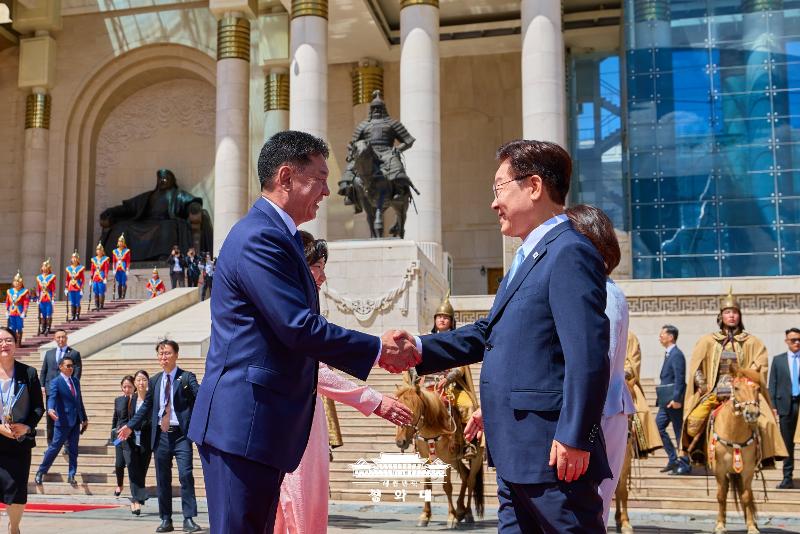
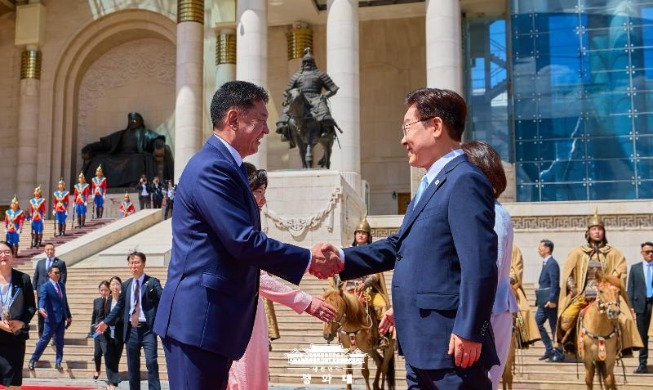
President Lee Jae Myung (right) and Mongolian President Ukhnaagiin Khurelsukh on July 9 shake hands at the official welcoming ceremony for the Korean leader at Sukhbaatar Square in Ulaanbaatar, Mongolia. (Cheong Wa Dae)
By Song Byeonggu
Professor, School of Asian and Middle Eastern Studies at Dankook University
Director, Institute for Mongolian Studies
President, Korean Association for Mongolian Studies
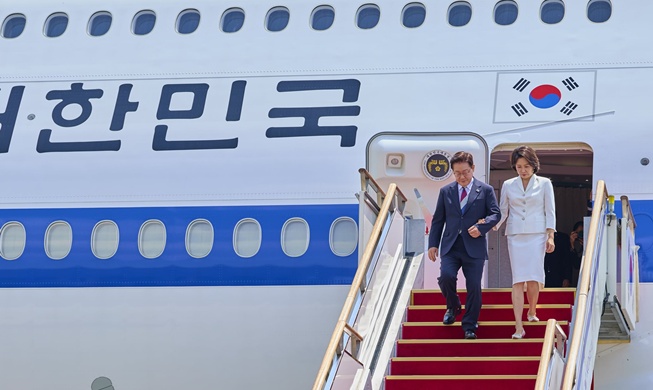
Diplomacy led by a country's head of state is a matter of life and death, a strategy of survival amid the Sino-U.S. conflict and resource nationalism. President Lee Jae Myung's state visit to Mongolia from July 9-11 marked the first summit-level diplomacy between the two sides in 15 years.
His trip is considered a qualitative turning point that secured a bridgehead for resource security amid the restructuring of global supply chains and systemized security cooperation in Northeast Asia. The joint declaration on the golden era of bilateral relations adopted by both leaders will serve as a catalyst for upgrading ties to a comprehensive and strategic partnership.
President Lee's visit demonstrated the full restoration of high-level diplomatic channels between both countries by resetting the clock on state visits at the summit level after a long hiatus that began in 2011. He took the podium at the opening ceremony of the Naadam Festival, a tradition that is Mongolia's top national event and a UNESCO Intangible Cultural Heritage of Humanity. He was the guest of honor, the first Korean head of state to receive an official invitation to that effect, and the warm and informal rapport between both leaders went far beyond the realm of mere diplomatic protocol.
This unprecedented treatment punctuated the high level of trust and special bond that the Mongolian government and people have for Korea as a partner. The emotional connection forged with the leaders of the steppe was far more than just diplomatic rhetoric; it was a powerful emotional foundation and intangible asset to firmly sustain a close partnership even amid the turbulence of geopolitics.
The most critical challenges facing the Korean economy are diversification to resolve the country's excessive reliance on supply chains from specific countries and the launch of resource security to survive the battle for technological supremacy. For Korea, a global leader in future-oriented industries such as advanced semiconductors, secondary batteries and electric vehicles, securing a stable supply of critical minerals is a lifeline. From this perspective, Mongolia's strategic value is unrivaled.
The most tangible and visible outcome of this state visit is undoubtedly the institutionalization of cooperation in supply chains for critical minerals and rare earth elements from Mongolia. By setting an independent and stable supply chain foothold in the Eurasian continent by countering the bids of certain countries to monopolize and weaponize resources, Korea has achieved a coup in upgrading the future competitiveness of its industries. For Mongolia, this also marks the completion of a perfect "win-win" economic model, namely moving beyond the role of mere raw material exporter to transform its industrial structure into a high value-added sector by integrating its resources with Korea's world-class smelting and processing technologies and infrastructure.
In diplomacy and security, Mongolia occupies a geographically unique and strategically vital position. Though a landlocked nation sandwiched between two major powers -- Russia and China -- it is one of a few traditional mediators that has historically retained strong diplomatic ties with both Koreas. Ulaanbaatar is also a strong ally that has consistently supported Seoul's stance in global talks on the denuclearization of the Korean Peninsula and settlement of peace. The Ulaanbaatar Dialogue, a multilateral security framework led by the Mongolian government, is also a diplomatic asset capable of bringing North Korea to the negotiating table.
A highly encouraging development from a geopolitical perspective was that during their summit, President Lee and his Mongolian counterpart Ukhnaagiin Khurelsukh reaffirmed their support for the complete denuclearization of the peninsula and regional peace and stability, while also agreeing to revive the Northeast Asian security dialogue framework. Another key achievement was the expansion of diplomatic outreach and reinforcement of multilateral cooperation by leveraging Mongolia as a strategic hub amid escalating security risks in Northeast Asia due to factors such as the growing closeness between Pyeongyang and Moscow.
President Lee's successful trip to Mongolia perfectly aligned the three core pillars of diplomacy: economic interests (resource diplomacy), security cooperation (peace on the peninsula), and cultural solidarity (attending the Naadam Festival as a guest of honor).
Yet more important than diplomatic declarations is the enforcement of agreements and filling the burgeoning "golden age" with tangible results. Future bilateral relations must transcend resource cooperation and make a comprehensive paradigm shift. To this end, the following are four proposals for practical results.
The first is comprehensive expansion of the green energy partnership. Korean companies must go beyond preventing desertification to lead the way for renewable energy across Eurasia by participating in the construction of renewable energy infrastructure for resources like wind and solar power in Mongolia.
The second is the launch of a formal platform to train Mongolian youth as future digital talent by transferring Korea's infrastructure in information and communications technology and artificial intelligence (AI) and software know-how.
The third is the modernization of Eurasian logistics and supply chain infrastructure. Support for the modernization of Mongolia’s rail, road and aviation transportation systems will secure access to the sea for Mongolia and an overland foothold in Eurasia for Korea.
And the fourth task is to institutionalize sustainable, next-generation academic and cultural exchanges. Stimulating joint research between universities and strengthening personnel exchanges will solidify the roots of an unwavering partnership.
Korea calls Mongolia "land of the blue sky" while Mongolia refers to Korea as "land of the rainbow" (Солонгос). This is clear evidence of the goodwill and trust shared by both sides. President Lee's state visit was a new catalyst that raised this friendly relationship to a new level.
The task at hand is to transform these declaratory diplomatic results into concrete legal and institutional mechanisms as well as elevate them through the expansion of autonomous and creative exchanges in the private sector. When the potential of Mongolia, embodied in its sweeping grasslands, meshes perfectly like machine gears with the strength of Korea, rooted in dynamic, cutting-edge technology, bilateral ties will form a powerful and practical central axis driving peace and shared prosperity across Northeast Asia.
Song Byeonggu is a professor at the School of Asian and Middle Eastern Studies of Dankook University and director of the university's Institute for Mongolian Studies. He is also president of the Korean Association for Mongolian Studies.
arete@korea.kr