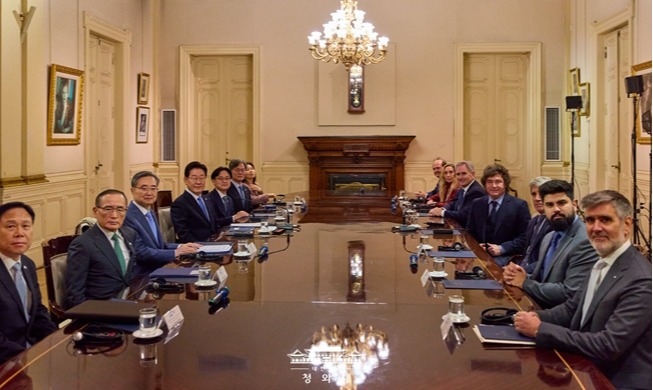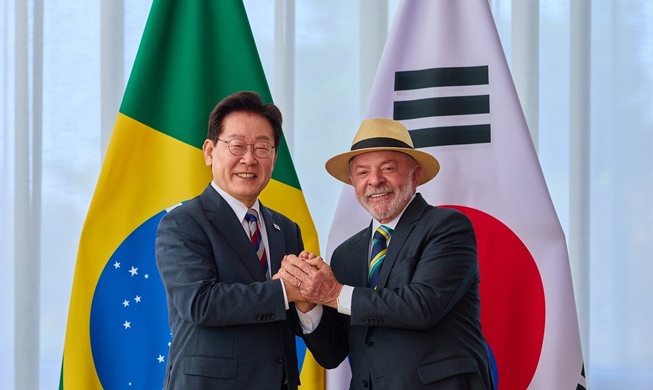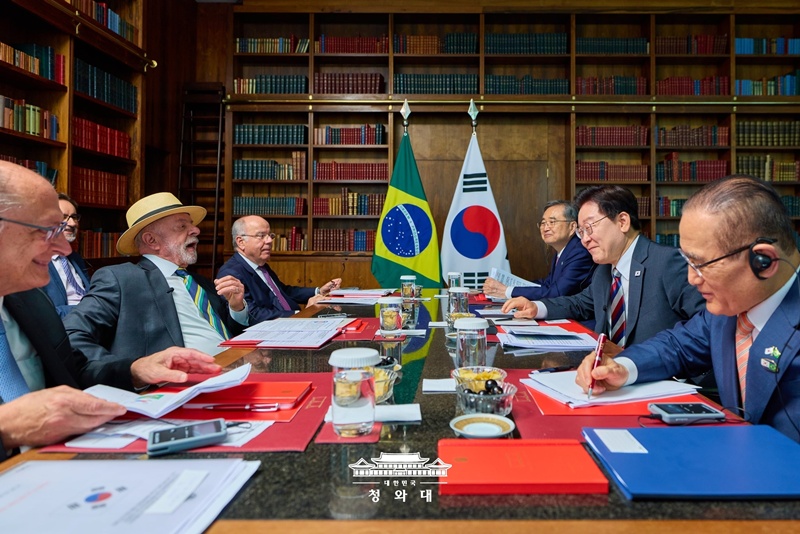
President Lee Jae Myung (second from right) and Brazilian President Luiz Inacio Lula da Silva on July 27 hold an expanded summit at the presidential office Palace of the Planalto in Brasilia, Brazil. (Cheong Wa Dae)
By Hong Hyun-Ik
Secretary general, Korean National Commission UNESCO
South Korea must place top priority on national security given the constant threat from North Korea's nuclear program. For this reason, the Lee administration strives to restore bilateral relations with Pyeongyang based on trust and solidarity among Seoul, Washington and Tokyo as well as normalize ties with China, which affects the security of the Korean Peninsula.
To revive the strategic partnership with Beijing that had cooled under the previous administration, President Lee Jae Myung early this year paid a state visit to China and later went to Japan. He also attended talks with U.S. President Donald Trump in both bilateral and multilateral settings to strengthen their multilayered alliance of trust. By doing so, he set at the top of his agenda creating the diplomatic foundation for reinforcing national security.
Economic security, trade and industry are increasingly critical in importance along with political and military security. Fierce competition even among allies in these sectors indicate the urgent need for a comprehensive, pragmatic diplomatic approach. President Trump's "America First" policy ignited a tariff war, while the rivalry between the U.S. and China disrupted supply chains.
Moreover, the global economy was thrust into turmoil after the war in Ukraine and the U.S.-Iran conflict disrupted supplies of oil and raw materials, causing international prices to soar. Given that it must import most of its energy and raw materials as an economy highly dependent on trade, South Korea must secure stable supply chains and export markets as its highest priorities. Securing reliable supply chains for rare earth elements, lithium, copper, oil and gas is considered a lifeline for the country's key future industries of semiconductors, batteries and chemicals.
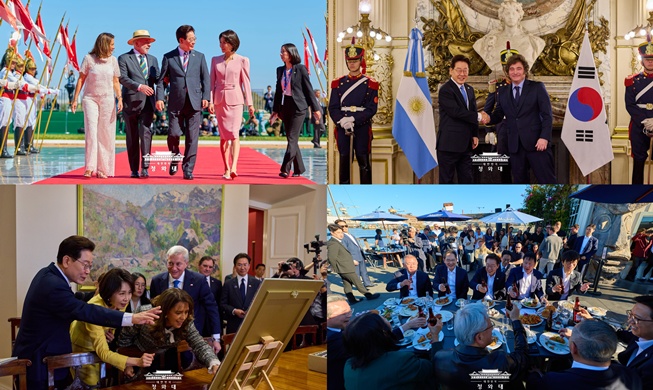
This precisely explains why President Lee went on a 11-day tour from July 24 to Aug. 3 of San Francisco, Brazil, Chile and Argentina, followed by a stopover in Frankfurt, Germany, to encourage the Korean expatriate community there before flying home.
Results and significance of tour
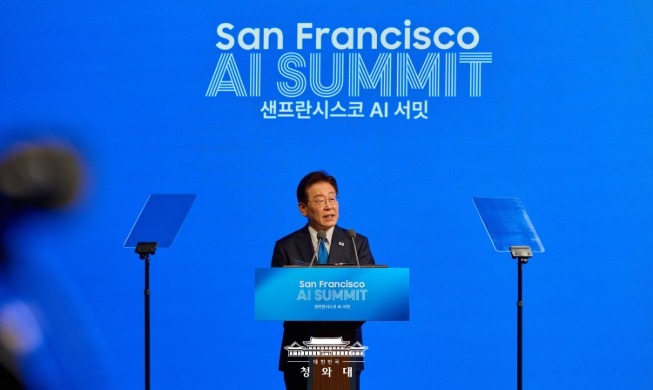
President Lee's first stop was San Francisco, the global hub of artificial intelligence (AI), where he spoke to the CEOs of major global tech companies including Jensen Huang of Nvidia, Sam Altman of OpenAI, Dario Amodei of Anthropic and Hock Tan of Broadcom to attract investment. President Lee also asked leading Korean executives including Lee Jae-yong of Samsung Electronics, Chey Tae-won of SK Group, Chung Eui-sun of Hyundai Motor Group and Lee Hae-jin of the leading web portal Naver Group to build a symbiotic AI cooperation network between Seoul and Washington, including a semiconductor partnership valued at USD 950 billion among these companies.
After securing pledges of capital cooperation with the heads of global venture capital companies, the country through the San Francisco AI Declaration proclaimed its ambition "to emerge as a pivotal country in the indispensable global AI supply chain." By doing so, this solidified the groundwork for Korea's future high-tech growth industries and secured a solid global steppingstone toward ascension as an AI power.
His subsequent visits to three Latin American countries focused on promoting trade, securing supply chains for core resources and expanding diplomatic horizons toward the Global South.
In his state visit to Brazil, the largest country in Latin American in territory, population and influence, he spoke to Brazilian President Luiz Inacio Lula, who shares a similar worldview in sharing a background as a child laborer with President Lee, and reaffirmed their solidarity and trust.
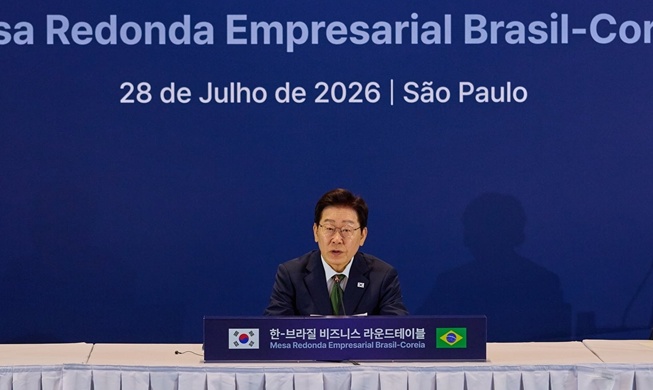
By securing a commitment to resume negotiations with Mercosur (Southern Common Market) -- the continent's largest -- on a trade agreement, the Lee administration built a bridgehead for entry into a Latin American market of 280 million people. Seoul and Brasilia signed seven memorandums of understanding (MOUs) covering areas such as energy and space cooperation, and agreed to boost the development and supply chains of key minerals like rare earth elements, of which Brazil holds the world's second-largest reserves, nickel and iron ore.
Both sides agreed on cooperation in the defense industry including the joint development of next-generation civil aircraft and wider access for Korean companies in Brazil in sectors such as cosmetics and beauty. They also pledged to become optimal partners combining Korea's innovative technological and manufacturing know-how with Brazil's abundant resources and energy to jointly drive stable supply chains and future industries.
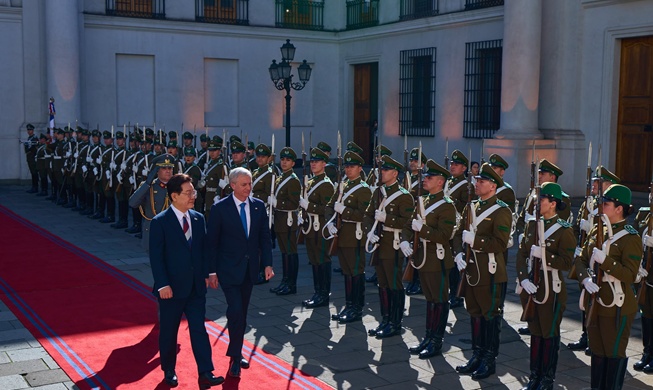
While in Chile, the first country to conclude a free trade agreement with Korea, President Lee pledged to streamline their accord as partners in global free trade for 22 years. The two sides also agreed to become optimal partners by combining Korea's world-leading competitiveness in high-tech manufacturing of items such as batteries, cars, semiconductors and AI with Chile's status as the world’s leading copper producer and holder of the largest lithium reserves as a key supply hub for the global eco-friendly industry.
Santiago is also expected to back Seoul's bid to join the 12-country Comprehensive and Progressive Agreement for Trans-Pacific Partnership.
As the first Korean leader to visit in 22 years, President Lee in Argentina resumed summit diplomacy with a country ranked fourth in reserves of lithium and second in shale gas. He and Argentine President Javier Milei signed an MOU on cooperation in critical minerals, covering the entire supply chain from exploration and extraction to processing, as well as an accord to prevent double taxation. They also agreed on full-scale Argentine crude oil imports to Korea from next year following a pilot program this year.
President Lee's tour helped build a "win-win" network between cutting-edge Korean and U.S. AI companies as a future growth engine for Korea in responding to the turbulent waves of protectionism and global instability in supply chains, thus carrying out a strategy focused on raising supply chain resilience and ensuring economic security. His trips demonstrated the essence of his pragmatic diplomacy by promoting high-tech industries and securing resources to bolster the country's future industrial competitiveness and securing economic security.
Future tasks of Korean diplomacy
Korea has held bilateral summits with every member country of the Group of 20 (G20) economies except Russia, thus laying the groundwork to assume the G20 presidency in 2028. Based on Moscow's desire to normalize relations and thus wisely striking a flexible balance in Russia's relations with the West, Seoul can achieve a comprehensive and pragmatic diplomatic strategy.
Korea must also strengthen its self-reliance in national defense to regain wartime operational control while consistently conveying its commitment to peaceful coexistence and mutually beneficial cooperation. By sticking to diplomacy grounded in such confidence, the Republic of Korea can ultimately bring back the North to dialogue to more firmly consolidate peace on the Korean Peninsula.
Since 1997, Hong Hyun-ik has researched national security and strategy at the Sejong Institute in Seoul, covering North Korea's nuclear program, inter-Korean relations, Seoul's alliance with Washington and ties with Moscow, and formation of a peace regime on the Korean Peninsula. He has served as head of the foreign affairs and security subcommittee of the Presidential Commission on Policy Planning and chancellor of the Korea National Diplomatic Academy.
arete@korea.kr