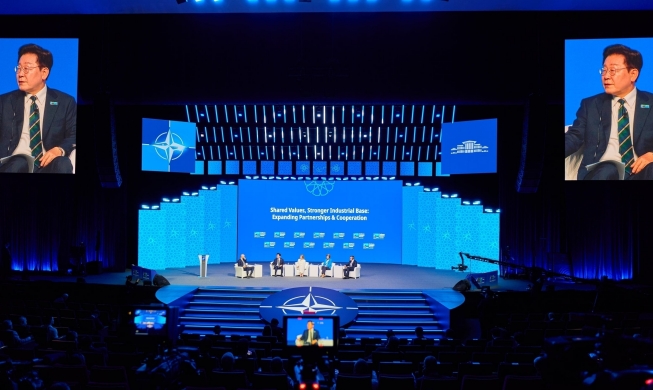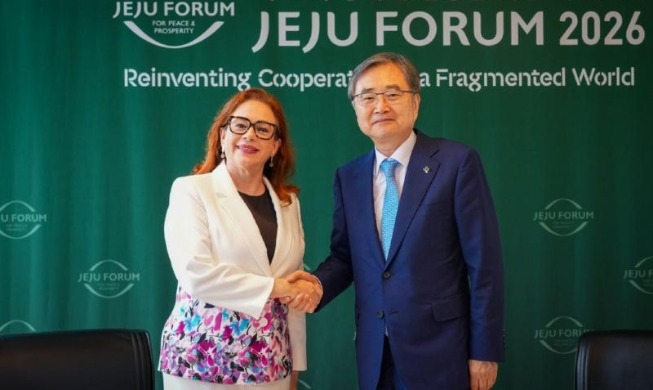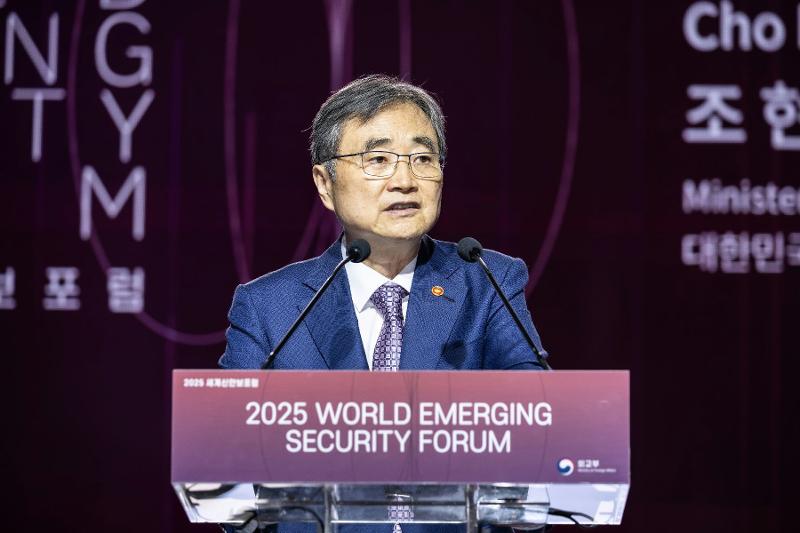
Hosted by the Ministry of Foreign Affairs, this year's World Emerging Security Forum on Sept. 9 will open at the hotel Grand Hyatt Seoul in the capital's Yongsan-gu District under the theme "Emerging Technology: Risks and Opportunities." Shown is Minister of Foreign Affairs Cho Hyun giving a speech at last year's forum in Seoul in September. (Ministry of Foreign Affairs)

By Jun Bong-Geun
Visiting research fellow at Sejong Institute and
president of Korea Nuclear Policy Society
The peaceful and stable global order of the post-Cold War era has rapidly worsened with the intensified U.S. rivalries with both China and Russia in the 2020s. The "unipolar moment" led by American hegemony has ended, and the world has entered an era of superpower politics, competition for influence, the mentality of "fend-for-yourself," and war amid trends toward multipolarity and bloc formation. This has led to the decline of the belief that the spread of globalization, free trade and digitalization will lead to a prosperous world free from war over the three decades following the end of the Cold War.
Emerging technologies such as artificial intelligence (AI), semiconductors, drones, cybersecurity and space technology are now not only tools for raising public welfare and the common good of humanity, but also key strategic assets for intercountry power struggles and instruments of warfare. This is the dawn of the era of "DIME+T," which adds "technology" to the traditional components of national power and grand strategy known as diplomacy, information, military and economy (DIME).
Emerging technologies are evolving with a dual nature presenting both opportunity and risk. While AI greatly contributes to knowledge creation and application, disease diagnosis, drug development, disaster prediction and productivity enhancement, it also maximizes lethality on the battlefield and expedites decisions to kill while bypassing in mere moments human and ethical deliberation.
A recent study applying AI models to decision-making in nuclear crises highlighted the risk of nuclear use, showing that the taboo against atomic weapons failed to sufficiently constrain AI's strategic judgments and led to frequent instances of nuclear threats and decisions to use nuclear arms.
It feels as though the post-apocalyptic AI-driven world of the film "The Terminator" is suddenly becoming reality. Drones monitor wildfires in remote areas and rapidly transport medical supplies, yet they are also inexpensive and effective instruments of lethal force. Space technology offers public services such as communications, navigation and climate monitoring but has simultaneously transformed space into a new theater of warfare.
In 2018, United Nations (U.N.) Secretary-General Antonio Guterres said in "Securing Our Common Future," a report on the world body's disarmament agenda, that the pace of international law, disarmament norms and government regulations lags far behind the speed at which emerging technologies are being militarized.
He said AI, autonomous weapons and drones could lower the threshold for the use of force by reducing a country's domestic casualties and political costs, thus undermining human judgment and accountability, while cyber, hypersonic and space technologies threaten to amplify the risks of miscalculation, escalation and strategic instability. Emerging technologies could threaten the non-proliferation regime by lowering the barriers to accessing weapons of mass destruction and advanced arms, he added.
In response, the U.N. chief urged restoring human control over the use of force, adhering to international norms, strengthening transparency and accountability, exercising restraint in the development and acquisition of indiscriminate and excessively lethal weapons systems, and setting new political and legal international norms required for the situation.
Considering the dual-use nature of emerging technologies, the key challenge is not to ban such know-how but ensure that their military application remains within the bounds of human control and global norms. To prevent the reckless and irresponsible application of such technologies to the development and use of autonomous arms and weapons of mass destruction, new norms for arms control requiring accountability, reliability and humanity in the creation and deployment of advanced weaponry are required.
Seoul has a vested interest in the advancement and use of these emerging technologies. First, as a nation at the forefront of science and technology and a major trading power, the country's future development hinges on the responsible use of these technologies. As a divided nation facing a nuclear threat from North Korea with a vulnerable security position surrounded by major powers, the Republic of Korea considers as a matter of direct national interest preventing the use of emerging technologies to destabilize the Korean Peninsula and the region.
And as a leading middle power, the nation seeks to become a "global responsible power." To this end, it actively supports the responsible use of emerging technologies while seeking to curb their reckless weaponization, a major concern of the international community.
Befitting its status as a leading middle power at the forefront of advanced science and technology, Seoul in 2021 launched the World Emerging Security Forum (WESF) to contribute to discussions on global norms on emerging technologies and emerging security issues. The sixth forum, slated to open on Sept. 9, will focus on the full-scale military application of emerging technologies as evidenced by the recent conflicts in Ukraine and the Middle East, as well as cover topics such as AI, drones, low-Earth orbit space technology, nuclear deterrence and strategic stability. This conference represents an extension of Seoul's traditional diplomacy as a middle power committed to international security.
The country's hosting of the 2012 Seoul Nuclear Security Summit played a pivotal role in reinforcing international norms to counter "nuclear terrorism," an emerging security threat at the time. Since 2023, the nation has also hosted the Summit on Responsible AI in the Military Domain, leading discussions on shaping norms for AI use in military operations. During its term as a non-permanent member of the U.N. Security Council in 2024–25, Seoul also chaired an open debate on cybersecurity.
Finally, to carry on its tradition of diplomacy focused on middle power and international security, I propose evolving the WESF from its annual format into the Seoul Emerging Security Process, a mechanism for creating international norms for emerging security challenges. For the country to fulfill its role as a "global responsible power" in the era of DIME+T, it must transcend its status as a traditional "technological power" to emerge as a "normative power" that leads the creation of global norms. This represents both a new global role for Seoul in the age of emerging security and a path toward advancing its national interests.
Jun Bong-Geun is a lifelong scholar of the Korean Peninsula, North Korea's nuclear program and nuclear non-proliferation. He has served as presidential secretary for international security, policy adviser to the Ministry of Unification and professor at the Korea National Diplomatic Academy. He is now a visiting research fellow at the Sejong Institute and president of the Korea Nuclear Policy Society.
arete@korea.kr