- 한국어
- English
- 日本語
- 中文
- العربية
- Español
- Français
- Deutsch
- Pусский
- Tiếng Việt
- Indonesian
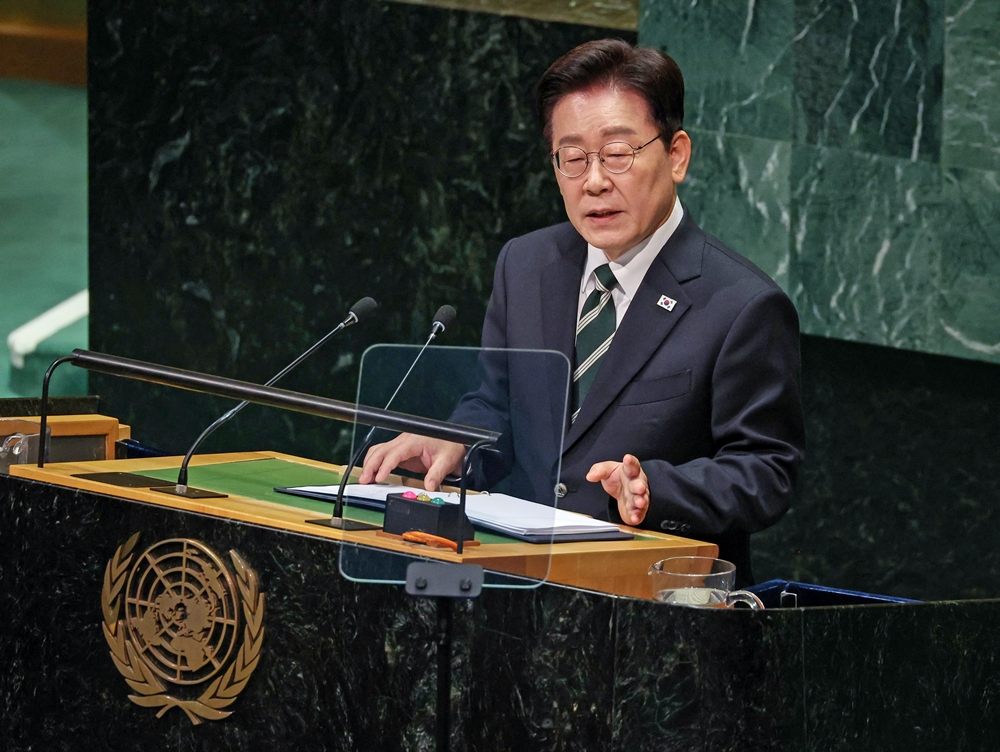
President Lee Jae Myung on Sept. 22 delivers a keynote speech at the annual High-Level Week of the United Nations General Assembly in New York. (Yonhap News)
By Hong Hyun-ik, secretary general
Korean National Commission for UNESCO
The international community is plunging into a turbulent period of rampant unilateralism and bloc building. Amid this period of major transition, Korea has stepped foward to advocate multilateral solidarity to lay the foundation for peace and prosperity on the Korean Peninsula and take a leap forward as a globally responsible power.
President Lee Jae Myung went on a diplomatic tour from Sept. 21-27 comprising his attendance at the United Nations (U.N.) General Assembly in New York, a summit with the U.S. and a state visit to Mexico. He showcased to the world pragmatic diplomacy befitting a responsible power, seeking to achieve peace on the peninsula, fulfill Seoul's role in major global issues, realign the alliance with the U.S., and strengthen bilateral and multilateral international cooperation.
A key feature of his tour was that it went beyond the traditional foreign affairs agenda of security and economy to link as a single diplomatic asset the values of peace, technology, global solidarity, multilateralism, and cultural and people-to-people exchanges.
UN speech expresses peace vision for both Koreas, multilateral cooperation
In his keynote speech at the U.N. General Assembly, President Lee placed high priority on formally ending the long-standing war on the Korean Peninsula and transitioning to a permanent peace regime. He presented a concrete roadmap with three principles of peaceful coexistence: "inclusive," "stable" and "responsible." His plan is to start with mutual respect for each other's systems and recognition of their differences, institutional management of crises and conflicts, and ultimately contributions to world peace through peace on the peninsula.
To end the state of war between the two Koreas and move toward a peace regime, he also presented a realistic approach to lay the groundwork for the prompt resumption of North Korea-U.S. dialogue and talks among the parties involved -- both Koreas, the U.S. and China. He proposed a phased approach to freeze and limit the North's nuclear and missile capabilities to open the door to dialogue, while pursuing the denuclearization of the peninsula and a permanent peace over the long term. Seoul thus assumed the role of a "pacemaker" in the process to help restart negotiations between Pyongyang and Washington.
President Lee also pledged to fulfill his country's global responsibilities as a technology leader through three "K-Initiative" visions. To punctuate the country's image as a globally responsible power, he proposed a vision for an inclusive "global AI (artificial intelligence) society" beneficial to humanity, green transition to solve humanity's common challenges and solidarity in international supply chains for energy.
His third proposal of an "alliance of constructive contributors" can also be seen as a wise response to U.S. pressure on the deployment of Korean troops to the Strait of Hormuz while contributing to the stability of global supply chains. He appealed to the international community to help resolve global issues such as AI development, climate change and security crises, displaying the demeanor of a model state.
Summit with US: building trust and realigning solidarity
Using his talks with U.S. President Donald Trump in New York as an opportunity, President Lee put bilateral relations, which had stagnated due to delays in Korean investment in the U.S. and other factors, back on track. President Lee also laid the groundwork for developing two-way ties into a future-oriented and strategic relationship that goes beyond a security alliance to cover advanced industries, supply chains, nuclear energy, shipbuilding and defense capabilities.
Based on a joint statement agreed on last year, both leaders pledged to raise cooperation in key issues such as fuel for nuclear-powered submarines, enrichment and reprocessing, cooperation in shipbuilding and the transfer of wartime operational control. President Trump also reaffirmed his willingness to resume dialogue with North Korea.
By reaffirming their trust and solidarity -- including their promise to hold a golf meeting --both presidents reinjected stability into their bilateral alliance. Building on this, South Korea can further expand its space for cooperation with an array of partners such as China, Japan, the European Union and the Global South.
Bolstering practical cooperation with Mexico, key hub of Latin America
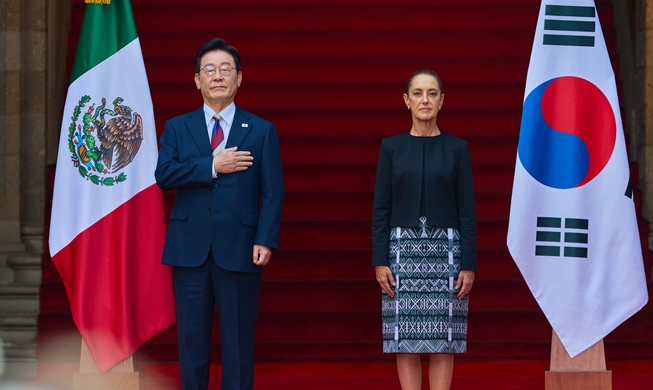
President Lee's state visit to Mexico at the invitation of Mexican President Claudia Sheinbaum -- the first such trip by a Korean leader in 16 years -- was an opportunity to broaden the horizons of Korean diplomacy to Latin America. Sharing ideological affinities and a pragmatic approach to policy, both presidents saw eye to eye on support for multilateralism, peaceful resolution of conflicts and respect for sovereignty.
Their summit can also be seen as showing their mutual understanding of the need to maintain relations with the unilateralist-leaning Trump administration while expanding the scope of their economic and diplomatic choices and raising sovereign autonomy. Presidents Lee and Sheinbaum discussed in depth boosting practical cooperation in a range of fields like AI, economy, trade, the defense industry, supply chains, energy such as crude oil, technology and culture.
With the restructuring of global supply chains and growing economic uncertainty, both sides reaffirmed their strategic importance to each other and pledged to pool efforts to expand mutual investment and launch stable supply chains. They also agreed to boost eco-friendly energy technology and infrastructure cooperation and people-to-people and cultural exchanges to strengthen the bonds between Koreans and Mexicans.
Against this backdrop, the two govenments signed 17 documents including the 2026–2030 Korea-Mexico Joint Action Plan, another on forming a joint committee on mineral resource cooperation, and those covering aerospace, the defense industry, AI, culture, finance and tourism. They also achieved a breakthrough by finalizing the text of a revised bilateral deal on investment protection, a process that had dragged on for seven years.
Republic of Korea: on course to becoming globally responsible power
This diplomatic tour demonstrated how Korea is exercising leadership as a core member of the international community, driving peace, joint prosperity and future innovation. The announcement of a clear vision for peace on the Korean Peninsula, fulfillment of international responsibilities in AI, climate, supply chains and security, reinforcement of security ties with the U.S. and expansion of multifaceted practical cooperation with Mexico will serve as key assets solidifying Korea's status as a globally responsible power.
Seoul must first reach a substantive agreement on restarting security negotiations with Washington, as well as continuously strengthen solidarity with the world and actively contribute to resolving global challenges. Now is the time for Korea to firmly continue its journey toward a better future and peaceful reunification while pursuing pragmatic diplomacy centered on national interests.
Since 1997, Hong Hyun-ik has researched national security and strategy at the Sejong Institute in Seoul, covering North Korea's nuclear program, inter-Korean relations, Seoul's alliance with Washington and ties with Moscow, and formation of a peace regime on the Korean Peninsula. He has served as head of the foreign affairs and security subcommittee of the Presidential Commission on Policy Planning and chancellor of the Korea National Diplomatic Academy.
arete@korea.kr