- 한국어
- English
- 日本語
- 中文
- العربية
- Español
- Français
- Deutsch
- Pусский
- Tiếng Việt
- Indonesian
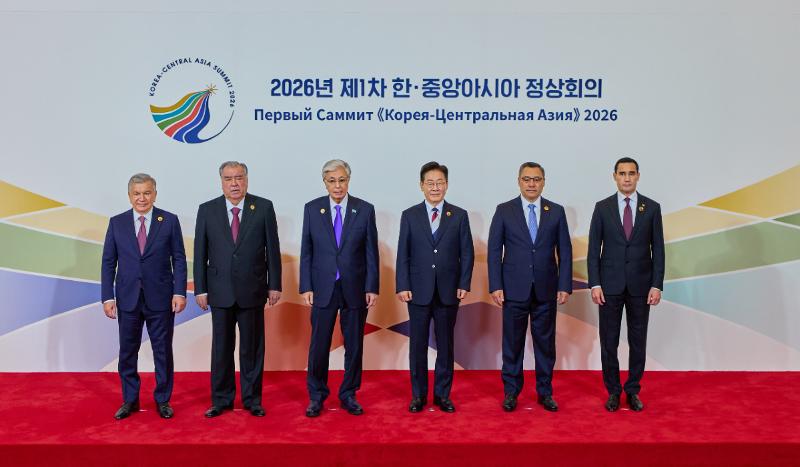
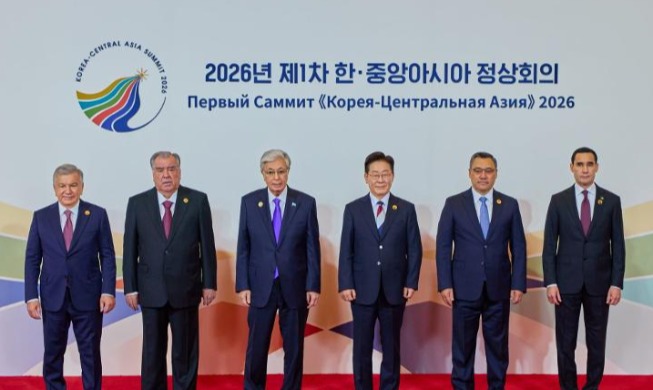
President Lee Jae Myung (fourth from left) on Sept. 14 poses for photos with the leaders of the five countries attending the inaugural Korea-Central Asia Summit at a hotel in Seoul. From left are Uzbek President Shavkat Mirziyoyev, Tajikistani President Emomali Rahmon, Kazakh President Kassym-Jomart Tokayev, President Lee, Kyrgyz President Sadyr Japaro and Turkmen President Serdar Berdimuhamedov. (Cheong Wa Dae)
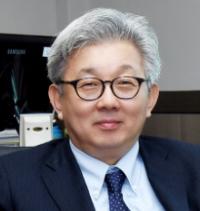
By Eom Guho, distinguished professor
Graduate School of International Studies at Hanyang University
Further rise of Central Asia's strategic value
Since the Roh Tae-woo administration's Nordpolitik (Northern Policy), the diplomatic positions of successive governments toward Central Asia have focused on economic interests like opening new markets and securing natural resources. With the exceptions of Roh and Kim Dae-jung, every Korean president has visited the region. Thus Central Asia is a key area in Korea's external economic strategy, serving as an emerging market for industrial plants, infrastructure and smart cities; a resource- and energy-rich power; and a pivotal hub for Eurasian logistics. Yet quite a few assessments said the results of such diplomacy fell short of expectations relative to its potential.
The strategic importance of Central Asia has shot up since the Russian invasion of Ukraine, stemming from a combination of three factors. First, critical minerals in Central Asia are returning to the spotlight as geopolitical competition intersects with the fragmentation of global supply chains. Second, as the Trans-Siberian Railway (Northern Corridor), formerly the backbone of Eurasian logistics, was curtailed due to the war in Ukraine and sanctions, the Trans-Caspian International Transport Route (TITR), which connects Central Asia to Europe via the Caspian Sea, has provided a key alternative route. And third, the points of contact of Central Asian states with the West are structurally expanding as they break free from the Russian sphere of influence and boost their pragmatic "multi-vector diplomacy."
Amid this trend, the U.S., European Union, Japan and Germany since 2023 have held a series of "C5+1" summits. Russia, China and India, all three of which are in the Shanghai Cooperation Organisation (SCO), are also holding bilateral summits with Central Asian nations independently of the SCO. Korea is a relative latecomer when it comes to hosting such talks.
First summit marks qualitative turning point in cooperation
The inaugural Korea-Central Asia Summit in Seoul that ran from Sept. 14-16 was a turning point in qualitatively improving cooperation between the two sides.
The main takeaway from the event was the consolidation of cooperative governance. The forum was upgraded from the ministerial to summit level, thus adding momentum for cooperation. An agreement to host the event on a biennial rotational basis also ensured sustainability based on reciprocity. And the launch of an industry ministers' conference and a vice ministerial-level senior officials' meeting enables the monitoring of the implementation of key agreements like those on critical minerals as well as management of their results.
Second is the diversification of the cooperation agenda. Ties in economic security were reinforced through an agreement on creating a full-cycle "mutually beneficial value chain for critical minerals," the idea being to combine Central Asia's abundance of uranium, lithium and rare metals with Korea's advanced processing and manufacturing know-how.
Artificial intelligence (AI), a key driver of future growth, is a new agenda item. Cooperation in AI could expand across all areas of collaboration including smart cities, digitization of logistics and future air mobility.
Third, newly launched mechanisms seek to mitigate risks associated with private investment. Korea desks, through which high-level officials directly handle corporate difficulties, have been opened in Kazakhstan, Kyrgyzstan and Tajikistan. The signing of an investment guarantee accord with Turkmenistan has also raised the stability of long-term, large-scale investments in plants there.
Fourth, a virtuous cycle of human resources and the basis for knowledge sharing are expected to expand. To enable staff in Central Asia to acquire Korea's industrial know-how and grow into key drivers of industrial advancement in each country, the two sides agreed to link the training of technical and industrial personnel with technology transfers. The scope of exchange will also expand beyond students and industrial workers to include researchers, entrepreneurs and government officials.
Kazakhstan has opened the Qazaqstan Advanced Institute of Science and Technology, aka Kaz-AIST, which is modeled after the Korea Advanced Institute of Science and Technology, aka KAIST, while Uzbekistan has opened a human resource training program centered on a rare metal center. This lays the groundwork for the expansion of a Korean-style technology ecosystem and standards throughout Central Asia.
Future tasks
First, expansion of financial support and funds is needed. Unlike China's Belt and Road Initiative or Japan's pledge to invest JPY 3 trillion, Korea lacks government-level policy finance funds. It must also consider launching multilateral cooperation funds like those with the Association of Southeast Asian Nations and countries bordering the Mekong River, as well as packaging grant-funded feasibility studies and master plan development with concessional loans from the Economic Development Cooperation Fund. Seoul must also explore collaboration with multilateral development banks like the World Bank and the Asian Development Bank.
Second, a vision is essential for connecting with Eurasian regional logistics networks such as the TITR. Korea lacks a strong strategy for regional logistics networks because of its heavy focus on bilateral resource transportation and individual projects. As a first step, the country must flesh out this vision by joining initiatives such as the digitization of logistics networks and development of key ports and their hinterlands.
Third, Korea needs a multi-layered institutionalization of cooperative governance. China runs a permanent secretariat for summits alongside 13 ministerial-level consultative bodies. While Seoul has strengthened its governance structure through the launch of a ministerial conference on industry and a senior officials' meeting, it still needs a summit secretariat to continuously monitor the implementation of agreed measures. And to stimulate cooperation among local governments, a permanent secretariat should be installed within the Governors Association of the Republic of Korea for integrated management.
Eom Gu Ho is a distinguished professor at Hanyang University's Graduate School of International Studies and an expert in Eurasian, Russian and Central Asian regional studies. He is now an adviser to the National Security Office under Cheong Wa Dae and president of the Korea Eurasian Policy Institute.
arete@korea.kr