View this article in another language
- 한국어
- English
- 日本語
- 中文
- العربية
- Español
- Français
- Deutsch
- Pусский
- Tiếng Việt
- Indonesian
Most people who have been raised in the digital era have probably never seen a traditional printing press, which uses movable metal typefaces that are individually selected and arranged for each page of the book.
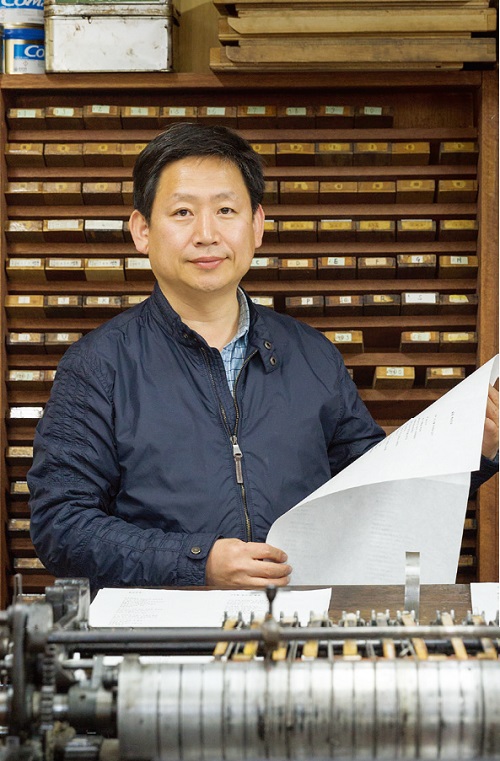
The majority of books are no longer made this way, with digital printing having rendered the technology obsolete. One must question, however, whether such technology is really no longer relevant. Although few young people are familiar with old-school metal typefaces, typographer and printing professional Park Han-su works with them every day; in fact, he operates the nation’s only printing press that stays true to the old ways.
“People think this type of printing is no longer utilized,” says Park, “but this technology is still alive and treasured in Europe, particularly in places like France and Germany, where they print many literary classics this way.”
Set in ink
As a student of typography, Park first became interested in metal typefaces and traditional printing methods while writing his dissertation about the importance and influence of typography. He realized the value of the printed word, the significance of a well-written sentence, phrase or book. If something is worth printing, he thought, it’s worth publishing with the utmost care possible.
“Reading a book in digital form and then reading the same title as a printed book, one made in the traditional way, is a different experience,” says Park. “It’s an aesthetic pleasure that’s hard to describe.”
Park’s printing studio is filled with aisles upon aisles of different metal typefaces. He works with five craftspeople who are masters at old printing methods, using machinery that is the fruit of over 10 years of investigative discovery, careful collection and patient refurbishing. Everything is really old, but it all still works. In our era of quick consumption and even quicker disposal, it’s hard to imagine a time when things were truly meant to last a lifetime – and longer.
“I started collecting these machines around 1998, tracking them down around the country,” Park recollects. “After I recovered them it took an additional three to four years to get them working again.”
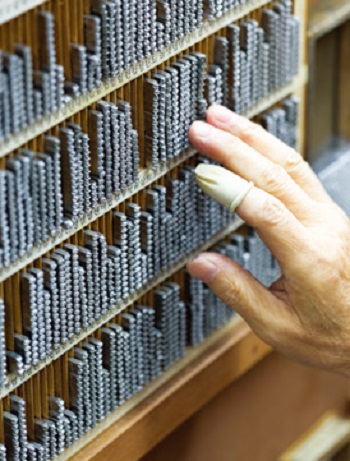 In addition to collecting machinery, Park also tracked down and recruited veterans from the old printing industry. After setting up shop in 2007 in Paju Bookcity, a collective of publishers based out of the Gyeonggi-do community, he and his team got to work on producing books the old-fashioned way. Each book is made with Hanji, or traditional paper, which is thicker and more durable than standard paper.
Since the old ways unavoidably involve more time and are less profitable than mass production methods, Park decided to create a limited number of copies of each book, thus increasing both the monetary and aesthetic value of each individual copy. Park’s company, Siwol Publishing, produced its first book, a poetry collection, in 2008.
Slowly but steadily, one book at a time, he has diligently worked towards his goal of publishing 100 poetry collections, having finished 40 thus far. Although he started out making 1,000 copies of each book, he has now cut back to 500.
Quality over quantity
“We actually have a surprising number of regular customers,” says Park. “Each book is numbered, so when you see the number of the book you get, you can get a true feel for how precious it is, something that can’t be made again. It’s your copy, and yours alone.”
Furthermore, to prevent too many copies going to one person, Park doesn’t sell a large quantity of his books to any single customer, stressing the importance of widespread distribution. Doing things the old way hasn’t always been easy, but Park believes that people are steadily starting to see the value of traditional methods. He plans to eventually open a typeface museum that also functions as an educational space for children to learn about typography and traditional printing technology.
“When Korea was undergoing rapid modernization, anything that seemed old was immediately discarded, and we ended up losing a lot,” he says. “These days, however, I think people are starting to reflect more, to see the value of looking into the past when deciding on our future.”
* Article from Korea Magazine (December 2014)
The majority of books are no longer made this way, with digital printing having rendered the technology obsolete. One must question, however, whether such technology is really no longer relevant. Although few young people are familiar with old-school metal typefaces, typographer and printing professional Park Han-su works with them every day; in fact, he operates the nation’s only printing press that stays true to the old ways.
“People think this type of printing is no longer utilized,” says Park, “but this technology is still alive and treasured in Europe, particularly in places like France and Germany, where they print many literary classics this way.”
Typographer and printing expert Park Han-su
Set in ink
As a student of typography, Park first became interested in metal typefaces and traditional printing methods while writing his dissertation about the importance and influence of typography. He realized the value of the printed word, the significance of a well-written sentence, phrase or book. If something is worth printing, he thought, it’s worth publishing with the utmost care possible.
“Reading a book in digital form and then reading the same title as a printed book, one made in the traditional way, is a different experience,” says Park. “It’s an aesthetic pleasure that’s hard to describe.”
Park’s printing studio is filled with aisles upon aisles of different metal typefaces. He works with five craftspeople who are masters at old printing methods, using machinery that is the fruit of over 10 years of investigative discovery, careful collection and patient refurbishing. Everything is really old, but it all still works. In our era of quick consumption and even quicker disposal, it’s hard to imagine a time when things were truly meant to last a lifetime – and longer.
“I started collecting these machines around 1998, tracking them down around the country,” Park recollects. “After I recovered them it took an additional three to four years to get them working again.”
Since the old ways unavoidably involve more time and are less profitable than mass production methods, Park decided to create a limited number of copies of each book, thus increasing both the monetary and aesthetic value of each individual copy. Park’s company, Siwol Publishing, produced its first book, a poetry collection, in 2008.
Slowly but steadily, one book at a time, he has diligently worked towards his goal of publishing 100 poetry collections, having finished 40 thus far. Although he started out making 1,000 copies of each book, he has now cut back to 500.
Quality over quantity
“We actually have a surprising number of regular customers,” says Park. “Each book is numbered, so when you see the number of the book you get, you can get a true feel for how precious it is, something that can’t be made again. It’s your copy, and yours alone.”
Furthermore, to prevent too many copies going to one person, Park doesn’t sell a large quantity of his books to any single customer, stressing the importance of widespread distribution. Doing things the old way hasn’t always been easy, but Park believes that people are steadily starting to see the value of traditional methods. He plans to eventually open a typeface museum that also functions as an educational space for children to learn about typography and traditional printing technology.
“When Korea was undergoing rapid modernization, anything that seemed old was immediately discarded, and we ended up losing a lot,” he says. “These days, however, I think people are starting to reflect more, to see the value of looking into the past when deciding on our future.”
* Article from Korea Magazine (December 2014)